The Islamist roots of these mass prayer rituals
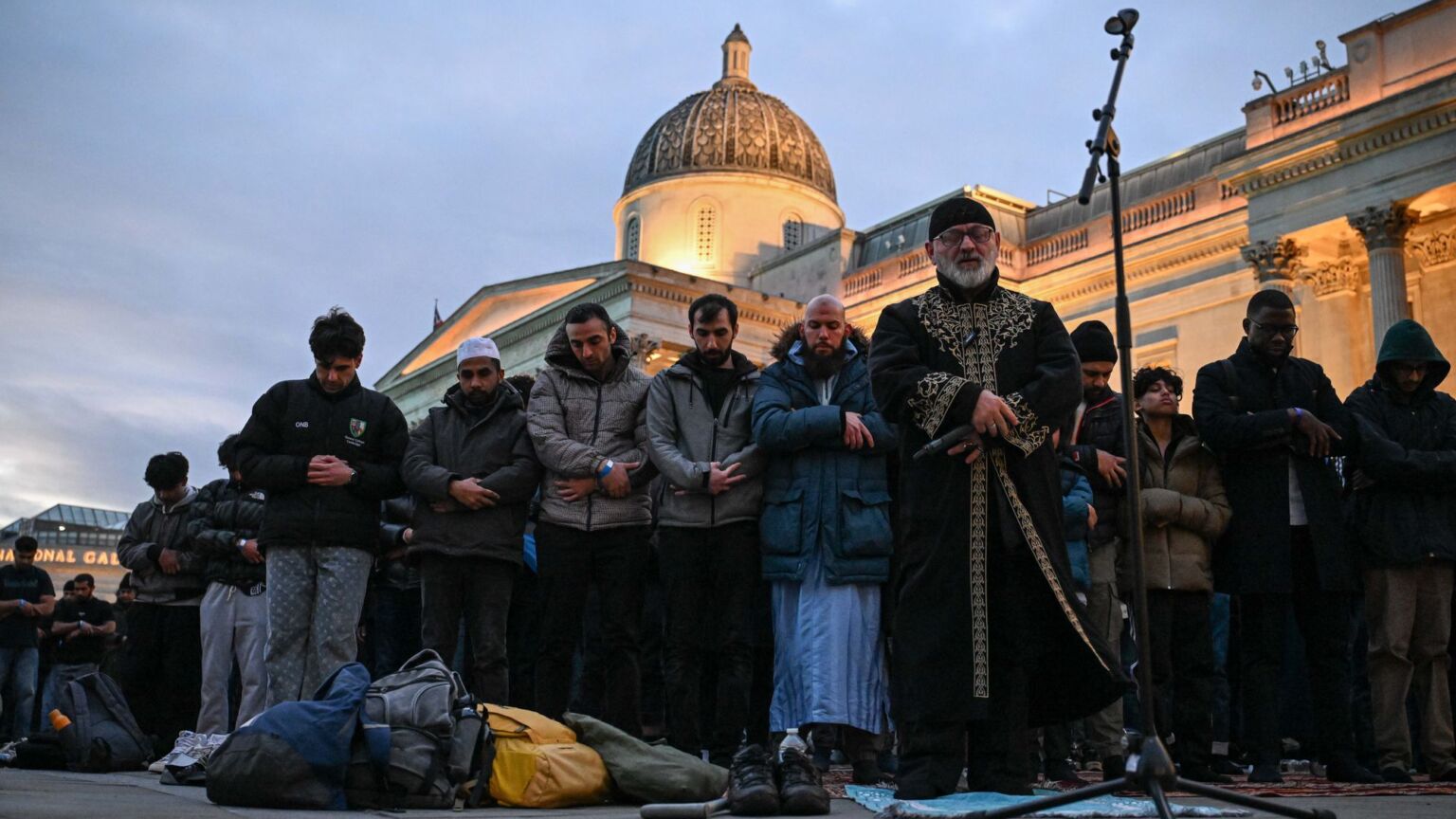
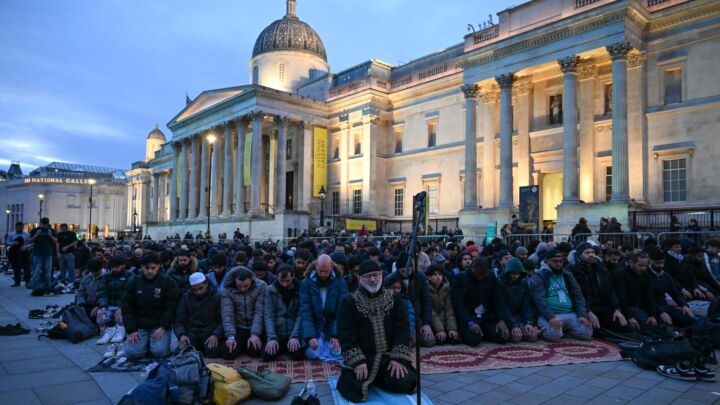
Nick Timothy was right to call out the Trafalgar Square prayer session.
Want unlimited, ad-free access? Become a spiked supporter.
Good on Nick Timothy for smoking out the hypocrisy, muddled thinking and cant that obscures the debate over Islamism in Britain. He must have known the furore that would follow when he branded the Muslim prayer session in Trafalgar Square an ‘act of domination’. He must have known it would attract the worst and weakest criticisms from the worst and weakest people. And lo it came to pass.
‘Islamophobia!’, came the shrill chorus, along with calls for his defenestration. What was their best argument? That since Catholics, Sikhs and Jews have held prayer sessions in public without criticism, Timothy must have been singling out Muslims out of bigotry. Yup. That was it.
Let’s set out a few facts of the matter that too often go unarticulated for fear of cancellation. For one thing, Catholics, Sikhs and Jews do not have a problem with extremism in their midst. When was the last time an adherent of one of these faiths blew himself up on the Tube or stabbed random members of the public to death in the name of their god? According to a 2024 study, half of British Muslims have some sympathy with Hamas and a third wish for us to live under Sharia. This subversive radicalism is simply not found in other religions.
The problem, in other words, is not so much the public prayer as the fact that statistically speaking, half of those bowing to Mecca in central London think that Hamas are jolly good chaps. (Roughly the same number believes that Jews have too much influence over British politics and wishes to make the display of a picture of the prophet illegal.) Moreover, massed prayer is a standard performance of political power by the Muslim Brotherhood, historically used in Egypt, Jordan and elsewhere. Indeed, in many Arab countries, such mobilisation is often restricted, controlled or broken up.
Why would they do that? Because they rightly see these sessions as acts of domination. Things have come to a pretty pass when Arab countries are tougher on Islamist extremism than Britain. But that is the reality: the United Arab Emirates (UAE) recently announced that it would not be sending any of its citizens to study in our country due to the risk of radicalisation.
Much of this boils down to the Muslim Brotherhood, about which I have written many times before (including at length in my latest book, Never Again? How the West Betrayed the Jews and Itself). Founded in 1928 by a disillusioned schoolteacher called Hassan al-Banna, that group is probably the most malevolent in the world; all jihadi movements, including Hamas, al-Qaeda, Islamic State and even the Iranian theocratic regime, were originally inspired by the Brotherhood.
In 2015, a government report by two respected security and Middle East experts, Sir John Jenkins and the late Sir Charles Farr, produced a report on the Brotherhood that detailed its history, modus operandi and threat to Britain. Reading back through the part that was made publicly available is sobering. The Brotherhood, we discover, is embedded in British Muslim communities, and pursues an agenda of subjecting our country to Sharia over a timespan of several generations.
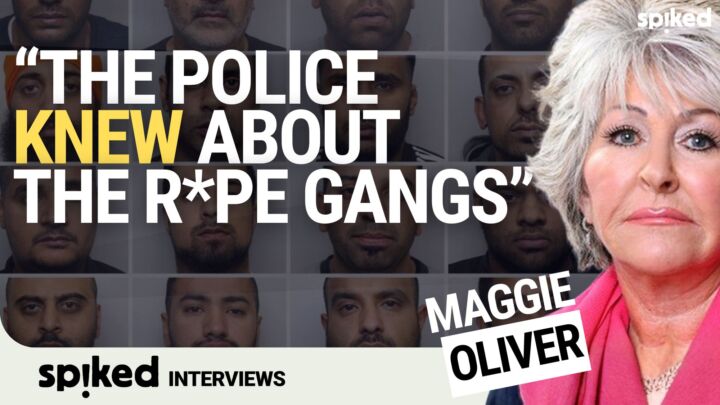
The Brotherhood is no stranger to political violence, the two civil servants reported, but it prefers to use such crude measures as a last resort. Instead, it inserts itself into the machinery of society, particularly our political system, forming a sectarian presence and gradually extending its influence until it is in a position to subvert our freedoms.
One of the most sinister aspects of the Brotherhood is the way in which it appoints its own ‘leaders’ and exerts control over Muslim communities in the West. Its activists run charities, sports clubs and mosques, brainwashing people with its extremist ideology and setting an expectation of radicalism. Those who fail to conform suffer ostracisation, bullying or even physical violence; when they see masses of idiotic white Britons cosplaying as Hamas and marching for Palestine, they have even less motivation to stand their ground. As writer Ed Husain, who was a committed Islamist extremist in his youth, put it: ‘If British policy makers and elected officials are content to tolerate intolerance, and give a platform to those who are committed to destroying democracy and advocate religion-based separatism, why should a minority Muslim population turn on its own?’
It is in this context that the massed prayer session should be seen. In recognising the fingerprints of the Brotherhood, however, we must never lose sight of the fact that there are many Muslims who do not have any truck with it. For one thing, it is banned in Egypt, the UAE, Saudi Arabia, Bahrain and Jordan (which again speaks volumes about the complacency and timidity of Britain). Moreover, many Muslims stand firm with the West, and many have done so in the past.
Tens of thousands paid the ultimate price for Britain in both world wars. On October 7, many risked their lives for their Jewish compatriots; some serve in the Israel Defence Forces, including Captain Ella Waweya, the Jewish state’s most senior female Muslim officer. A number of Muslim organisations, like Indonesian group Nahdlatul Ulama (the largest in the world, with more than 50million members), the Ahmadiyyas and the Sufis are either relatively moderate or positively liberal in their interpretation of their faith.
In his post on X, Timothy took exception to the adhan, the Islamic call to prayer, with its famous line, ‘there is no God other than Allah’, for its ‘explicit repudiation of Christianity’. If this is so, how can we countenance Christianity’s explicit repudiation of Judaism, or the famous verse in John 14:6, ‘I am the way and the truth and the life. No one comes to the Father except through me’? Clearly, we are not talking about inherent characteristics of doctrine but the dominant culture of a faith, which determines how it is interpreted.
For a thousand years, Jews generally had an easier time living in Muslim lands than in Christendom. Classic Islamic literature has no equivalent of Protestant theologian Martin Luther’s vicious anti-Semitic screeds, no Barabbas, no Shylock, no Fagin, no Jew with devil’s horns. Not that it was all sweetness and light; as the late Middle East scholar Bernard Lewis put it, their situation was never as bad as in Christendom at its worst, not ever as good as in Christendom at its best.
The change came in the 20th century, when – for reasons explored in detail in my book – the Muslim world largely aligned with Nazi Germany. Via Palestinian propagandist and Hitler fan Amin al-Husseini, the anti-Semitism of the Third Reich was adapted into the Arabic vernacular and transmitted throughout the Middle East in thousands of hours of blood-curdling radio broadcasts. It is this that breathed energy into the Muslim Brotherhood and jihadism, which trouble us so significantly today.
There is nothing inherent in Islam that makes it destined for anti-Semitism. After all, most religions possess such a sprawl of scriptures that followers must elevate some while downplaying others, in accordance with prevailing sensibilities. Take Christ’s statement in Matthew 10:34–36: ‘Think not that I am come to send peace on Earth: I came not to send peace, but a sword. For I am come to set a man at variance against his father, and the daughter against her mother, and the daughter-in-law against her mother-in-law.’ Such is the centre of gravity of Christian culture that these verses are far less well-known than 5:38–48 of the same Gospel, ‘whosoever shall smite thee on thy right cheek, turn to him the other also’. For a thousand years, Muslims were often able to take a similar approach when it came to the Jews.
Right now, however, in the weird afterlife of the Second World War, the Muslim world is undergoing a struggle with a powerful religious radicalism that threatens both devotees and wider society. If we condemn Islam as intrinsically anti-Western and nihilistic, then how do we explain those Muslims who stand by our side? If we say they are not true Muslims, we are making the same argument as the fundamentalists, and then there is no hope. For the future of the world, it is vital that enlightened Muslims win out against the forces of darkness within their ranks and emerge as a moderate, open, peace-loving force for good. To support this effort, we must embrace those who are willing to embrace us, while showing ruthlessness towards the extremists who are determined to make themselves our enemy.
Timothy was right: given the radical centre of gravity of British Muslims today, mass prayer in this country is indeed a sinister expression of dominance. If the extremists are stamped out and our Islamic communities become friendly to the West, however, then their prayers will not be a problem, whether conducted in large numbers or not. Their hijabs will be no more threatening than the headscarves and wigs worn by British Jews, who are among our most patriotic and law-abiding minorities. This transformation is the struggle of our times, but it will not be easy to achieve. In fact, as Sir Trevor Phillips put it back in 2016, ‘the integration of Muslims will probably be the hardest task we have ever faced’.
Jake Wallis Simons is the author of Never Again? How the West Betrayed the Jews and Itself.
You’ve hit your monthly free article limit.
Support spiked and get unlimited access.
Support spiked and get unlimited access
spiked is funded by readers like you. Only 0.1% of regular readers currently support us. If just 1% did, we could grow our team and step up the fight for free speech and democracy.
Become a spiked supporter and enjoy unlimited, ad-free access, bonus content and exclusive events – while helping to keep independent journalism alive.
Monthly support makes the biggest difference. Thank you.

Comments
Want to join the conversation?
Only spiked supporters and patrons, who donate regularly to us, can comment on our articles.