Don’t mourn the death of the ‘assisted dying’ bill
Proponents of state-sponsored suicide tried every trick in the book to avoid debate on this dangerous bill.
Want unlimited, ad-free access? Become a spiked supporter.
The Terminally Ill Adults (End of Life) Bill is on its last legs. Having been voted through by the House of Commons at second reading in November 2024 with a majority of 55, it was approved at a third reading in June 2025 with a reduced majority of just 23. It is now in the House of Lords, with little hope of progressing any further.
According to Lord Falconer, the bill’s sponsor in the Lords, 1,253 amendments have been tabled by peers. There remain over 850 left to debate. With only five allocated days left before the next parliamentary recess, there is almost no hope of getting through them. Last week, the Labour government refused to allocate more time before the bill’s May deadline, effectively signing its death warrant.
What went wrong? Ultimately, the bill’s advocates made a major strategic error. Their plan was (and always has been) to push through the legislation with as little debate and discussion as possible. They wanted to – dishonestly – represent this monumental legal change as a simple act of compassion, affecting only a handful of people who are in pain, already on death’s door and who merely wish to speed up the process. The issue is, of course, much more complex, and the pro-suicide forces have been hoist by their own petard in their attempts to pretend otherwise.
The first way they attempted to pull the wool over the eyes of the public was in trying to brand assisted suicide as ‘assisted dying’. Whenever it is pointed out that ingesting poison with the intent of ending one’s life cannot honestly be described as anything other than suicide, the bill’s supporters have no answer to this except to say that it is ‘deeply offensive’, ‘stigmatising’ and ‘derogatory’.
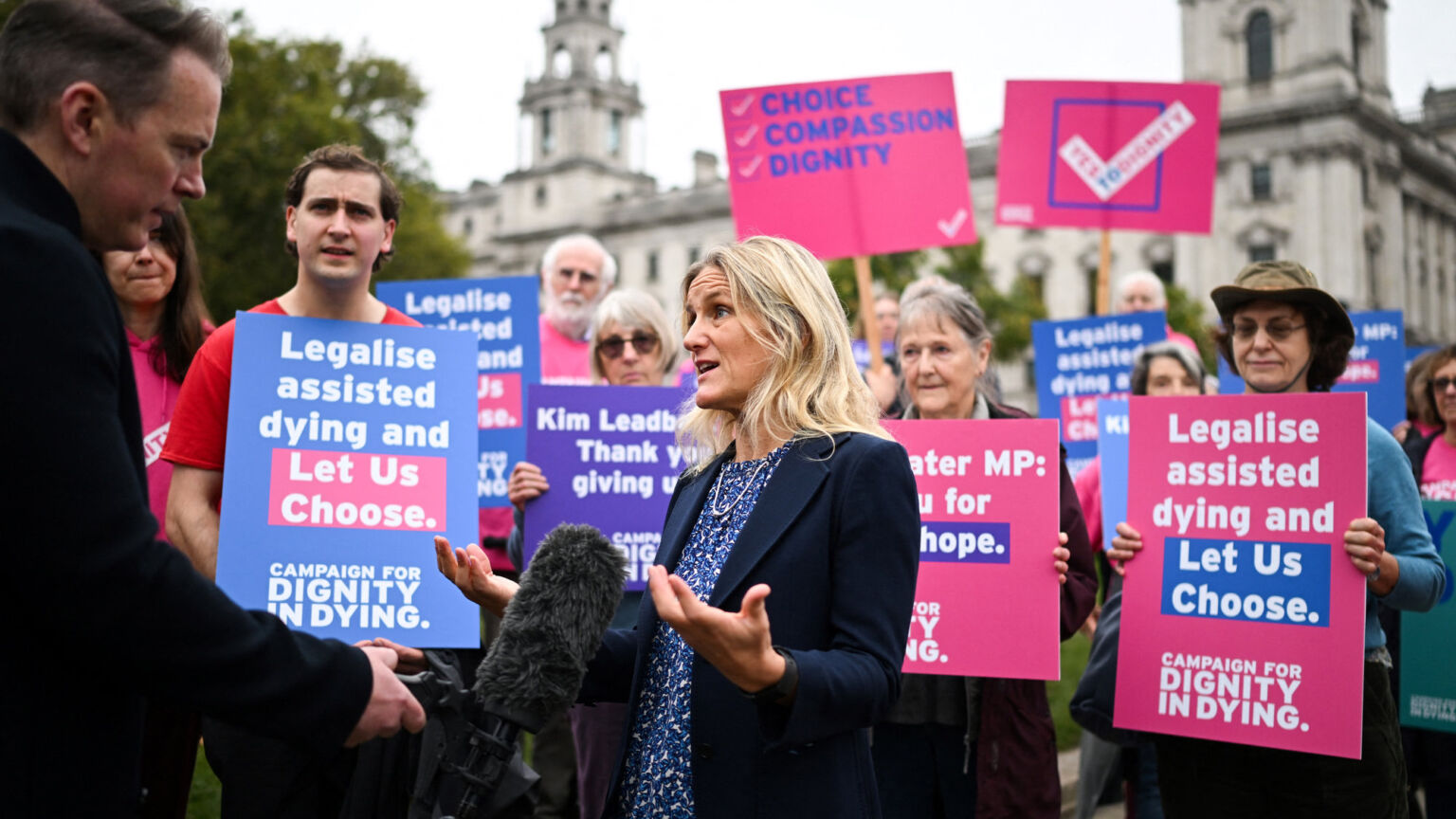
Avoiding debate has been the modus operandi of the bill’s proponents from the outset. The Labour Party did not include assisted suicide in its General Election manifesto. Instead, then opposition leader Keir Starmer ‘made a promise’ to the terminally ill television personality, Esther Rantzen, that he would provide ‘time for a debate’. Then, when Labour MP Kim Leadbeater came top of the ballot for private members’ bills in September 2024, there was pressure on her to drop her interest in puppy smuggling, and to use her position instead to push assisted suicide. Private members’ bills are allocated far less time for debate than government bills, which are generally introduced by a minister and prioritised above others. Unlike government bills, they can fall if time runs out.
Even the way Leadbeater introduced the bill did not allow for much scrutiny. As Ruth Fox and Matthew England of the Hansard Society observed: ‘The bill is unusually long for a [private members’ bill], spanning 32 pages of legal text, comprising 43 clauses and six schedules, and with financial and other consequences for the NHS and the court system’. Two impact assessments – of 24 and 150 pages respectively – were released on Friday 2 May 2025 – the same day as a momentous by-election result. The intention was clearly that as few people should read them as possible.
At the outset, pro-assisted suicide organisations like Dignity in Dying argued that MPs, even if they weren’t certain about all elements of the bill, should support it on the basis that scrutiny in the House of Lords would improve it. ‘Meaningful second-chamber oversight still to come’, they assured MPs. ‘With specialist expertise amongst its membership, and additional committees engaging in the process, there’s a robust safeguard phase ahead, ensuring that the final legislation is refined, balanced, and workable.’

Now that these ‘experts and specialists’ are scrutinising the bill in the Lords, assisted-suicide proponents have changed their tune. ‘A handful of hardline opponents in parliament’s unelected chamber’, they complain, are now ‘filibustering’ the bill.
Once again, the language here is deceptive. ‘Filibustering’ is what US senator Strom Thurmond did when, in 1957, he set a record for speaking for 24 hours and 18 minutes to try (unsuccessfully) to stop the passage of the Civil Rights Act. The average speaking time on the assisted-dying bill, in contrast, is less than five minutes. Instead, peers are, as the normally pro-assisted death Times noted this week, trying ‘to clarify the shockingly woolly language’ of the bill.
The arrogance and incompetence of pro-suicide lobby has not healped either. Leadbeater and her supporters in the Commons unconvincingly recycled stock phrases from Dignity in Dying, while failing to address genuine concerns. In the Lords, Falconer and others have brushed away warnings about the bill expressed by medical colleges like the Royal College of Psychiatrists and the Royal College of Physicians, along with the British Geriatrics Society, Liberty and even the Lords Delegated Power Committee. They have preferred to treat any criticism and scrutiny as part of a plot to stop the legislation. As Lord Toby Young noted in the Telegraph, ‘Falconer is more of a demolition expert than a bridge builder’.
In the end, the whole mess must be laid at Keir Starmer’s feet. It is he who at first pushed the bill and, like so many of his other policies, has dropped it as opposition has got louder.

There is no point in keeping this bill, already on artificial life support, alive. It deserves to die. To paraphrase Oscar Wilde on the death of Little Nell, one must have a heart of stone to hear about the death of this bill and not laugh.
Kevin Yuill is emeritus professor of history at the University of Sunderland and CEO of Humanists Against Assisted Suicide.
You’ve hit your monthly free article limit.
Support spiked and get unlimited access.
Support spiked and get unlimited access
spiked is funded by readers like you. Only 0.1% of regular readers currently support us. If just 1% did, we could grow our team and step up the fight for free speech and democracy.
Become a spiked supporter and enjoy unlimited, ad-free access, bonus content and exclusive events – while helping to keep independent journalism alive.
Monthly support makes the biggest difference. Thank you.






Comments
Want to join the conversation?
Only spiked supporters and patrons, who donate regularly to us, can comment on our articles.