The Iran strikes have put the Middle East on the brink
The US and Israel’s hopes for regime change seem likely to end in turmoil.

Want unlimited, ad-free access? Become a spiked supporter.
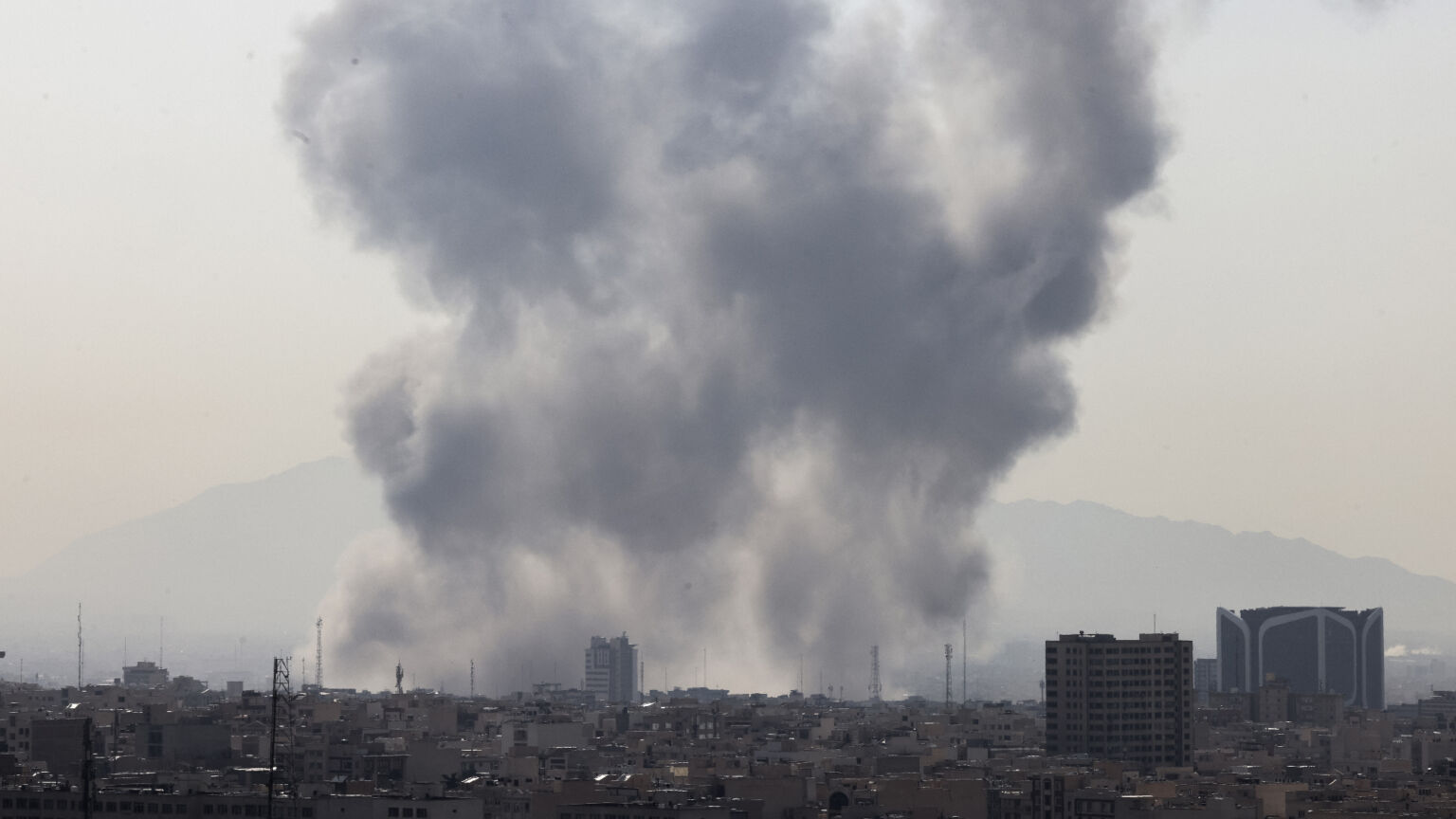
And so begins the latest, most dangerous phase in a Middle Eastern conflict that first erupted with Hamas’s attack on Israel on 7 October 2023. Well over two years on from that murderous, anti-Semitic onslaught, Israel and the US have this morning launched a large-scale aerial assault on Hamas’s chief sponsor, the Islamic Republic of Iran. In response, Tehran has launched retaliatory strikes not just against Israel, but also US bases across the Middle East. A whole region now stands on the brink.
There has been a grim inevitability about what is now unfolding for a while now. At the start of the year, as Iranians poured out on to the streets in anguished protest against the Ayatollah Khamenei and his repressive regime, Trump rallied to the protesters’ side. He said the US was ‘locked and loaded’ and ready to support them, should the regime respond with lethal repression. From that point on, the US has slowly but surely moved a huge volume of aircraft and naval assets to the region – a sign, as Axios reported earlier this month, that the US was preparing the ground for a sustained, weeks-long military operation.
There have been Omani-mediated talks between Washington and Tehran over the past fortnight. But the noises emanating from both sides were never hopeful. The US wanted Iran not just to abandon its dream of nuclear-weapons but also to scrap its ballistic-missiles programme and stop backing Islamist militias like Hamas and Hezbollah. The Islamic Republic was never likely to agree to such a significant demilitarisation. By the time Oman foreign minister Badr Albusaidi flew to Washington on Friday, in a last-ditch effort to persuade the White House against striking Iran, the slim possibility of diplomatic resolution had all but vanished.
And so we are now entering profoundly dangerous and uncertain territory. This will be nothing like the 12 Day War last June, when Israel and the US carried out a limited bombing campaign on military and nuclear facilities in Iran. It’s clear the stated objectives of this US-Israeli ‘major combat operation’ go far beyond eliminating nuclear capabilities or even the aims of the failed Oman talks. They amount to nothing less than so-called regime change. ‘We are going to destroy their missiles and raze their missile industry to the ground’, said Trump on Truth Social. He offered the Iranian military ‘immunity’ should they lay down arms or ‘certain death’ if not. Addressing the Iranian people, he told them that their ‘hour of freedom is at hand’ – ‘When we are finished, take over your government. It will be yours to take.’
The scale and targets of the initial wave of strikes – hitting key military and political sites – certainly suggest the US and Israel really are aiming to topple the Islamist regime. Israel in particular wants to see the end of the principal source of regional animus towards it. Yet no matter how much many of us inside and outside Iran may want to see the Ayatollah fall, there is a real possibility that this war plunges Iran into chaos, and creates a conflict that begins to consume the wider region.
The Islamic Republic is the weakest economically, militarily and politically it’s ever been, since the 1979 revolution that brought it to power. But it’s still a foe far more formidable than the US has faced in decades. Comprising a security apparatus of several-hundred thousand members of the IRGC and Basij, which exist, Iron Dome-like, to protect the ayatollah at their centre, the Islamic regime won’t simply crumble in the face of military aggression. It was built for the preservation of its Islamist mission and figurehead. It will and has to lash out, causing widespread death and destruction, if it is to fulfill its function – to ensure its own and its supreme leader’s survival. Its members have nowhere else to go, and no other purpose to serve, than the Islamic regime.
And that’s what we’re now seeing. As well as taking aim at Israel, Iran has already launched retaliatory strikes against US bases in Bahrain, UAE, Qatar, Jordan and Kuwait. And there will be many more of these counter-strikes to come, each one carrying the potential to destroy and kill hundreds, causing the war to further spiral out of control.
The risks of this operation are enormous, the consequences potentially shattering. Israel’s own Iron Dome air-defence system has largely protected it from Iranian aerial attacks in the past. But even so, some missiles have penetrated Israeli defences before, and could easily do so again – to potentially devastating effect.
And US forces, as Trump has admitted, are also at significant risk. The Islamic Republic can use its naval power to not only cause a global economic shock by blocking the Strait of Hormuz – through which approximately 20 per cent of the world’s oil supplies travel – but also deal significant damage to US forces off its coast. If it was to use its Khalij Fars anti-ship missile, deployed to lethal effect in the Red Sea by the Houthis, it could do serious damage. As one expert points out, the sinking of an American aircraft carrier ‘could knock the US out of the war’.
And that’s before we come to the persistent threat posed by what’s left of Iran’s so-called Axis of Resistance – that array of vicious anti-Semitic militias, from Hamas and Hezbollah to the Houthis and assorted Iraq-based proxies. The Islamic Republic’s menace extends way beyond Iran’s borders.
But perhaps the biggest threat posed by this US-Israeli war with the Islamic Republic is to the Iranian people’s own fight for freedom. As US-led regime-changing interventions in Iraq, Libya, Afghanistan and beyond have shown, the external destruction of a despotic, repressive state doesn’t tend to liberate a people. It tends to create a power vacuum which external actors then have to fill. In the act of foreign intervention, a popular struggle against an oppressive regime is taken out of people’s own hands by those claiming to liberate them. The future, in this case, of Iran becomes a question less for Iranians themselves than for a coalition of external actors.
There’s no doubt that vast swathes of Iran really mean it when they shout ‘Death to the dictator’ in the direction of the supreme leader. Indeed, there is no doubt the fall of the Islamic Republic is a desirable outcome for the Iranians, and for Israel. But that doesn’t make this attempt to bring it about right. As we know only too well from recent experience in the Middle East, the road to hell is paved by Western actors’ good intentions.
So Trump may well want to help the Iranian people. He and Israeli prime minister Benjamin Netanyahu may well hope that this finally puts an end to the Israel-Iran conflict. But there’s a real chance that the ‘no new wars’ president has just started one of the most dangerous and consequential of them all.
Tim Black is associate editor of spiked.
You’ve hit your monthly free article limit.
Support spiked and get unlimited access.
Support spiked and get unlimited access
spiked is funded by readers like you. Only 0.1% of regular readers currently support us. If just 1% did, we could grow our team and step up the fight for free speech and democracy.
Become a spiked supporter and enjoy unlimited, ad-free access, bonus content and exclusive events – while helping to keep independent journalism alive.
Monthly support makes the biggest difference. Thank you.



Comments
Want to join the conversation?
Only spiked supporters and patrons, who donate regularly to us, can comment on our articles.