Why Europe’s elites have embraced sneering anti-Americanism
From boycotting US goods to booing its athletes, Europe is giving vent to old prejudices.

Want unlimited, ad-free access? Become a spiked supporter.
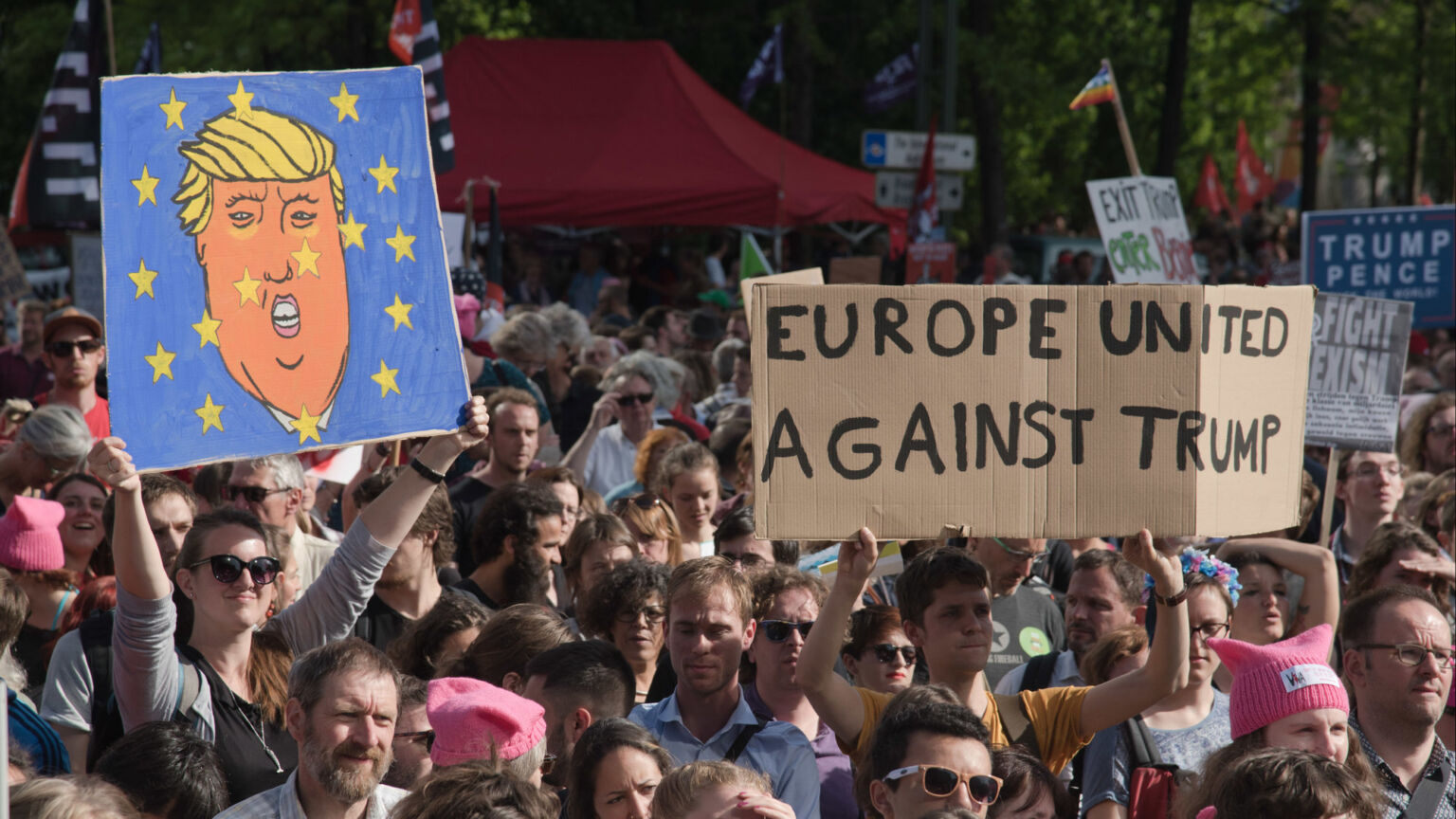
In recent months, anti-Americanism has emerged yet again as a respectable prejudice in Europe. It is widely promoted through the mainstream media and enthusiastically endorsed by the continent’s cultural elites. There are now even numerous campaigns to boycott American goods – most respondents to a survey in France said they would support a boycott of US brands like Tesla, McDonald’s and Coca-Cola. As a piece in Euractiv put it, anti-Americanism is ‘in vogue across Europe’.
This has become all too clear at the Winter Olympics, currently being held in northern Italy. At the opening ceremony for Milano Cortina 2026, Team USA and vice-president JD Vance were booed by a crowd of over 65,000 people. Someone I know who attended the event told me that the booing was spontaneous and quickly became widespread. According to the European Union’s foreign-policy chief, Kaja Kallas, those booing were displaying ‘European pride’. It seems that for the Brussels elites, anti-Americanism bolsters Europe’s self-esteem.
The explicit target of this resurgent anti-American animus is, of course, US president Donald Trump. But it’s implicitly aimed at all those who voted for him, too. In a piece on boycotting American goods in the normally sober Financial Times, published last March, the author gave the game away. While saying it is ‘wrong to conflate Americans and their president’, he argued that ‘it’s [also] wrong to disentangle them entirely… Trump reflects half of America. He reflects a society where a democratic majority is prepared to tolerate mass shootings and a warped political system.’
Certain politicians are being boosted by this wave of anti-Americanism. Canadian prime minister Mark Carney, in particular, has been turned into the unexpected hero of the European political establishment. His defiance of Washington has turned him into the posterboy for this new brand of anti-Americanism. ‘Europe has a lot to learn from Mark Carney’, was the verdict of the New Statesman. The Guardian echoed this sentiment: ‘Europe must heed Mark Carney – and embrace a painful emancipation from the US.’
Expressing anger against America appears to be the one emotion that binds the European political establishment. As one Financial Times commentator explained earlier this month, ‘Trump is Europe’s best enemy yet’. He has apparently provided Europe with the ‘common foe’ it needs. It appears that anti-Americanism is now the glue holding together otherwise disoriented and divided European elites.
The reason usually given for this turn against the US is Trump’s behaviour towards Europe, specifically his threats to annex Greenland, impose tariffs and downgrade America’s NATO commitments. No doubt these policies have played an important role in putting Europe’s ruling classes on the defensive. However, they are not the leading cause of this wave of anti-Americanism. Rather, they have merely brought to the surface pre-existing prejudices deeply entrenched within Western Europe’s elite culture.
In his fascinating study, Anti-Americanism in Europe (2004), Russell Berman linked the growth of anti-Americanism during the 1990s and 2000s to the project of European unification. Berman claimed that, in the absence of an actual pan-European identity, anti-Americanism ‘proved to be a useful ideology for the definition of a new European identity’. He noted that the main way Europe defines itself as European is precisely by underscoring its difference from the United States.
Berman’s argument has been echoed by political scientist Ivan Krastev. He observed in 2007 that anti-Americanism is particularly strident among Europe’s elites and its young people. ‘Elites in search of legitimacy and a new generation looking for a cause’, he wrote, ‘are the two most visible faces of the new European anti-Americanism’.
The elite hostility to America was captured well by Matthew Karnitschnig in Politico: ‘It’s got cold in Europe, the economy is tanking and the natives are getting restless. There’s only one answer: Blame America.’ As Karnitschnig put it, ‘pointing across the Atlantic has long been a favorite diversionary tactic for Europe’s political elites when things start to get dicey on the continent’.
Historically, European anti-Americanism often emphasised the moral inferiority of American people and their way of life. Jesper Gulddal’s review of anti-Americanism in 19th-century European literature showed that authors from France, Britain and Germany ‘argued emphatically that America’s lack of tradition and culture, as well as its materialism, vulgarity, religious bigotry and political immaturity constituted not only the essence of this country’s very being but that they would also somehow infest Europe’.
Contempt for the American way of life has always been particularly widespread among European intellectual and the cultural elites. Writing at the turn of the 20th century, British economist Sydney Brooks attributed the hostility to America to ‘envy of her prosperity and success’. Europeans, he wrote, ‘intensely resent the bearing of Americans… They hate the American form of swagger.’ They saw a country ‘crudely and completely immersed in materialism’.

One of the most famous slurs against the US came in the early 20th century, when French prime minister Georges Clemenceau sneered that, ‘America is the only nation in history which miraculously has gone directly from barbarism to degeneration without the usual interval of civilisation’.
During the Cold War years, Europe’s cultural elite continued to view America with a mixture of resentment and contempt. ‘America the violent, America the crass, America the inept have all become everyday images in Europe’, concluded the US ambassador in London in early 1987. This attitude has got much worse since. The well-known British author Margaret Drabble wrote in May 2003, two months after the invasion of Iraq:
‘It has possessed me like a disease. It rises in my throat like acid reflux… I can’t keep it down any longer. I detest Disneyfication. I detest Coca-Cola. I detest burgers. I detest sentimental and violent Hollywood movies that tell lies about history.’
Drabble’s visceral disgust towards America was shared throughout Europe. German theatre director Peter Zadek gave full vent to his prejudices against the American people during the Iraq War:
‘The Bush administration was more or less democratically elected, and it had the support of the majority of Americans in its Iraq War. One can therefore be against the Americans, just as most of the world was against the Germans in the Second World War. In this sense, I am an anti-American.’
Today, the European elites’ anti-American ideology has acquired a new dimension. It is now interwoven with their fear and loathing of the right-wing populism now rising within Europe itself. As Mark Leonard, director of the European Council on Foreign Relations, wrote in the Guardian last week:
‘European governments are terrified of Donald Trump’s threats on trade, Greenland and the future of NATO. But the biggest threat is not that Trump invades an ally or leaves Europe at the mercy of Russia. It is that his ideological movement could transform Europe from the inside.’
Leonard warned that ‘a year after Trump’s return to the White House, his “second American revolution” is radiating outward into Europe’. Like Leonard, the EU elites are worried that the Trump administration could boost the populist challenge to their rule. Several commentators have drawn attention to the alliance between European populist movements and Washington. As one put it earlier this year, ‘European democracies are facing a pincer attack: externally taking fire from the US administration and Silicon Valley companies, internally from the European far right.’
The argument that Europe is under siege from Washington without and populists within is not without merit. After all, the recently published US National Security Strategy explicitly promotes ‘cultivating resistance to Europe’s current trajectory within European nations’. But for all that, this ‘resistance’ really is a home-grown phenomenon. Its future does not depend on external encouragement, but on its capacity to continue to provide a voice for the people of Europe.
There is no reason to think that the populist surge in Europe will abate when Trump departs the White House. European elites, uncomfortable with the principle of national sovereignty, have long channelled decision-making away from the people and towards expert institutions, non-governmental organisations and international bodies. It is this profound democratic deficit, not the Trump White House, that has provided populist movements with their energy. They appeal to vast swathes of Europe’s national publics – to those, that is, who believe that they have been excluded from the decision-making that impacts their lives.
It is therefore unlikely that European elites’ increasingly shrill anti-Americanism will do much to dent the growing influence of populist parties. Nor can it create a European identity with widespread public appeal. As matters stand, European anti-Americanism is likely to emulate the post-Brexit ‘Remainer’ identity. Like Remainerism’s antipathy to British national sovereignty, this new Europeanism has little substantive content beyond its opposition to Trump’s America.
In the end, anti-Americanism serves as a distraction. European leaders would far rather sneer at Trump’s America than confront their own profound failures and unpopularity. Anti-Americanism might help the elites feel better about themselves, but it is growing increasingly clear that it won’t save them at the ballot box.
Frank Furedi is the executive director of the think-tank, MCC-Brussels.
You’ve hit your monthly free article limit.
Support spiked and get unlimited access.
Support spiked and get unlimited access
spiked is funded by readers like you. Only 0.1% of regular readers currently support us. If just 1% did, we could grow our team and step up the fight for free speech and democracy.
Become a spiked supporter and enjoy unlimited, ad-free access, bonus content and exclusive events – while helping to keep independent journalism alive.
Monthly support makes the biggest difference. Thank you.




Comments
Want to join the conversation?
Only spiked supporters and patrons, who donate regularly to us, can comment on our articles.