Spain’s ban on X is a tyrannical attempt to silence the people
Pedro Sánchez is desperate to shut up critics of mass immigration and his government’s corruption scandals.
Want unlimited, ad-free access? Become a spiked supporter.
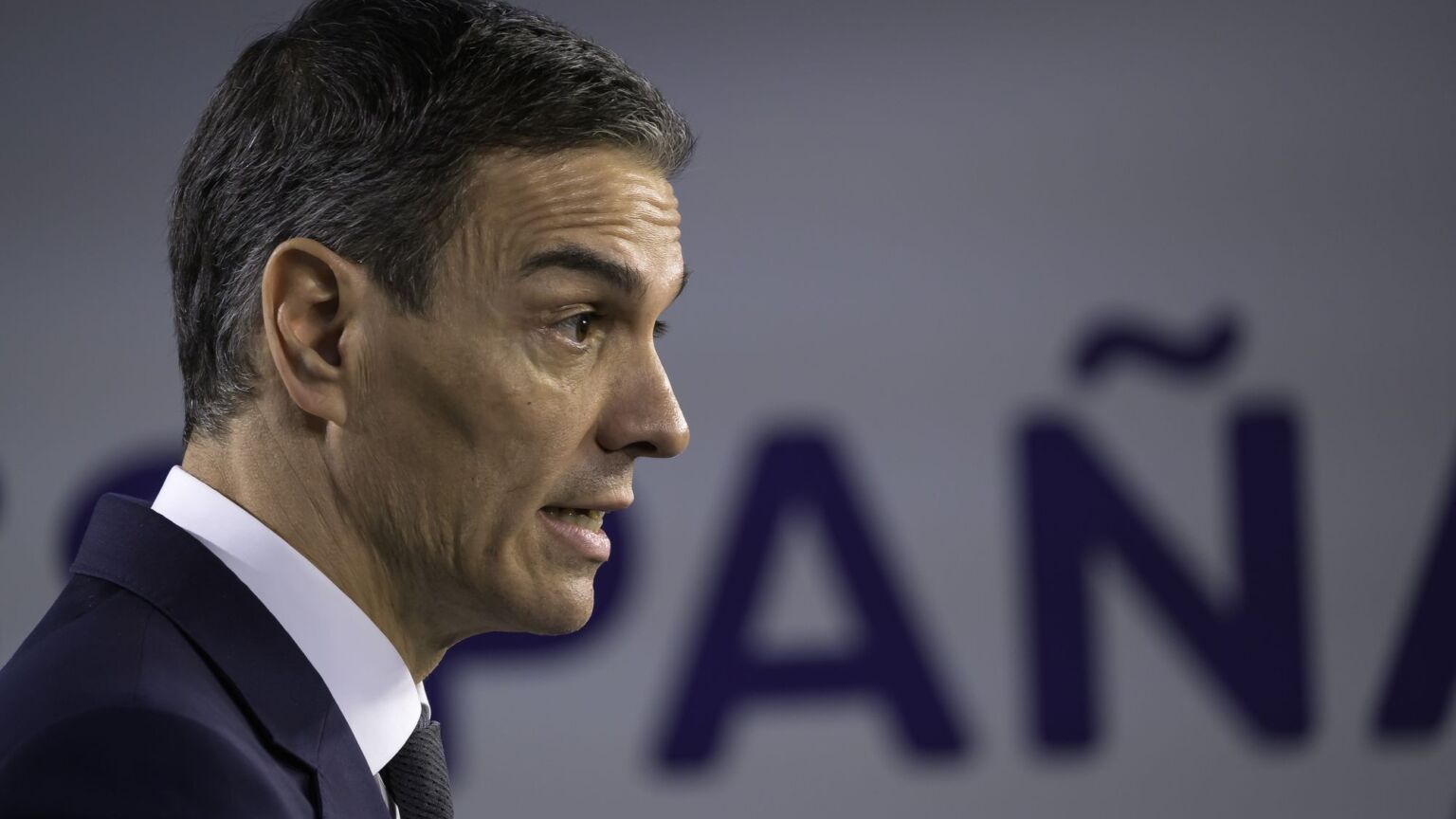
When Spanish prime minister Pedro Sánchez announced plans to ban social media for under-16s earlier this month, Spaniards could be forgiven for suspecting his real objective was not to limit children’s screentime. Indeed, just days later, Sira Rego, the youth and children’s minister, admitted that the next step would be to ‘restrict and ban’ X (formerly Twitter) for all Spanish users, whose ‘fundamental rights’, she claimed, ‘are being violated’ by the platform.
The prime minister and his so-called progressive coalition have long sought to narrow the boundaries of free speech in Spain. Social-media platforms have become the final frontier in this effort to control the political narrative – not least as Spain’s taxpayer-funded broadcaster, TVE, has already effectively been turned into a propaganda outlet for Sánchez’s party, the PSOE.
The Spanish left has descended to levels of authoritarianism that are unprecedented in Spain’s democratic era. Former vice-president Pablo Iglesias, whose hard-left Podemos is a junior party in Sánchez’s coalition, has openly proposed expropriating major private social-media platforms and replacing them with a state-owned or publicly controlled network. This has been presented as ‘democratising the space in which public communication occurs’.
It’s not hard to see why the government is so eager to keep citizens quiet. The new social-media restrictions were announced just after Sánchez’s bombshell pledge to give legal residency to at least 500,000 illegal immigrants who are already living in Spain – a policy that is guaranteed to cause public anger and division.
Then there is Spain’s corruption problem, which is now having lethal consequences. On 18 January, a high-speed train collision took place near Adamuz, Córdoba. When one train derailed and hit another, 46 people were killed and 292 others were left injured. Two days later, a commuter train derailed near Gelida, Catalonia, having been hit by a landslide. A trainee driver passed away as a result. Both of these tragic incidents can be linked to the institutional negligence, nepotism and corruption that’s rampant within the Spanish state.
Indeed, one former transport minister, José Luis Ábalos, was even imprisoned last year for corruption, as part of what’s known in Spain as the Koldo Case. Isabel Pardo de Vera, former director of ADIF, a state-owned company that owns and manages the railways, has also been indicted in the case. ‘Koldo’ here refers to Koldo García Izaguirre, a former adviser to Ábalos, who is currently in pre-trial detention, facing charges such as embezzlement, bribery and trading of confidential information.
The Koldo Case is primarily linked to illegal commissions and fraud in the procurement of medical masks and other health supplies by the Spanish government during Covid-19. Most of those involved are close allies of the prime minister. García Izaguirre was handed a senior position in the Spanish government despite having no previous relevant experience – unless you count working as a bouncer in a brothel.
And he is far from Sánchez’s only questionable appointment. Óscar Puente, a particularly useless minister for transport, spends most of his time on X insulting Spanish citizens. He recently admitted to using his team to monitor the ‘hate’ that’s directed towards him on social media. A fantastic use of government resources, I’m sure.
Sánchez has framed his offensive against social media as a fight for ‘safety’ and ‘protecting children’, but it is clearly a bid to go after platforms that refuse to conform to government-approved narratives. It plans to impose ‘real barriers’ for age verification, which some fear could open the door for a digital ID system. At the same time, it promises to hold platform executives, such as Elon Musk, liable for user-generated content. In other words, the Spanish government wants to place pressure on tech firms to restrict content it doesn’t like.
Meanwhile, Sánchez’s regularisation of illegal immigrants seems almost designed to antagonise the Spanish public. At a rally in Zaragoza, Irene Montero – former equality minister and now a Podemos MEP – seemed to deliberately invoke the so-called Great Replacement theory when praising the migrant amnesty. ‘Of course I hope for replacement theory’, she said. ‘I hope we can sweep fascists and racists out of this country with migrants and working people.’ Such rhetoric reflects Podemos’ broader political strategy. The party that introduced identity politics into the Spanish mainstream – championing measures such as a gender self-identification law and housing reforms widely criticised for weakening property rights in favour of squatters – is tacking further and further to the left in a desperate bid to remain relevant. Having exhausted gender ideology as a mobilising force, it is increasingly turning to race-based narratives to reignite division.
Except, the Spanish people are now fed up with being labelled ‘fascists’ by elite leftists like Podemos and their ilk, who live lavish lives at the taxpayers’ expense. They are no longer willing to be morally castigated by a class that opens its arms to illegal migrants, but who will never have to live with the consequences. Meanwhile, regular Spaniards are struggling with unemployment, the cost of living, a housing crisis and endemic corruption. Being called racist on top of that goes well beyond what most people are willing to put up with.

As a result, it was no surprise that regional elections in Aragon last Sunday delivered a serious blow for Sánchez’s PSOE, with the party losing five seats. Podemos fared even worse, winning less than one per cent of the vote and losing all representation in the regional parliament. Together, the results marked a significant retreat for the left, with the centre-right People’s Party emerging in first place and the hard-right Vox increasing its share of the vote.
Yet, as the Spanish saying goes, the left may yet ‘die by killing’. In the months ahead, as Pedro Sánchez’s grip on power weakens, the temptation to rule more coercively will only grow. If these authoritarian instincts shift into overdrive, then Spain will look like a warning to the world.
Maria Reglero is a consultant on women’s rights based in Barcelona.
You’ve hit your monthly free article limit.
Support spiked and get unlimited access.
Support spiked and get unlimited access
spiked is funded by readers like you. Only 0.1% of regular readers currently support us. If just 1% did, we could grow our team and step up the fight for free speech and democracy.
Become a spiked supporter and enjoy unlimited, ad-free access, bonus content and exclusive events – while helping to keep independent journalism alive.
Monthly support makes the biggest difference. Thank you.






Comments
Want to join the conversation?
Only spiked supporters and patrons, who donate regularly to us, can comment on our articles.