Australia must face up to its anti-Semitism crisis
Even after the Bondi massacre, Labor is desperate to avoid talking about Jew hatred that’s engulfing the nation.
Want unlimited, ad-free access? Become a spiked supporter.
Australia’s royal commission into anti-Semitism, announced by prime minister Anthony Albanese in January in the wake of the Bondi beach terror attack, came with an important addendum. It was to be the ‘Royal Commission into anti-Semitism and Social Cohesion’ (my italics).
It may have seemed like an unremarkable extra clause at the time. But the sting in the tail has now emerged. Speaking to a senate committee on Monday, Labor’s minister for indigenous affairs, Malarndirri McCarthy, said she had asked the attorney general to expand the remit of the royal commission to include anti-indigenous hatred as well as anti-Semitism. McCarthy said she was ‘very concerned about the increase [in] online hatred and racism in particular towards Aboriginal and Torres Strait Islander people… I am also looking very closely at what possibilities there are with the royal commission.’
There is a grave danger here. Albanese already had to be dragged, kicking and screaming, into holding a royal commission into anti-Semitism in the first place. He very clearly didn’t want to. In the end, the prime minister was effectively shamed into the decision after a campaign led by prominent business people, former sports stars and ex-politicians.
Following the murder of 14 Jews in Bondi in December last year, many Australian Jews have felt it is necessary to hold a royal commission – essentially, a public inquiry with considerable powers, including ability to compel witnesses to give evidence – on anti-Semitism. After all, this killing spree was not an isolated incident. It was the culmination of many, many anti-Semitic attacks on Australian soil since 7 October 2023. There was the burning of the Adass Israel synagogue in Melbourne, vandalism targeting the offices of Jewish parliamentarians, and the now notorious celebration at the Sydney Opera House of the 7 October pogrom. The need for the commission has long been clear, as has the need for it to focus specifically on anti-Semitism.
Yet, even before the royal commission had been announced, there was a widespread political opposition to the idea that Jews might require any additional protections from the state. When updated hate-speech legislation was proposed by Albanese in January, hardline elements of the Australian Muslim community came out fiercely against it. The Australian National Imams Council, rather than taking responsibility for the toxic anti-Semitism spawned in mosques in western Sydney, said it felt threatened by the legislation. It amounted to ‘Islamophobia in law and practice’, the council said.
These responses reveal some of the dangers of a royal commission with too broad a focus. ‘Social cohesion’ is an invitation to look far beyond anti-Semitism to other sources of community tension. It provides the royal commission – as well as Albanese and Labor – with a convenient slip road to talk about anti-Semitism and anti-indigenous racism. Or anti-Semitism and Islamophobia. Or anti-Semitism and the rise of hate speech and misinformation. It would give the Labor Party yet another opportunity to avoid a subject it would prefer not to discuss. The original purpose of the royal commission could then be buried.
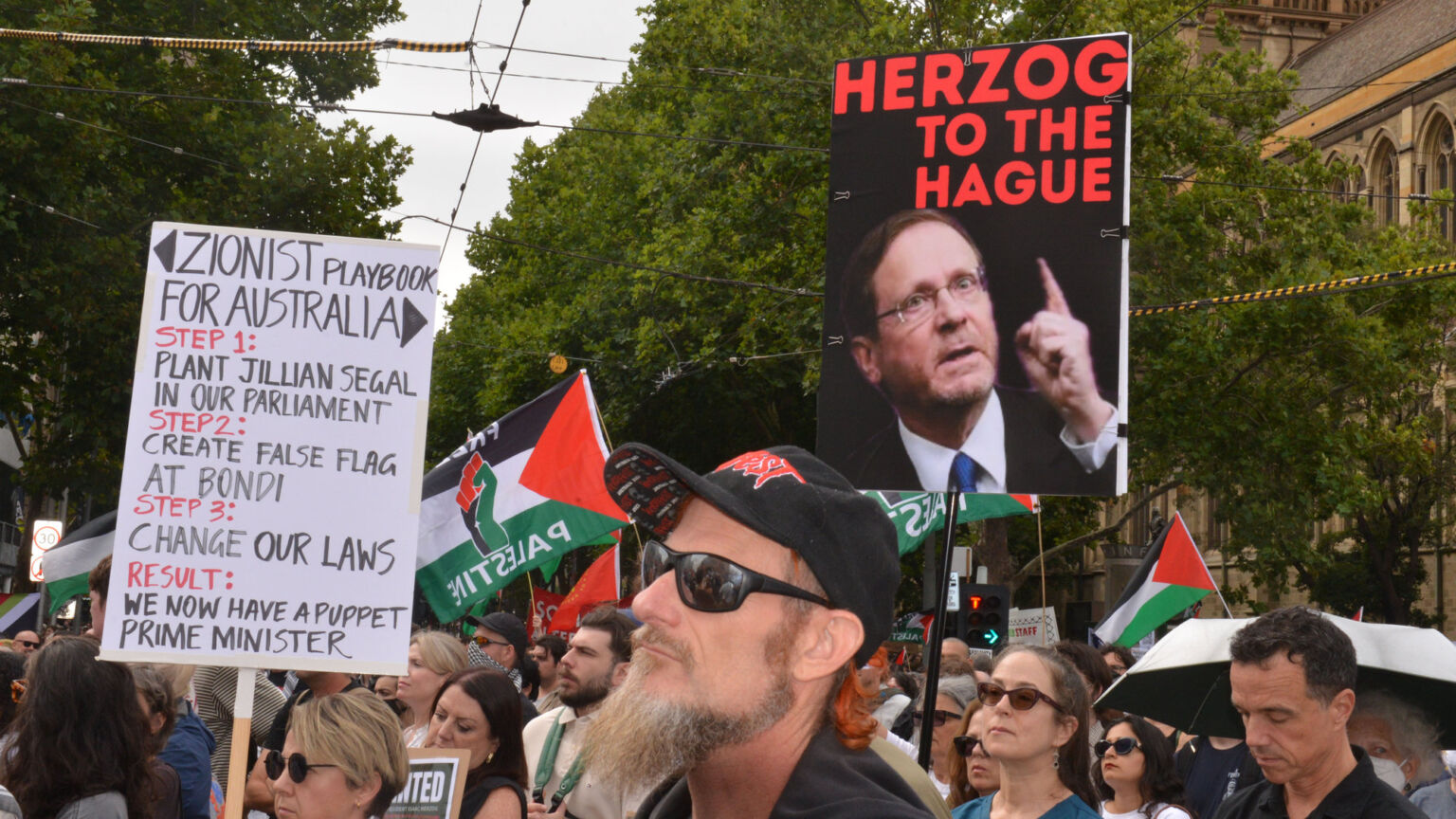
This would be a betrayal of Jewish Australians, who this week were reminded once again what a radically different place their country has become to the one in which their parents and grandparents once sought refuge. On Monday, Israeli president Isaac Herzog arrived in Australia for a four-day visit, having been invited over following the Bondi massacre. He was met with enormous counter-protests. Signs were waved depicting Herzog and New South Wales premier Chris Minns – who, with his public displays of solidarity with Jewish Australians, has been an admirable outlier in the Labor Party – as Nazis. Speaking at the Sydney Town Hall, Grace Tame – an activist and former ‘Australian of the Year’ – said Herzog had ‘signed bombs sent to kill innocent civilians’. Nine protesters have been charged for various violent offences, including one man who is alleged to have bitten an officer.

Australia is now a nation that refuses to tolerate the presence of a leader of the world’s only Jewish state, yet at the same time, publicly mourns the death of Hezbollah chief Ismail Haniyeh – a man who dedicated much of his life to killing Jews. To say Australia has a problem with anti-Semitism would be an understatement. This is a full-blown crisis. The protests offered further proof, if any more were needed, of just how necessary it is to hold a royal commission into anti-Semitism.
McCarthy’s call for the commission to also focus on anti-indigenous hatred was not just a blow for Jewish Australians. Many Australians, regardless of background, would also have found her demands curious. There are, of course, small and odious pockets of Australian society where you’ll find racist attitudes towards indigenous Australians. Yet there is no shortage of attention directed at this form of racism, as any recent visitor to Australia could testify.
Great strides have been made towards indigenous advancement. Every public event begins with a Welcome to Country ceremony. More than half of Australia has been returned to indigenous Australians through native title agreements. As McCarthy’s own ministerial title testifies, there are entire government departments dedicated to ‘closing the gap’ between the living standards of indigenous Australians and white Australians. The wrongs visited on indigenous people, from settler violence to the forced integration of the Stolen Generation, were indisputably terrible. But Australia’s recent attempts to atone for them can hardly be faulted.
The royal commission must explore one issue – and one issue only. It must be laser-focussed on the explosion of anti-Semitism in Australia since 7 October 2023. This horrific development has already cost lives. It is the very least Australia’s Jewish community deserves.

Of course, a royal commission won’t bring back Alexander Kleytman, the Holocaust survivor shot multiple times trying to protect his wife on Bondi beach. It won’t bring back 10-year-old Matilda, the youngest victim of that dreadful pogrom. But it might help to prevent a similar evil from happening again. Albanese and the Australian Labor Party must be given no opportunity to worm their way out of it.
Hugo Timms is a staff writer at spiked.
You’ve hit your monthly free article limit.
Support spiked and get unlimited access.
Support spiked and get unlimited access
spiked is funded by readers like you. Only 0.1% of regular readers currently support us. If just 1% did, we could grow our team and step up the fight for free speech and democracy.
Become a spiked supporter and enjoy unlimited, ad-free access, bonus content and exclusive events – while helping to keep independent journalism alive.
Monthly support makes the biggest difference. Thank you.
Comments
Want to join the conversation?
Only spiked supporters and patrons, who donate regularly to us, can comment on our articles.