Japan’s populist moment has arrived
Sanae Takaichi’s tough talk on China and immigration has delivered her an unprecedented landslide victory.
Want unlimited, ad-free access? Become a spiked supporter.
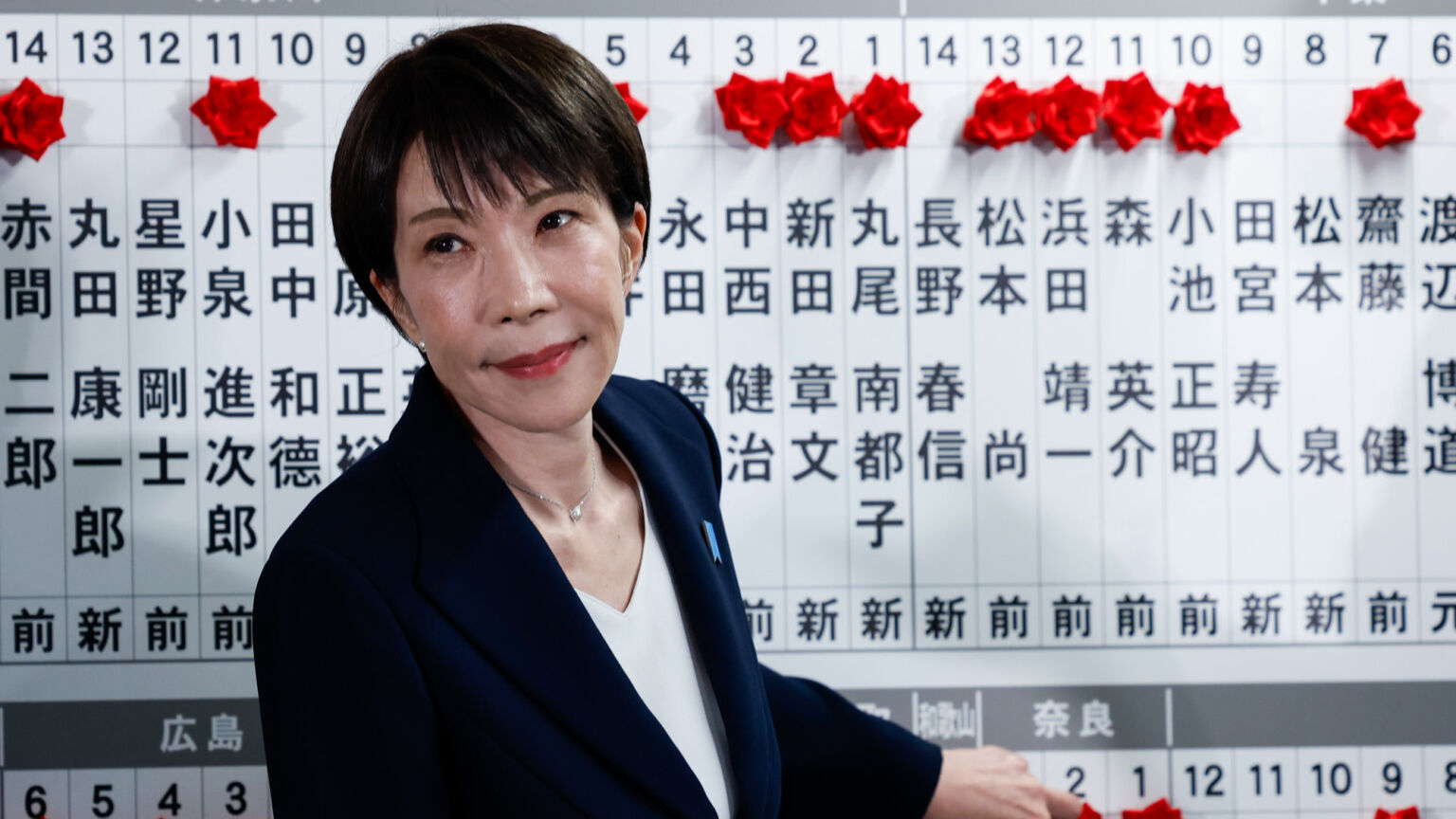
Having called a snap election last month, Japan’s prime minister Sanae Takaichi, an outsider in the ultra-establishment Liberal Democratic Party (LDP), won a landslide victory this weekend. It was a significant moment for Takaichi herself, who only became prime minister last October, and for Japanese politics as a whole.
At 64 years old, this heavy-metal drummer and motorcyclist struck a clear populist tone. Japan’s first female prime minister, and a staunch Margaret Thatcher fan, put standing up to China and a crackdown on immigration at the centre of her campaign. And it paid off. Her party won 316 seats of the 465-seat House of Representatives – the largest majority for a single party in Japan’s postwar history. When combined with the seats won by the LDP’s junior partner, the Japan Innovation Party, her total comes to a whopping 352 seats – around three-quarters of the lower house. This gives her a near-unprecedented amount of power to pursue her agenda. Not only will she not have to do deals with opposition parties – by winning more than two-thirds in the lower house, she has the right to bypass attempts to stall her programme in the opposition-controlled upper house.
Despite the heavy snow on polling day, turnout, at 56 per cent, was higher than at the last General Election in 2024, but only just – a statistic that points to the Japanese electorate’s relative disengagement from their political system. Indeed, a Pew Research poll from 2024 – that is, before Takaichi became LDP leader – found that only 30 per cent of adults had a favourable view of the LDP, and just 29 per cent liked the opposition Constitutional Democratic Party. At 56 per cent, the share of the populace not feeling close to any party was ‘far higher’ in Japan than in the UK and Europe. In particular, the Japanese working class, so very active in the 1950s and 1960s, remains conspicuously absent from the Japanese political scene.
Still, Takaichi seems to have revitalised support for the LDP. Since its formation in 1955, the LDP has enjoyed almost uninterrupted one-party rule, but its support and legitimacy has atrophied in recent years. By last October, when Takaichi, at her third attempt, won leadership of the LDP and thus became prime minister, the party was lacking a majority in either house of the Japanese parliament.
So how has Takaichi now managed to reverse the LDP’s slide? Principally, by standing up to China on the question of Taiwan. Back on 7 November, Takaichi said that an attack by the Chinese Communist Party and its People’s Liberation Army on Taiwan could trigger a military response from Tokyo. ‘If battleships are used and a naval blockade involves the use of force’, she argued, ‘that would, by any measure, constitute a situation that could be deemed a threat to Japan’s survival’. As such, this would permit Japan to mobilise its Self-Defence Forces.
Beijing’s reaction was furious. China’s consul-general in Osaka wrote of Takaichi: ‘A dirty head that sticks itself out must be chopped off.’ Yet even after Chinese foreign minister Wang Yi had condemned her remarks as ‘shocking’, Takaichi refused to withdraw them.
It seems as if her willingness to speak out against China’s designs on Taiwan has endeared her to the Japanese public. Indeed, she continued to talk tough on China well into her election campaign. On 26 January, she told TV Asahi that should ‘something serious’ happen in Taiwan, ‘we would have to go to rescue the Japanese and American citizens [there]’.

Takaichi’s stance on China clearly resonates with Japanese voters. They know that the Japanese island of Yonaguni is just 70 miles away from Taiwan, that PLA manoeuvres around the island are of an ever-increasing intensity, and that two Chinese aircraft carriers spent last summer performing perhaps 90 fighter and helicopter landings a day south of Japan. They know, too, that any involvement of America in a conflagration around Taiwan would likely make the 54,000 US troops stationed in Japan, about half of them in the southwestern island group of Okinawa, a target for PLA missiles. And lastly, the Japanese public is sensitive to increasing attempts by Beijing to wield influence over Okinawa.
Takaichi’s position on immigration has also touched a nerve. Between 1990 and 2016, the foreign share of Japan’s overall population rose from 0.7 to 1.8 per cent. By 2024, Japan’s foreign-born population numbered 3.8million, or three per cent of its inhabitants. Japanese corporations have become ever more reliant on cheaper migrant labour – especially in manufacturing, retail, food services and accommodation.
Of course, Japanese immigration is tiny by Western standards. Nevertheless, prior to Sunday’s election, the Japanese public had not been given a say on the government’s approach to migration. This lack of consultation had fuelled a sense of what has been dubbed ‘foreigner fatigue’. And Takaichi has played on this growing discontent. During the election campaign, she called for tougher immigration screening, and emphasised national identity and safety, rather than integration and inclusion.
It’s a message that has appealed particularly to middle-class women and younger voters. As an alternative to importing cheap foreign labour, she has pledged to increase public spending and capital investment, especially on nuclear power. Her plans to reflate the Japanese economy at a time when inflation is already on the rise – and when public debt stands around a staggering 235 per cent of GDP – might sound unwise, but they are nevertheless striking a chord with voters demanding change.

Takaichi’s victory marks a significant moment in Japan’s political trajectory. It is a clear move away from the ancien régime, albeit from within the establishment LDP. Japan’s populist moment has officially arrived.
James Woudhuysen is visiting professor of forecasting and innovation at London South Bank University. Follow him on X: @jameswoudhuysen.
You’ve hit your monthly free article limit.
Support spiked and get unlimited access.
Support spiked and get unlimited access
spiked is funded by readers like you. Only 0.1% of regular readers currently support us. If just 1% did, we could grow our team and step up the fight for free speech and democracy.
Become a spiked supporter and enjoy unlimited, ad-free access, bonus content and exclusive events – while helping to keep independent journalism alive.
Monthly support makes the biggest difference. Thank you.







Comments
Want to join the conversation?
Only spiked supporters and patrons, who donate regularly to us, can comment on our articles.