The West needs a reckoning with America’s decline
Trump’s erratic foreign policy is a sign of the US’s weakness, not its strength.
Want unlimited, ad-free access? Become a spiked supporter.
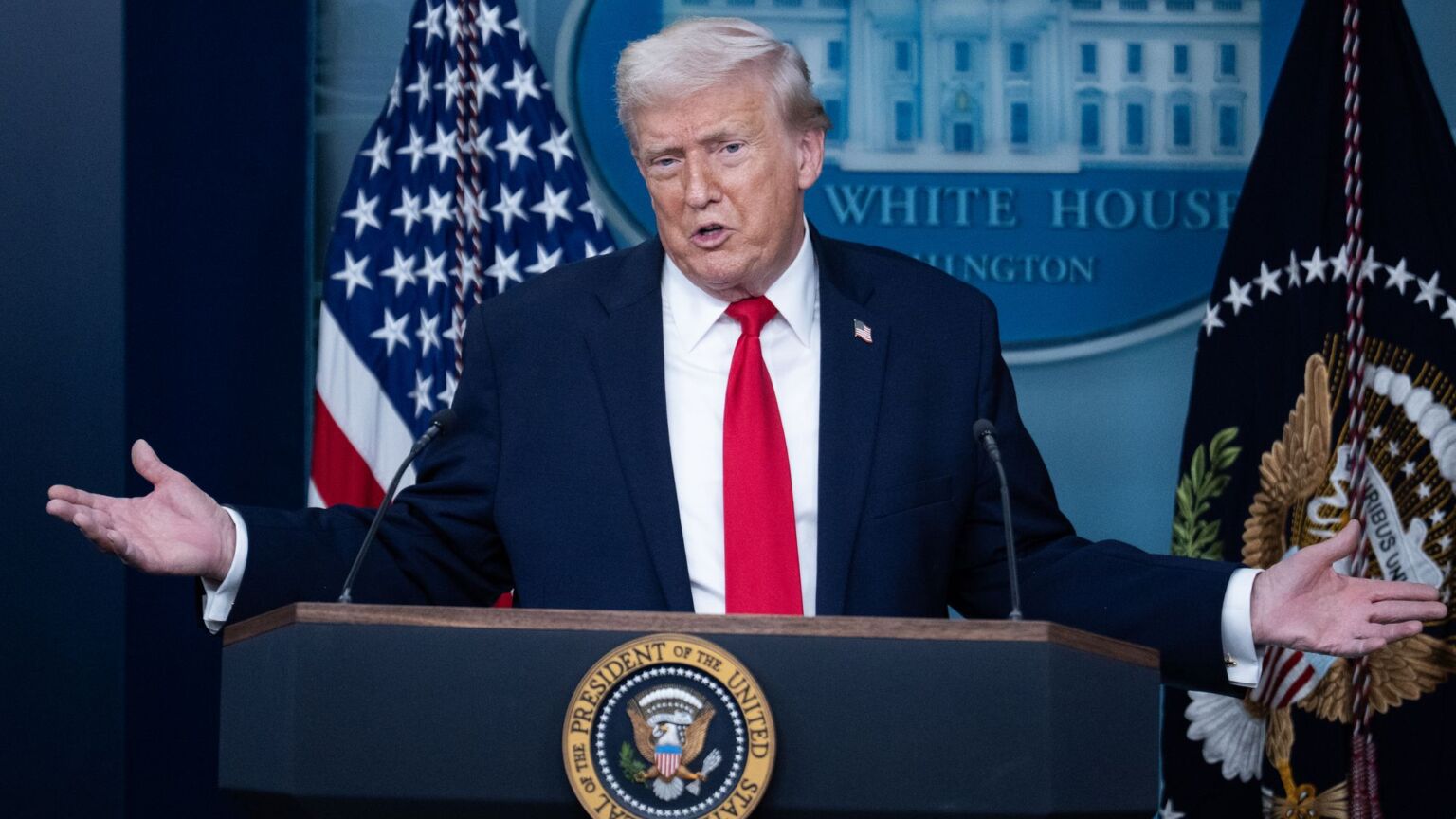
Despite Donald Trump proclaiming that a ‘framework of a future deal’ had been agreed on Greenland, it is still unclear how his demands are likely to be resolved. In any case, the fracas over this icy island is about far more than just the unpredictability and narcissism of the White House incumbent.
The Greenland saga has exposed the shortcomings in geopolitical nous of the West’s leaders – Trump included – and just how hazardous this can be for everyone. International flashpoints are more likely to get out of hand when traditional statecraft is replaced by kneejerk, megaphone diplomacy.
This danger is compounded by the fact that world leaders should already be grappling with a perilous situation: a potential Thucydides trap. But they are refusing to do so.
In The History of the Peloponnesian War, Thucydides, the Athenian historian and general, wrote: ‘What made war inevitable was the growth of Athenian power and the fear that this caused in Sparta.’ Thankfully, war is never inevitable, but historically, the circumstances Thucydides described have often proved dangerous. A great power that is past its prime, that senses its further decline, and targets the upcoming powers, creates a predicament that requires careful handling by all parties. But this is beyond the capacity of today’s Western rulers.
Trying to make sense of Trump’s mercurial outbursts one by one is a fool’s errand. But placing his impulsive behaviour in the context of the broader incoherence of American foreign policy would give other leaders a clearer perspective. A key symptom of the West’s geopolitical fecklessness is that America’s relative decline – and its global implications – has not been properly grasped by most transatlantic governments. In Europe, many ministers still see the United States as an all-powerful bully, one that can be restrained only by the mythical ‘rules-based order’. They miss the fact that it is America’s waning influence that is what is making it so erratic abroad.
At one moment, the US is making a chaotic exit from Afghanistan and declaring an end to foreign military entanglements. Then, it is bombing Syria, or Iran, or claiming it is going to reconstruct Gaza, or seizing Venezuela’s Nicolás Maduro. We should recall that it was Trump, in his first term, who negotiated that hideous withdrawal agreement with the Taliban. Trump reduced US troop levels from about 13,000 to 2,500 before Joe Biden oversaw the humiliating fall of Kabul in 2021.
Until last year, there was bi-partisan agreement in the US that China should be isolated economically. Allies were forbidden from trading technology with Chinese firms. Then, in August, Trump lifted America’s ban on technology exports to companies linked to the Beijing party-state. Chinese inward investment is now welcome once again.
Strikingly, a recent report on China’s overseas lending and grant-giving activities worldwide revealed that the biggest recipient of its financing over the past two decades has actually been the United States. And that doesn’t include all the US Treasury bonds China has been buying over the years.
The same report also illustrates the decisive shift in the world’s economic gravity. China has been outspending America in foreign aid and credit for years. Its role as a global benefactor now spans every region, reaching around 200 countries.
The study found something that would surely surprise most Westerners. Today, more than three-quarters of China’s overseas lending goes to upper-middle income and high-income countries, not to the poorer countries in Africa, Asia and Latin America associated with the Belt and Road Initiative. Much of this outbound credit is focussed on critical infrastructure, critical minerals and the acquisition of high-tech assets.
The speed and scale of this change in the world’s balance of power is what’s driving the vacillating responses of successive US administrations. Washington simply does not know how to handle the global realignment. The American state has now found itself stuck in one of those fraught relationships with China, where the two parties can’t live together, but can’t live apart.
The cause for this dilemma is not the rise of China in itself. It is that, after the Cold War, consecutive US administrations have failed to come to terms with the end of America’s ‘superpower’ status – and with what America’s purpose should be. The Soviet Union had given America an enemy to define itself against. But once the Soviet empire had imploded, American and Western leaders in general lost any sense of strategic clarity. And this has been most apparent in their foreign policies.
Some in America tried to locate a substitute for the Soviet Union by emphasising, even lying about, the danger from third-world despots. The US state invaded countries, then later retreated. US presidents pledged no more wars, then carried out foreign bombing campaigns. It is the peculiar fusion of America’s strength and its weakness over the past four decades that underlies its governments’ increasingly arbitrary and mercurial actions overseas. Trump is merely a symptom of this, not its cause.
The irony is that by evading their biggest diplomatic challenge – the shifting balance of power to the east – America’s leaders have made the US’s position in the world more tenuous, and thus more dangerous for everyone. In acting myopically, or imperiously, or both, the United States has given the space for other nations to extend their international influence.
The tragedy is that with a stronger sense of America’s long-term national interests, things could have been different. US administrations could have led the reorganisation of international relations to smooth out the Thucydides moment. If it had done this, America could have retained an important role in a new stable international arrangement, sitting alongside the rising nations of China, India and the rest.
It is not too late. Although America no longer has the same global authority as before, it remains by far the world’s wealthiest country with substantial military potency. This legacy could still ensure it remains a great player among other major countries. But to achieve that, its leaders need a far more mature understanding of geopolitics.
Washington certainly shouldn’t look across the Atlantic for guidance. One inconsistent and befuddled power is bad enough for global stability. The threat is aggravated when most other Western governments have been similarly clueless about their national interests. For decades, successive governments in most major European countries – Britain, France, Germany, Spain and the Netherlands – have been caught napping. They believed it was sensible to outsource their external security and military defence to the United States.
And they continue the charade even now. European leaders seem to have been stuck in a Groundhog Day loop. They repeatedly proclaim: ‘The world has changed, and we must change.’ But then little actually changes in how they act.
There were a few such statements – perceptive in earlier times – about the world having changed after the end of the Cold War. They followed the wars in former Yugoslavia, 9/11, and again, after France and Germany opposed the US-led invasion of Iraq in 2003. Even by the 2010s, declarations that the ‘old world is over’ became increasingly repetitive and inconsequential. The supposed wake-up calls have been coming in thick and fast. Russia’s seizure of Crimea in 2014, the autarchic national responses to the Covid-19 pandemic in 2020, America’s rushed unilateral departure from Kabul in 2021, Putin’s full-scale invasion of Ukraine in 2022, Trump’s threat to annex Canada in 2024, and the derogatory Oval Office attack on Ukrainian president Zelensky have all led Europeans to proclaim that something must change, but then it never does. In recent weeks, we have heard the same in response to Trump’s threats over Greenland.
It really ought to be obvious by now that the ‘rules-based order’ was never a solid reality. That hard power never went away. And that NATO has been a purposeless Cold War hangover ever since the 1990s, in perpetual search for a replacement raison d’etre.
Now, having made their grand declarations that nothing will be the same again, as soon as the Trumpian drama subsided a little, Europe’s leaders have since deluded themselves further. They claim that Trump seeking a ‘deal’ on Greenland, rather than its outright acquisition, is all thanks to the awesome diplomatic and persuasive powers of Europe’s political classes. In the parallel universe inhabited by European elites, the White House team was left quivering by Keir Starmer, the king of u-turns, declaring, ‘I will not yield’, and by its fear, as US treasury secretary Scott Bessent sarcastically put it, of ‘the dreaded European working group’.
If Western leaders are to break out of their Groundhog Day cycle, they could do well to study the history of previous eras of statecraft. Not just the obvious successes of Winston Churchill’s wartime premiership, but also back to Viscount Palmerston, Britain’s two-time 19th-century prime minister, whose method Churchill updated for 100 years later. If they did, they might be more grounded and resilient. They wouldn’t react in a panic to every puerile jibe from the current potentate in the Oval Office.
Palmerston was an accomplished practitioner of balance-of-power diplomacy. As revolutions and turmoil raged across Europe in 1848, the then foreign secretary came under attack from his political opponents. In response, Palmerston spelt out his approach to pursuing Britain’s national interests. He concluded his five-hour speech in the House of Commons with his famous words that no nation ‘is to be marked out as the eternal ally or the perpetual enemy of England’. ‘We have no eternal allies, and we have no perpetual enemies’, he said. ‘Our interests are eternal and perpetual, and those interests it is our duty to follow.’
For the benefit of today’s pseudo-diplomats, it is just as instructive to quote what he said next:
‘When we find other countries that take a different view, and thwart us in the object we pursue, it is our duty to make allowance for the different manner in which they may follow out the same objects. It is our duty not to pass too harsh a judgment upon others, because they do not exactly see things in the same light as we see; and it is our duty not lightly to engage this country in the frightful responsibilities of war, because, from time to time, we may find this or that power disinclined to concur with us in matters where their opinion and ours may fairly differ. That has been… the guiding principle of my conduct…
‘In one sentence, the principle which I think ought to guide… every British minister: the interests of [Britain] ought to be the shibboleth of his policy.’
The only sure resolution to geopolitical tensions and dangers is to follow the national interest. Yet the current crop of leaders has lost sense of this. They are disconnected not only from their publics, but also from any sense of what their nations need. This makes their foreign-policy interventions arbitrary and unpredictable. It reinforces geopolitical fragmentation and international dealignment.
Last week, the level-headed Italian defence minister, Guido Crosetto, subtly reprimanded his European colleagues for their stunt of sending a smattering of troops to Greenland. He made the commonsense point that it is in everyone’s interest ‘to avoid fragmenting a world already fragmented’.
So, when Trump is off on one of his rambles again, and talks excitedly about Greenland, Iceland or any other land that takes his fancy, a good first step for his allies would be to put down the megaphones. Instead, they should engage in robust backroom diplomacy, built on a firm defence of national sovereignty.
Phil Mullan is the author of Beyond Confrontation: Globalists, Nationalists and Their Discontents.
You’ve hit your monthly free article limit.
Support spiked and get unlimited access.
Support spiked and get unlimited access
spiked is funded by readers like you. Only 0.1% of regular readers currently support us. If just 1% did, we could grow our team and step up the fight for free speech and democracy.
Become a spiked supporter and enjoy unlimited, ad-free access, bonus content and exclusive events – while helping to keep independent journalism alive.
Monthly support makes the biggest difference. Thank you.



Comments
Want to join the conversation?
Only spiked supporters and patrons, who donate regularly to us, can comment on our articles.