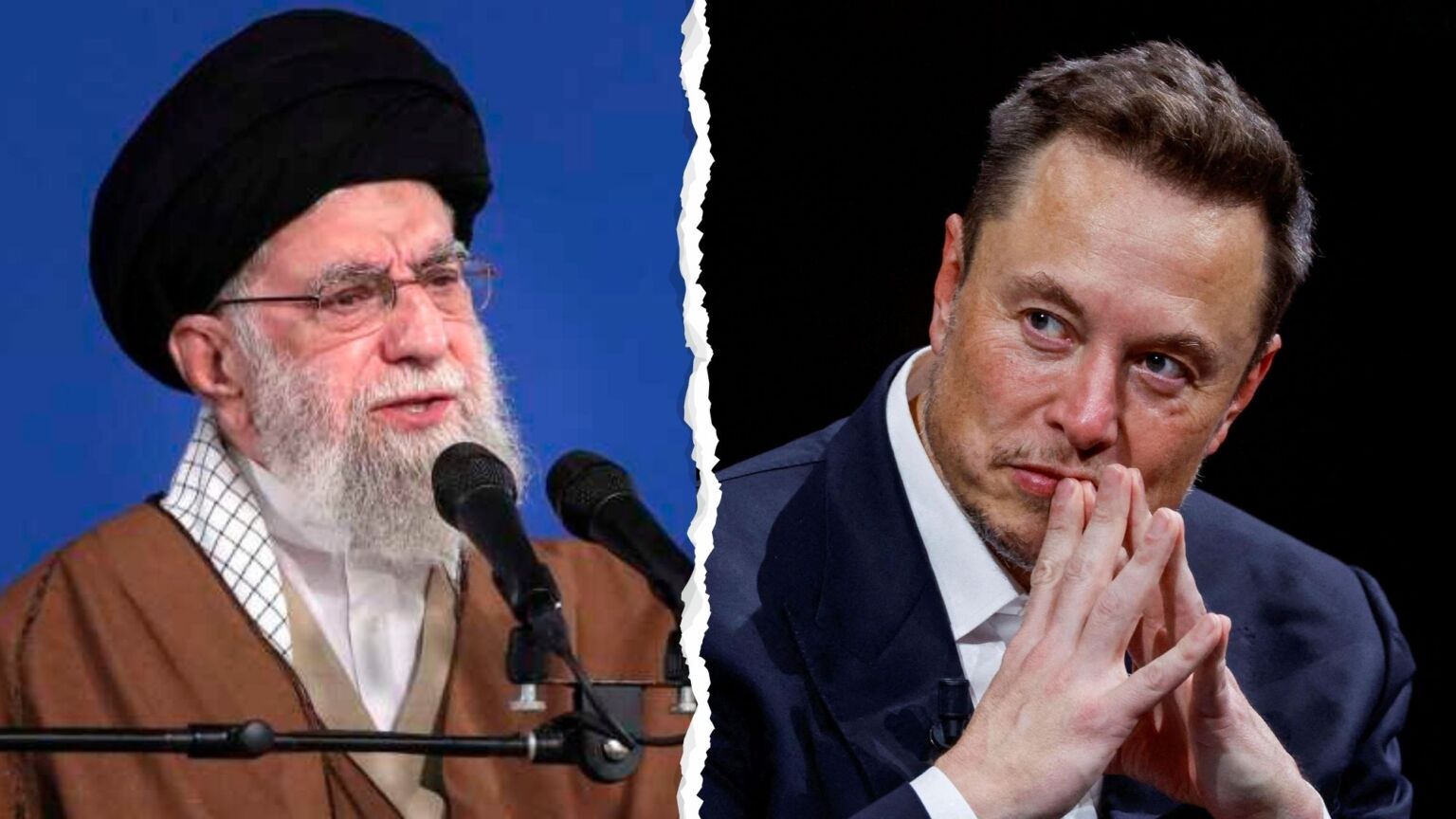
Elon Musk vs the ayatollah
How Starlink has kept the communication alive during the Iranian regime’s internet blackout.
Want unlimited, ad-free access? Become a spiked supporter.
When the Iranian regime shut down the internet on 8 January, anyone paying attention knew precisely what was coming – first the digital darkness, then the analogue slaughter.
The horrific scale of that slaughter is only now emerging. Reports suggest that perhaps over 16,000 Iranian citizens were killed and hundreds of thousands wounded. The blackout was not incidental to the mass killing – it was its enabling condition. Murder is easier when there are no witnesses.
These events exposed, with brutal clarity, a defining fact of modern power – namely, that those holding it in the 21st century can switch off the digital public square at will. They can erase protest, hide truths and avoid accountability as and when they please. That reality raises questions that reach far beyond Iran. It raises questions about free speech today, democracy tomorrow and the dangerous hypocrisy of Western leaders who condemn this act abroad while increasingly aspiring to control the same digital public square at home.
The Iranian internet shutdown was near total. According to Cloudflare Radar, which monitors global internet traffic, Iran’s connectivity dropped to ‘effectively zero’ at around 18.45 UTC on 8 January. ‘Effectively zero’ means no uploads, no messaging, no livestreams, no coordination, no e-commerce. It also means families cannot locate detained relatives, journalists cannot report and the world cannot see what is being done out of digital sight.
Western leaders were quick to condemn the blackout. EU foreign policy chief Kaja Kallas said that Iran’s actions exposed a regime ‘afraid of its own people’. And the British government called on the Iranian authorities ‘to respect the fundamental rights and freedoms of their citizens’.
Yet while Western governments rightly condemn Tehran for turning off the internet, the whiff of hypocrisy is impossible to ignore. At home, many of these same politicians increasingly speak of the digital public square as a problem to be managed and regulated.
Across Europe and the UK, governments have floated bans and restrictions, and constructed regulatory regimes with the power to suppress or reshape the entire social-media landscape. The EU’s Digital Services Act, justified in the language of safety and harm reduction, grants sweeping powers to the authorities over content moderation and platform design. Our politicians may see the internet as a human right in Iran, but they view it as a menace in Europe.

This is not to equate Brussels with Tehran. Europe regulates; Iran murders. But the underlying logic is disturbingly aligned. Both believe that uncontrolled speech is dangerous and must therefore be supervised.
This is not the only uncomfortable paradox that recent events in Iran have laid bare. While Western leaders issued statements, it was their bête noire, X owner and establishment hate-figure Elon Musk, who did most to help the Iranian protesters.
When the Iranian regime pulled the plug, Starlink, Musk’s satellite internet system, became one of the few viable ways for Iranians to communicate with the outside world. Because Starlink bypasses fibre networks, towers and gateways, it can evade the state’s kill switch. According to Reuters, many Starlink terminals (numbering between 50,000 and 100,000) have been smuggled into Iran, despite the service being illegal. Iranian authorities have tried to respond with satellite jamming and GPS spoofing, confirming they understand exactly what is at stake.
Starlink has demonstrated its utility before. It has proven itself essential to Ukraine in its war with Russia. By mid-2025, Reuters reported that more than 50,000 Starlink terminals were operating across Ukraine, supporting military coordination, emergency services and civilian communications.

Crucially (though rarely reported by the media), Starlink was initially provided to Ukraine free of charge. SpaceX absorbed the costs at a moment when speed mattered more than contracts. Musk deserves enormous credit for that decision. Lives were saved, resistance was sustained, and Ukraine was able to muster a defence of its sovereignty.
There are, however, important caveats to all this. In September 2022, Reuters revealed that Musk disabled Starlink coverage in certain areas during a Ukrainian counteroffensive, reportedly to avoid escalation with Russia. The decision disrupted Ukrainian communications at a critical moment.
It was a telling intervention. It showed that a single Big Tech entrepreneur, accountable to no electorate and constrained by no democratic oversight, possessed the power to shape battlefield communications in an active war.
There’s no doubt that Musk has repeatedly acted to keep people connected at times of great danger, often at political and financial cost. Even so, praiseworthy behaviour cannot disguise the underlying problem. Whether exercised by a repressive state or a capricious billionaire, the power to pull the plug is an immense form of authority. It is sovereignty without territory. And liberal democracies have not yet resolved how such power should be governed, limited or distributed.
Though Starlink has the power to disrupt state monopolies on communication, it does not democratise control. It relocates decisive power – from Tehran to California, from ministries to boardrooms. In Ukraine, a partial remedy emerged. In June 2023, the US Department of Defence contracted Starlink services in Ukraine and brought them under formal state control. This was significant. Control shifted – imperfectly but meaningfully – from a private individual to a public institution. Decisions about coverage and escalation became, at least in principle, subject to political oversight and thus to democratic accountability.
The real question raised by Iran, Ukraine and Starlink is not whether Elon Musk is a hero or a menace. It is whether democratic societies are willing to treat communications infrastructure and free speech as a shared civic good, rather than a regulatory problem or a market opportunity. Until democratic societies confront who controls the switch – and how that power can be made accountable – the future of free speech will remain as fragile as the bandwidth on which it now depends.
Dr Norman Lewis is a writer and visiting research fellow at MCC Brussels. His Substack is What a Piece of Work is Man!.
You’ve hit your monthly free article limit.
Support spiked and get unlimited access.
Support spiked and get unlimited access
spiked is funded by readers like you. Only 0.1% of regular readers currently support us. If just 1% did, we could grow our team and step up the fight for free speech and democracy.
Become a spiked supporter and enjoy unlimited, ad-free access, bonus content and exclusive events – while helping to keep independent journalism alive.
Monthly support makes the biggest difference. Thank you.






Comments
Want to join the conversation?
Only spiked supporters and patrons, who donate regularly to us, can comment on our articles.