Berlin’s blackout was a grim taste of our Net Zero future
When eco-activists attacked the power grid, they unwittingly exposed the horrors of life without fossil fuels.
Want unlimited, ad-free access? Become a spiked supporter.
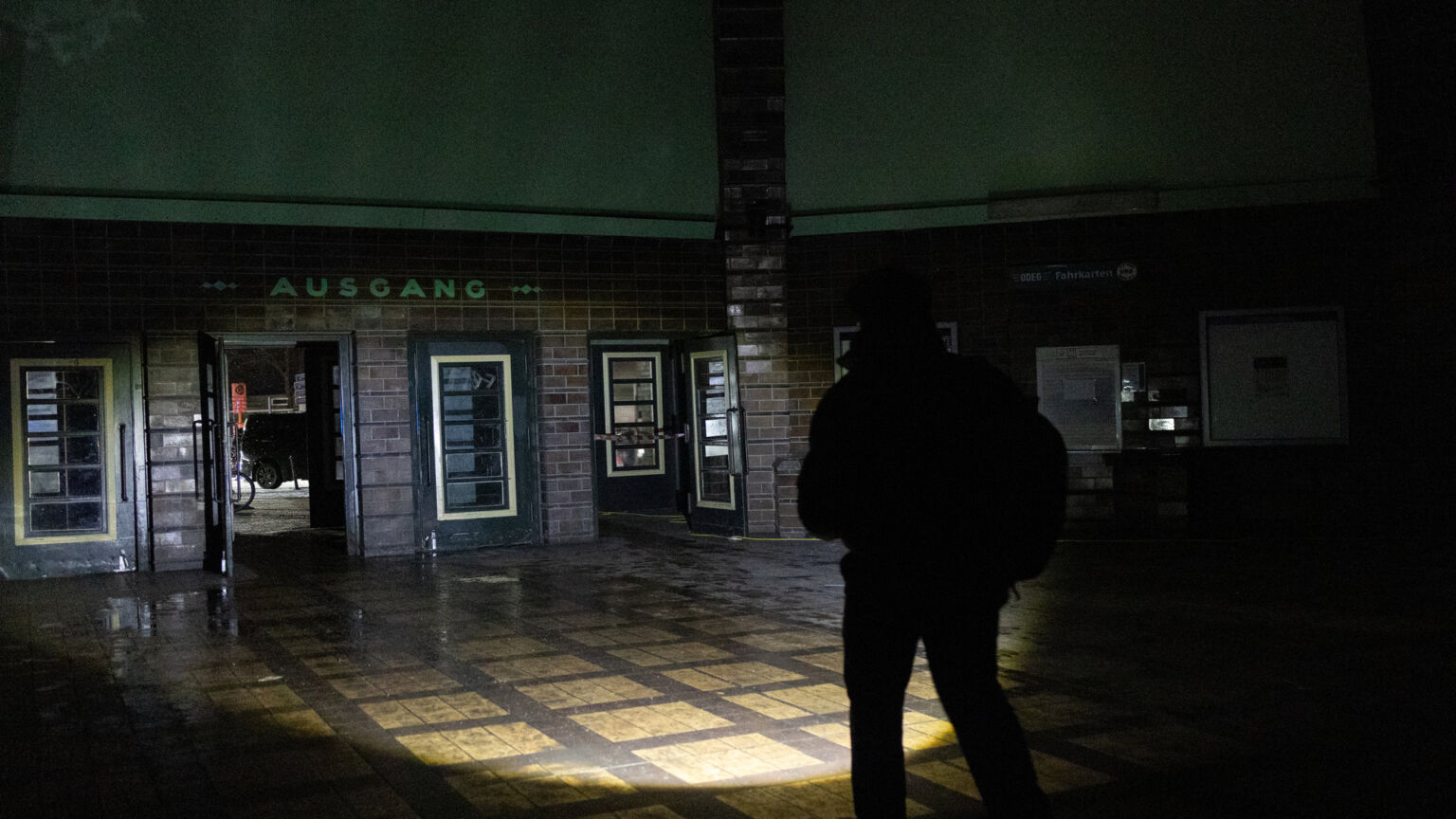
Berlin’s horrendous four-day blackout, which plunged over 45,000 households in the city’s south-west into darkness, is finally over. Beginning last Saturday and lasting for four nights, the blackouts left homes, shops and care facilities without light, heating and communications access – just as a particularly nasty cold spell sent temperatures plummeting to minus-10 degrees Celsius. The far-left ‘Volcano Group’ (Vulkangruppe) has claimed responsibility for the blackout, which it reportedly achieved by setting fire to electricity cables connected to Berlin’s largest gas power plant.
Few events could more vividly reveal what’s at stake when civilisation fails – a civilisation that is still fundamentally dependent on fossil fuels. For four days, tens of thousands of Berliners existed in the ‘state of nature’ Thomas Hobbes described in Leviathan in 1651:
‘In such condition, there is no place for industry… no Arts; no Letters; no Society; and which is worst of all, continual fear, and danger of violent death; and the life of man, solitary, poor, nasty, brutish, and short.’
The blackout has been an incredibly unpleasant experience. It has also offered a grim preview of life in the fossil-free ‘utopia’ our political elites dream of. Indeed, the letter sent by the Volcano Group claiming responsibility for the attack will sound depressingly familiar to anyone with a passing knowledge of the green movement:
‘We can no longer afford the rich… We can end the imperial mode of life… Because of greed for energy, the Earth is being depleted, burned, raped, destroyed.’
This could have been lifted from any number of elite speeches at climate summits or eco-activist manifestos. It echoes the sermons of former ministers in the German government – notably former Green Party leader and former vice-chancellor Robert Habeck, who lamented humanity’s ‘insatiable hunger for fossil fuels’.
Last week’s attack was not the first of this nature. In September, another serious power outage left 50,000 Berlin households without electricity for 60 hours. As with the most recent attack, mobile-phone networks and emergency services failed, and emergency calls couldn’t be made for hours. Again, left-wing extremists were to blame. Citizens are justifiably asking how this could happen for a second time in less than six months.
The Volcano Group (which was not involved in the sabotage in September) has been active since 2011. Since then, it has been linked to dozens of attacks – from sabotaging railways and telecom towers to a 2024 arson attack that temporarily halted production at Tesla’s Berlin factory. Yet authorities have seemingly pursued these cases with lethargy – a striking contrast to their zeal in combating right-wing extremism.
For years, German elites have obsessed over the dangers posed by the nation’s far right. Yet they have been blind to the violence perpetrated at the other end of the ideological spectrum. This has much to do with the fact it comes from people whose underlying values they broadly share, such as support for Net Zero and mass migration. And so the instinct is to downplay the threat.
This led to sections of the press immediately minimising the latest attack. They sought to deflect attention to the populist AfD, who they feared would ‘exploit’ the crisis for their own electoral ends. Some chose simply to ignore it: on the third day of the blackout, ARD, Germany’s main news broadcaster devoted more time to the plight of South African penguins on its evening news broadcasts, than to the citizens in Germany’s capital shivering without power.
Beyond ideology, the blackout exposed something darker: the deep incompetence of a state that barely functions in a crisis. As Bild noted bitterly, war-torn Ukraine is able to repair damaged electricity grids within 24 hours. Yet it took nearly a week for Berlin to get its act together.
Until that point, it was sheer chaos. Residents were told to move to hotels and streets went pitch black when the sun fell. Only a few vintage gas lamps illuminated the streets. Some households managed to keep warm with diesel generators, but most were left helpless. After electricity returned, at least one woman – an 83-year-old – was found dead in her flat.
A retired firefighter summed it up perfectly in the Berliner Zeitung: for years, officials at every level of government have been more concerned with non-issues such as gender-neutral language and the width of cycle paths, than the legitimate needs of the public. Add to that the enormous resources spent policing ‘hate speech’, and the result is a state distracted from, and unable to perform, its core duties.
This mass discontent has found a target in Berlin mayor Kai Wegner. And for very good reason. As the city descended into chaos, he was conspicuously absent. When he eventually addressed the press, he muttered something about having made important phone calls during the crisis. It later emerged that he continued playing tennis when he first heard of the attack. The anti-establishment mood was perhaps best encapsulated by a pundit on NIUS, a populist TV channel. Responding to an image of Wegner bending over a nonagenarian shivering under a blanket, the commentator bitterly remarked that if she had been a young man from Syria or Afghanistan, the state would have found her a hotel room – ‘a picture of everything wrong with the German state’.
Berlin’s blackouts, then, are not just the handiwork of extremist saboteurs. They are also the consequence of the complacency, incompetence and performative morality of Germany’s rulers. Decades of Net Zero dogma, in particular, helped to make an already terrible situation so much worse. The citizens of Berlin who were left in the cold and dark will not forget this any time soon.
Sabine Beppler-Spahl is spiked’s Germany correspondent.
You’ve hit your monthly free article limit.
Support spiked and get unlimited access.
Support spiked and get unlimited access
spiked is funded by readers like you. Only 0.1% of regular readers currently support us. If just 1% did, we could grow our team and step up the fight for free speech and democracy.
Become a spiked supporter and enjoy unlimited, ad-free access, bonus content and exclusive events – while helping to keep independent journalism alive.
Monthly support makes the biggest difference. Thank you.

Comments
Want to join the conversation?
Only spiked supporters and patrons, who donate regularly to us, can comment on our articles.