What Venezuela reveals about the ‘Don-roe doctrine’
Trump’s interventions may be perilous, but they are far more restrained than those of his liberal predecessors.
Want unlimited, ad-free access? Become a spiked supporter.
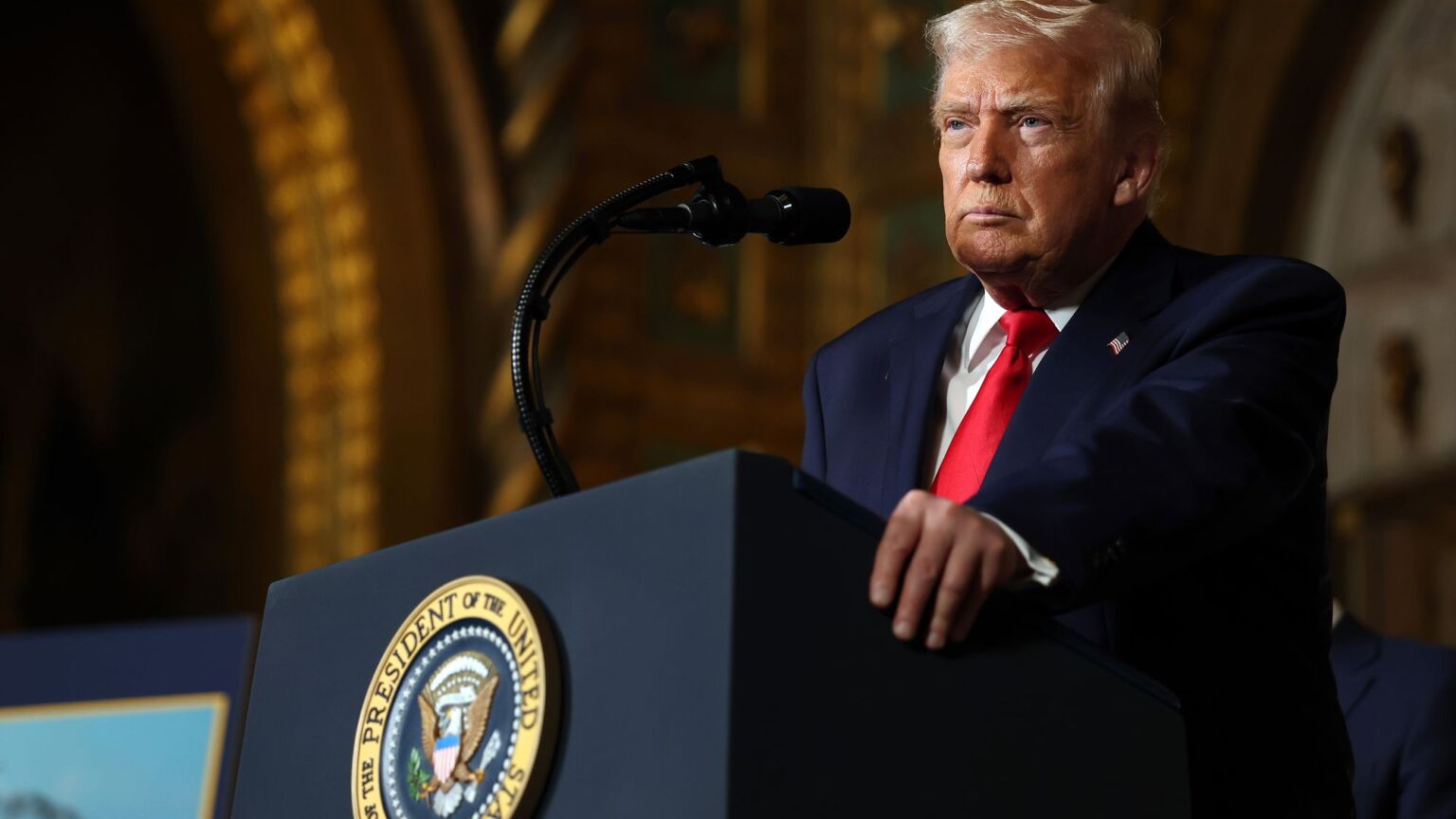
President Trump is a wager of ‘un-war’, which confounds his critics and some of his supporters alike. The capture of Venezuelan leader Nicolás Maduro over the weekend is a case in point. The usual semi-professional leftist protesters are hitting the streets of Europe and a few American cities to decry America’s latest war – but what kind of war lasts just two-and-a-half hours?
US troops didn’t invade en masse. A handful of special forces were dropped in, they killed el presidente’s guards, nabbed their man and got out. Whatever one thinks about the justice of the whole thing, calling it a ‘war’ is ridiculous. If that’s what this was, then Jimmy Carter waged a war with Iran in 1979 when he launched a doomed military mission to rescue US hostages. And the US must have been at war with Pakistan in 2011 when special forces raided Abbottabad and killed Osama bin Laden.
Critics of US foreign policy have long mocked the tendency of neoconservative hawks to frame every foreign tension as a replay of 1939. Such mockery is well deserved. Yet many of the same people who perceive the idiocy of treating every dictator as a new Adolf Hitler treat every US intervention, however small or brief, as a new Iraq War. Whatever else the Venezuelan operation might be, it isn’t that.
In fact, what Trump did in Venezuela isn’t even really ‘regime change’: the socialist regime that began under Hugo Chávez is still in power, only with a more pliable successor to Maduro now in charge. Former vice-president and now acting leader Delcy Rodríguez, despite initial remarks condemning the US action (and who would expect her to say anything different?), appears to be willing to de-escalate and cooperate with Washington. Trump’s own record, such as his intervention last summer in the Iran-Israel war, suggests he will want to de-escalate as well. He’s now made his point.
That doesn’t mean the situation isn’t perilous, of course. This may not be a war. There’s no ongoing fighting and Venezuela has continuity of government, albeit not the same president as a week ago. But even if Rodríguez and Trump both want a thaw in US-Venezuela relations, there are a multitude of scenarios that could lead to disaster. Hardliners or malcontents within the Venezuelan regime could stage a coup against Rodríguez. Or a popular revolt, with perfect justice on its side, could lead to bloody confrontations between the government and people. Trump seems to be inclined to minimise those risks by not pushing for speedy democratisation and liberalisation, but there may be some in his administration with less patience and more idealism.
Trump, who was quite frank about saying the US should have seized Iraq’s oil when George W Bush invaded, wants the US to have some say over Venezuela’s considerable petroleum resources, too. Although just what that means is anybody’s guess as yet. Experts in the industry say modernising Venezuela’s oil capacities would require enormous capital investment, and of course oil companies – and influential oil-rich countries with foreign lobbies – don’t always want to increase supply and thereby lower prices. Most likely, Trump has in mind some kind of partnership, like the deal he offered involving Ukrainian mineral rights.
Trump is a dealmaker, not an ideologue. This earns him condemnation from liberal idealists, of both the progressive and libertarian varieties. The US president built his fortune in the cut-throat world of New York City real estate, a field not entirely free from the influence of organised crime. Trump knows how the world works, and he plays by its unromantic rules. This is appalling to idealists of every stripe. ‘It’s gangsterism’, the critics gasp.
The odd thing is that these critics come from intellectual traditions that are supposed to be alert to the fact that all states have something of the quality of gangsters – that’s why the original liberals were opposed to state power. Over time, however, right-liberals as well as left-liberals came to imagine that all states are gangsters except their states. When a liberal like Barack Obama orders the bombing of Afghan wedding parties in the name of promoting the holy liberal international order, dead civilians are simply an acceptable ‘collateral damage’, the sad yet inevitable cost of doing what’s morally righteous. But if Donald Trump kidnaps a foreign dictator because he doesn’t like the guy and wants to cut a business deal with his successors, that is a crime against humanity, illegal under international law, and all right-thinking (or left-leaning) liberals must take to the streets and their Bluesky accounts to demand the release of poor little Nicolás, who only wanted to be free to exploit his people and their natural resources for himself. He has fallen prey to Yanqui imperialism, which means to racism, too.
The earliest liberal precursors thought it was a good thing if economic interest replaced religious principle, and while Voltaire and others looked to the stock market as a place where intractable conflicts over principle could simply be ignored, the idea applies more broadly. Disputes over material interests are amenable to negotiation and compromise; disputes over moral principles are not. The need for economic ventures – even wars and outright gangsterism – to turn a profit imposes limitations that do not apply when wars are perpetrated for the sake of ideals. While there are certainly many people making profits off the 20-year war the US conducted in Afghanistan under liberal Republican and Democratic presidents, the war’s legitimacy depended on a kind of theology: a belief in the basic righteousness of the cause, whatever the costs, and the inevitable triumph of good over evil.
Trump disposed of that theology. As soon as he declared his unbelief in the 2016 campaign, Americans who had guiltily gone along with what their betters had told them was the morally correct opinion decided they didn’t have to keep funding and fighting these ‘forever wars’. Trump was never an ‘anti-war idealist’ challenging war-loving idealists. Rather, he was an anti-idealist, a realist – and the realities of international politics are not nice. But they need not be any nastier than necessary to meet practical aims. That’s the Trump doctrine.
One can argue about whether his aims in toppling Maduro made any sense in the first place, or were worth pursuing in light of the risks. But his aims are notably more limited than those of his liberal detractors. Is it possible that bad yet limited aims may be less deadly than good but unlimited ones? What does the record indicate?
When liberals can answer these questions honestly, they will be in a position to offer meaningful criticisms of Trump, who is in power in the first place because of what their ideals have wrought.
Daniel McCarthy is the editor of Modern Age.
You’ve hit your monthly free article limit.
Support spiked and get unlimited access.
Support spiked and get unlimited access
spiked is funded by readers like you. Only 0.1% of regular readers currently support us. If just 1% did, we could grow our team and step up the fight for free speech and democracy.
Become a spiked supporter and enjoy unlimited, ad-free access, bonus content and exclusive events – while helping to keep independent journalism alive.
Monthly support makes the biggest difference. Thank you.


Comments
Want to join the conversation?
Only spiked supporters and patrons, who donate regularly to us, can comment on our articles.