The creeping threat of Islamic blasphemy laws
The attempted conviction of Hamit Coskun for burning a Koran risked reviving a medieval form of censorship.
Want unlimited, ad-free access? Become a spiked supporter.
In June 1976, fortnightly newspaper Gay News featured a now infamous poem, ‘The Love That Dare Not Speak Its Name’. It described a Roman soldier making love to Jesus after his crucifixion, accompanied by a sexually explicit illustration. In July the following year, thanks to a legal case brought by conservative activist Mary Whitehouse, Gay News editor Denis Lemon was found guilty of blasphemous libel and handed a suspended prison sentence.
Whitehouse vs Lemon was the last successful blasphemy trial in the UK – until 2025, that is. Of course, the conviction of Hamit Coskun by a London court in June for setting fire to a Koran wasn’t technically for blasphemy. After all, the actual offences of blasphemy and blasphemous libel were abolished in 2008. Coskun was also successful in appealing his conviction. Nevertheless, the closer one looks at both cases, the more difficult they become to distinguish. Just as Lemon and Gay News were punished for insulting Christianity nearly 50 years ago, so Coskun was put on trial this year for insulting Islam.
Coskun arrived in England from Turkey in 2022 as a political asylum seeker. There seems to be some confusion around his nationality, however court documents describe him as an Armenian Kurd who was born and raised in Turkey. The persecution of the Armenians and Kurds at the hands of successive Turkish rulers, and the increasingly theocratic rule of Turkish president Recep Tayyip Erdoğan, were among his reasons for seeking political asylum in the UK.
After his arrival in England, Coskun kept a keen and despairing eye on Turkish affairs. He criticised Erdoğan for eroding secularism and driving Turkey in an Islamist direction. By early 2025, Coskun had had enough. On the afternoon of 13 February, he travelled to the Turkish embassy in Knightsbridge, west London, to make a pointed protest.
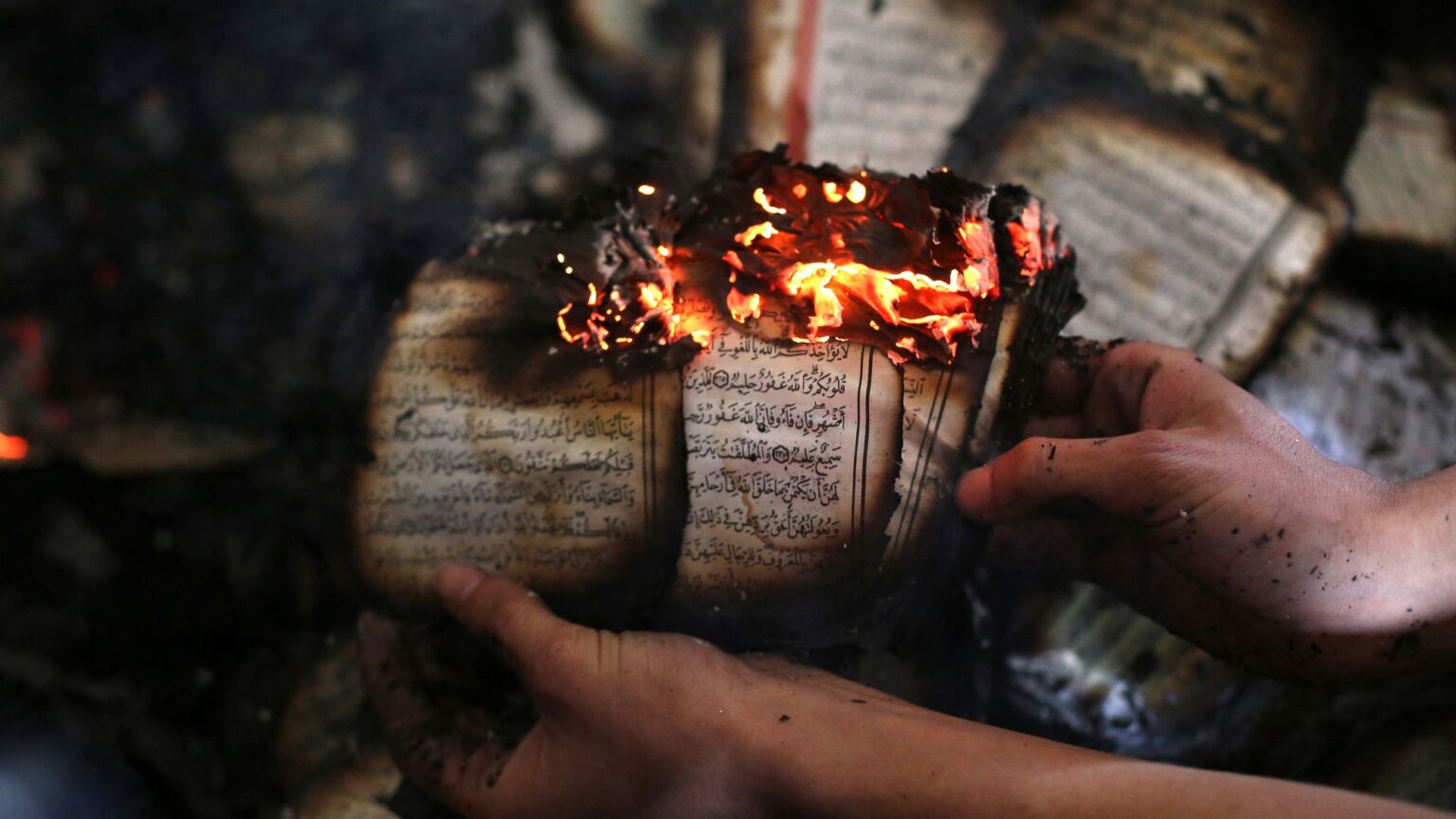
Nothing much happened initially. Coskun set fire to a Koran he had brought with him, and waved it in the direction of the embassy. According to witnesses, he shouted, ‘Fuck Islam’, and, ‘Islam is the religion of terrorism’. But no one, at first, paid him much attention.
That was until Moussa Kadri, a 59-year-old Muslim, entered the scene. As a recording of the encounter shows, he first rushes towards Coskun, exchanges a few words with him, before disappearing into a nearby building. Minutes later, he returns with a large bread knife. He starts swinging wildly at Coskun, telling him that he is ‘going to kill’ him. Coskun tries to fend him off with his burning Koran, but trips and falls down outside the embassy. Kadri is seen leaning over Coskun, kicking him multiple times and spitting on him. Kadri then raises the knife above Coskun. He takes the Koran, and appears to walk off, before rushing towards Coskun a second time, as if to continue the assault. It is a harrowing minute or so of footage.
No sooner had Coskun recovered from his vicious assault than he was charged by the Metropolitan Police for a ‘religiously motivated public-order offence’. In June, he was convicted in Westminster Magistrates’ Court and fined £240. District judge John McGarva denied the case had anything to do with blasphemy, but his written judgement suggested otherwise. He scolded Coskun for his ‘hostility towards members of a religious group, namely Islam’, and said that Coskun ‘knew his decision to burn the Koran would be provocative’. Incredibly, he used the assault – the fact Coskun was kicked, spat on and nearly stabbed – as proof of just how ‘provocative’ the Koran-burning was.

Worryingly, this is not an isolated case. Disrespecting Islam in Britain may not always result in legal punishment, but it does open you up to attack – and those who threaten and assault so-called blasphemers are routinely given a free pass.
Back in 2021, there was the religious-studies teacher at Batley Grammar School in West Yorkshire who, following pressure from Islamic activists, was forced to go into hiding (where he remains) for showing pupils a copy of the Charlie Hebdo cartoons depicting Muhammad as part of a lesson on blasphemy. Then there was the incident at Kettlethorpe High School in Wakefield in 2023, when four boys were suspended and subjected to death threats for ‘scuffing’ a copy of the Koran. The police addressed a public meeting, alongside a local imam, where one of the children was publicly chastised. The child also had a ‘non-crime hate incident’ logged against him. Yet in both Wakefield and Batley, the police did nothing about the religious fanatics issuing serious, credible threats at a teacher and a child.
We saw a similar dynamic in Hamit Coskun’s case, where the authorities took a strikingly lenient approach to his knife-wielding attacker, Moussa Kadri. At Southwark Crown Court in September, Kadri pleaded guilty to possessing a knife in public and common assault. He received a suspended prison sentence and was ordered to pay a paltry £150 victim surcharge. In other words, he received a far lighter punishment for physical violence than Coskun initially received for insulting Islam.
Judge Hiddleston came dangerously close to blurting the quiet part out loud in his sentencing remarks. Kadri, he said, was ‘deeply offended’ by this desecration of the ‘holy Koran’. He then waxed lyrical about the offender’s character, describing him as ‘exemplary’. It was a ‘tragedy’ such a man had ended up in court, Judge Hiddleston said.
In October, some good news finally arrived. With the backing of the Free Speech Union, Coskun managed to successfully appeal his conviction. But we shouldn’t celebrate too soon. In November, the Crown Prosecution Service announced that it intends to challenge Coskun’s acquittal, such is its determination to punish critics of Islam. Naturally, it has said nothing about challenging the incredibly soft punishment dished out to the knife-wielding Moussa Kadri.
There may be other good news in the pipeline, though. There is reason to believe that the outcry over Coskun’s prosecution has prompted the Labour government to water down its proposed definition of ‘Islamophobia’. While the new definition of what it now calls ‘anti-Muslim hostility’ will still grant Islam protections that don’t exist for other religions, all the signs suggest Labour has taken a step back from the far-more censorious definition it adopted in 2018 for internal party matters.
There is still everything to fight for, as the ongoing persecution of Hamit Coskun attests. Will Britain remain a secular country, where people are free to criticise religion however they see fit? Or will the offended feelings of one particular religious group be allowed to trump freedom of speech? It has never been more important to fight for the right to blaspheme.
Hugo Timms is a staff writer at spiked.
You’ve hit your monthly free article limit.
Support spiked and get unlimited access.
Support spiked and get unlimited access
spiked is funded by readers like you. Only 0.1% of regular readers currently support us. If just 1% did, we could grow our team and step up the fight for free speech and democracy.
Become a spiked supporter and enjoy unlimited, ad-free access, bonus content and exclusive events – while helping to keep independent journalism alive.
Monthly support makes the biggest difference. Thank you.
Comments
Want to join the conversation?
Only spiked supporters and patrons, who donate regularly to us, can comment on our articles.