The EU is a basket case – rejoining would be a disaster
This year, Europe was marred by economic decline and political dysfunction. What do Remainers see in it?
Want unlimited, ad-free access? Become a spiked supporter.
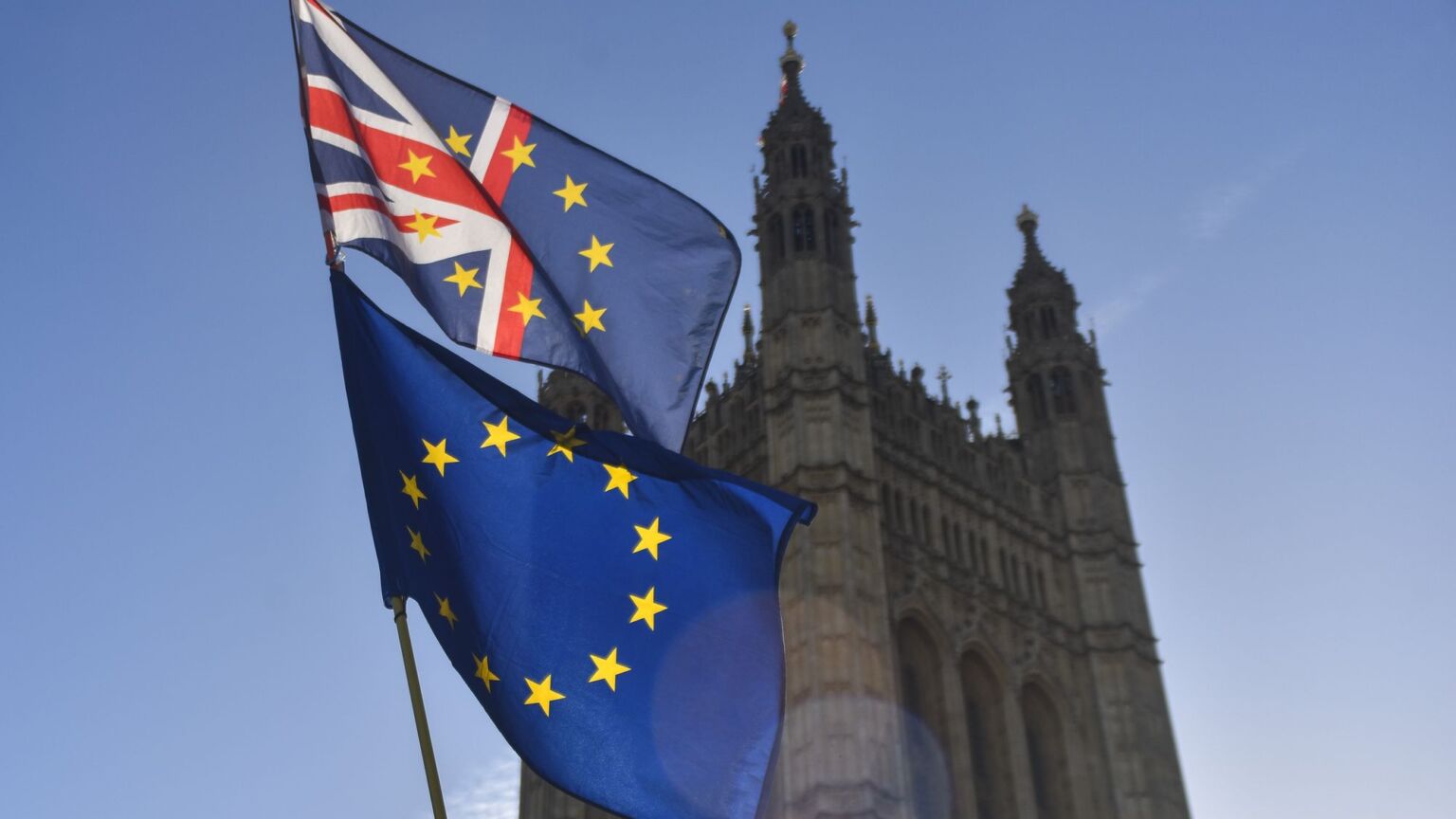
Did anyone really think that UK prime minister Keir Starmer, who spent much of his time in opposition demanding a second referendum on Brexit, had given up on his ambitions to rejoin the EU? The argument is over, he said, during the General Election. All he wants is a closer and more effective relationship between Britain and Brussels, he said. There’s no question of us rejoining the bloc or applying for associate membership of its Single Market or Customs Union, he said.
Anyone who was tempted to believe all this surely felt the scales fall from their eyes in May, when Starmer unveiled his ‘reset’ deal with the EU. Suddenly, the bloc’s gravitational forces were unleashed in all their horror. The deal which Starmer negotiated turned out to involve the European Court of Justice, which will be granted powers to adjudicate on whether Britain is sticking to its side of the ‘reset’ deal – bringing us back under the jurisdiction of a foreign court, and one of the main reasons why people voted to leave in the first place.
Meanwhile, the French have done what the French always do and demanded that Britain pay a subscription fee for the privilege of selling its consumers British goods. So much for ‘free’ trade. Not that it will stop French farmers torching our lambs alive on the autoroute if they feel like it. That is the reality, and always has been, of the Single Market – vested interests will always seek a way to frustrate the free flow of goods.
In December, we even had deputy PM David Lammy, following hot on the heels of chancellor Rachel Reeves, telling us that Brexit has damaged the economy. He even appeared to float the idea that Britain should negotiate a new bespoke customs union with the EU. This came just weeks after Starmer had been proclaiming the advantages of Britain’s trade deal with India and its carveout from US tariffs – neither of which could have happened had we been in an EU customs union.
For Europhiles, 2025 will therefore go down as the year in which Britain’s long march back to EU membership began. Yet while Rejoiners rejoice, there is another reality that has become more stark this year – the extent to which the European Union has fallen behind the rest of the developed world. For all the envious looks Rejoiners cast towards Brussels, and for all the shade they throw at Brexit Britain, life in the EU really is not all they crack it up to be.
Britain, it is true, is economically stagnant. The OECD expects GDP growth in 2025 to be 1.3 per cent. When you take into account population increases that is hardly any sort of growth at all. And you’ve probably heard that Brexit is to blame for these economic struggles. The only trouble with this narrative is that the EU is even more economically stagnant. France’s GDP growth is predicted to come in at 0.7 per cent, Germany at 0.2 per cent and Italy at 0.5 per cent. People point to Spain as a success story, with growth in 2025 at 2.9 per cent. But then Spain is experiencing a dead-cat bounce from years of economic failure.
You’ve probably also heard that Britain is up to its eyeballs in debt – it currently stands at 93.6 per cent of GDP. But Britain is not quite so much in the soup as are Spain (101.8 per cent), France (113 per cent) or Italy (135.3 per cent).
The EU’s political performance is no better. You’ve probably noticed that Labour backbenchers are standing in the way of the UK government doing what will be necessary to prevent a fiscal crisis. Earlier this year, they stamped their feet so hard over a proposed modest £6 billion cut in the £384 billion welfare budget that Starmer gave way and backtracked. But just look at France, where the government falls whenever it proposes that citizens should work a day beyond the age of 62.
You’ve probably also been told that Britain is a national embarrassment for having had a prime minister, namely Liz Truss, who lasted only 49 days. But matters are no more stable in the EU. Just look at France again. In September, prime minister Sebastien Lecornu managed to out-Truss Truss by lasting only 27 days before resigning – although he was then appointed back into the job. His immediate predecessors lasted nine months, three months and eight months.
And just how clean are our respective political systems? You’ve no doubt been told that Boris Johnson’s Covid rule-breaking, Angela Rayner’s stamp-duty shenanigans and Rachel Reeves’s overlooked property-letting licence are evidence that Britain is a bit sleazy. But Johnson, Rayner et al are amateurs in comparison with the behaviour of those working for the sainted EU. Just this month, Federica Mogherini, the EU’s former foreign-policy chief, was arrested as part of an investigation into allegations of multimillion-dollar fraud. This comes against the ongoing Qatar-gate scandal, featuring multiple allegations of bribery involving several former MEPs.
Then there was the farce of the Romanian presidential elections. In 2024, right-wing nationalist and political outsider Calin Georgescu came from nowhere to beat the candidates of Romania’s pro-EU centrist parties. That result was lamented in Brussels and was quickly overturned by the Romanian courts following allegations of Russian interference. Ahead of the re-run this year, Georgescu was set to participate again – and win. So Romania’s election bureau intervened to prohibit his participation. In May this year, the EU finally got its way when the pro-EU mayor of Bucharest, Nicuşor Dan, narrowly beat what was left of the Eurosceptic opposition to become Romania’s president. It looked like a classic case of the EU’s tried-and-trusted election playbook – getting people to keep voting until they deliver the EU’s desired result.

Then there are our respective struggles with energy policy. You are probably aware that Britain is a rustbelt country whose industries are being destroyed by high energy prices driven by Net Zero targets? So it is, but no more so than Germany, whose once mighty car industry has plunged off the carriageway and is heading for a lamppost. Germany now has the highest domestic energy prices in the EU. There, as here, consumers are rebelling against laws which are trying to force them to fit fantastically expensive heat pumps.
The tragedy of Brexit is that, having voted for it, we have never had a government that seems to have any intention of taking advantage of it. And now we have a Labour government seemingly determined to slowly and surreptitiously reverse it. Starmer, Lammy and Co seem to be convinced that the EU is the answer to Britain’s problems. As should be clear by now, it really isn’t.
Ross Clark is author of Far From EUtopia: How Europe is Failing – and Britain Could Do Better.
You’ve hit your monthly free article limit.
Support spiked and get unlimited access.
Support spiked and get unlimited access
spiked is funded by readers like you. Only 0.1% of regular readers currently support us. If just 1% did, we could grow our team and step up the fight for free speech and democracy.
Become a spiked supporter and enjoy unlimited, ad-free access, bonus content and exclusive events – while helping to keep independent journalism alive.
Monthly support makes the biggest difference. Thank you.



Comments
Want to join the conversation?
Only spiked supporters and patrons, who donate regularly to us, can comment on our articles.