The Bondi massacre has shredded Australia’s social fabric
Australia once thought of itself as the most peaceful multicultural nation on Earth. Not anymore.
Want unlimited, ad-free access? Become a spiked supporter.
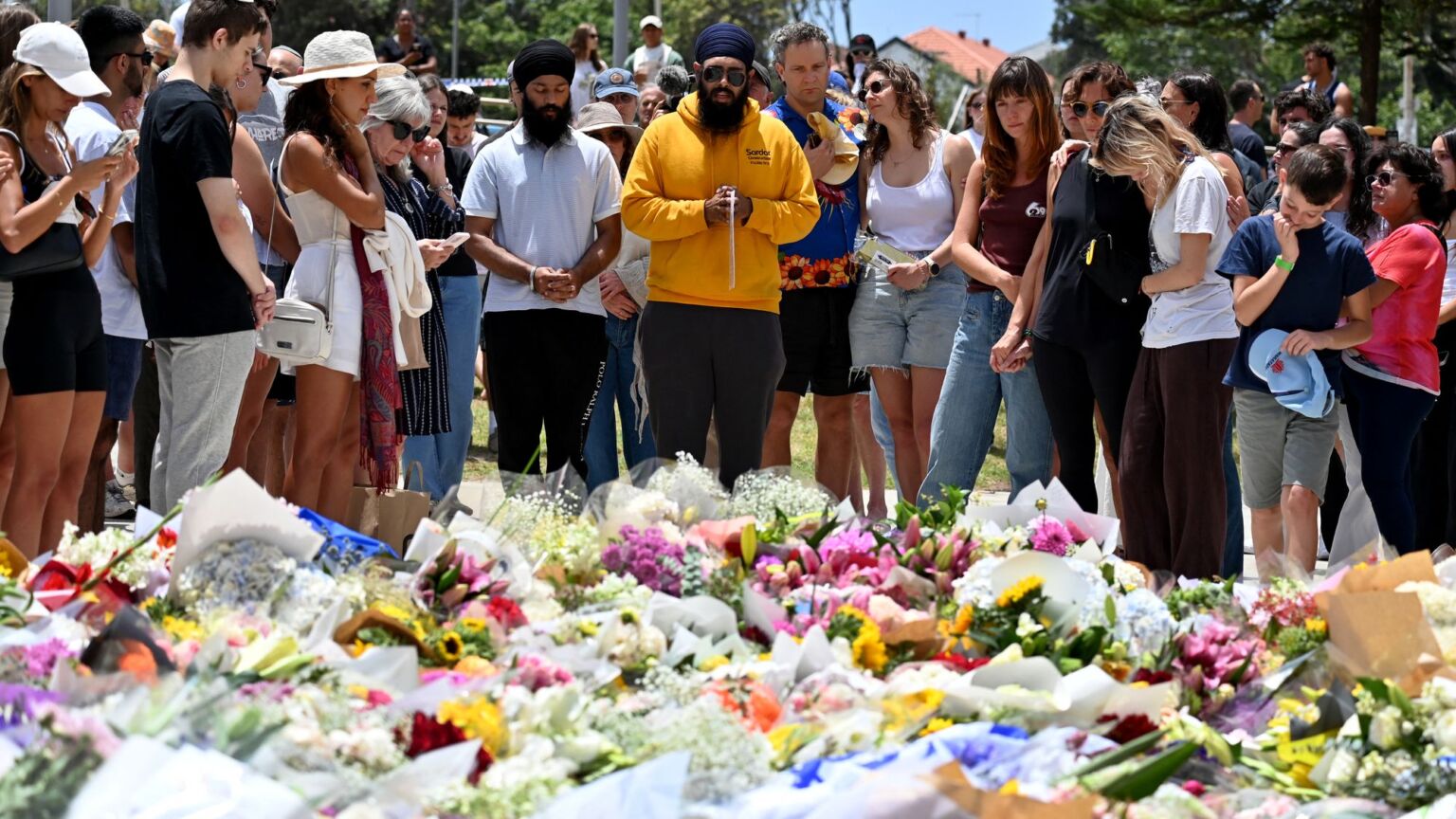
The anti-Semitism that drove Alexander Kleytman to seek sanctity in Australia finally caught up with him. Kleytman fled Ukraine as a child with his mother to escape the unspeakable terror of the Holocaust. They survived sub-zero temperatures and near starvation in Siberia, counting themselves lucky to be alive. Yesterday, at the age of 87, he was killed by a jihadist’s bullet on a warm summer evening at Bondi Beach in front of his grandchildren.
The Bondi massacre, which has claimed at least 15 lives, shattered the peace of a lazy summer Sydney afternoon, together with the notion of Australian exceptionalism, the idea that we are the happiest, most integrated multicultural nation on Earth.
We once hoped that the jihadists might leave us out of their plans for a global caliphate, just as Hitler held back his troops on the borders of Switzerland. Those hopes were destroyed two days after the 7 October 2023 atrocity in Israel, when a large and threatening group of Palestinian protesters marched to the Sydney Opera House, brandishing jihadist flags and chanting ‘Gas the Jews’ and ‘Where’s the Jews?’.
Last Sunday, the anti-Semites found the Jews gathered by the sea to celebrate Hanukkah. The backyard jihadists, father and son, fired at least 40 single-round shots, cold-bloodedly singling out their victims through the sights of their long-barrelled rifles.
Parents instinctively threw their bodies on their children. Kleytman shielded his wife, Laris, also a Holocaust survivor. The youngest victim was a 10-year-old child, pictured smiling on social media.
It was once tempting to imagine that anti-Semitism, like smallpox, might be eradicated in Australia. Such naivety was exposed in the aftermath of 7 October, when an intense hatred of Jews erupted not just among a radical Islamist contingent, but also among their fellow travellers on the progressive left. Since then, almost 4,000 anti-Semitic incidents have been recorded in Australia, an average of five a day.
The anti-Semitic attacks are too frequent and their targets too varied to be solely blamed on jihadists or neo-Nazis, who, though active in Australia, are small in number. There is no common modus operandi. The best assessment is that these are spontaneous expressions of everyday Jew hatred in an atmosphere in which anti-Semitism has become a normalised form of political expression.

Here are just a few examples:
- 1 February 2025: A Melbourne doctor with an ‘identifiably Jewish surname’ checking into a Sydney hotel is grabbed by the arm and scratched by a female staff member who mutters, ‘You’re a fucking Jew’.
- 20 March 2025: A Jewish man is pushed off his bike near a Melbourne synagogue by a man yelling ‘Fucking Jews’, ‘Free Palestine’ and ‘You kikes’.
- 21 August 2025: A pig leg is thrown inside a Kosher business in Waverley, Sydney.
- 9 October 2024: About 20 protesters, most wearing masks, some wearing keffiyehs, broke into and occupied a Jewish physics professor’s office at the University of Melbourne. They chant, ‘Stephen Prawer, you can’t hide. You’re guilty of genocide.’ Prawer leads a joint Israeli / Australian PhD programme exploring how birds navigate.
- 19 December 2024: Post by a Sydney man on X: ‘Let’s go to the [elderly-care] home in [suburb] and bash some Holocaust survivors!’
- 2 December 2025: Sydney Police investigating a six-month anti-Semitic graffiti campaign in the up-market harbourside suburb of Rose Bay arrest a 71-year-old grandmother.
This is the moment to acknowledge that Australia has crossed a threshold into what Hannah Arendt described as the banality of evil. Arendt’s insight was not that evil was committed by monsters, but that many of the perpetrators of Nazi atrocities were disturbingly ordinary people who had surrendered their capacity for moral reflection. Hatred of Jews became routine, enacted by individuals who were socially and institutionally affirmed rather than restrained, and who came to see their actions not as moral choices but as normal, even virtuous, conduct.
The cold-blooded, clinical assassination of men, women and children in Bondi was the worst terrorist incident on Australian soil and ranks among the most evil acts committed on this ancient continent. Yet the perpetrators are distinguished by their banality: a father and son living in a relatively respectable neighbourhood in Western Sydney, where Australian-born residents are a minority.
Locals were shocked when their neighbour’s house was stormed by heavily armed police on Sunday night. It is an area populated largely by migrants who aspire for a better future for their children in a country that has granted them freedom and opportunities. The attack was a brutal assault on that ideal.
Australia’s Labor prime minister, Anthony Albanese, should seize the Bondi massacre as the cue for a reset on his policy towards Israel and his vacillating support for the Jewish population in Australia.

In July last year, Albanese responded to the wave of anti-Semitic attacks by appointing Jillian Segal a special envoy to combat anti-Semitism. Yet he couldn’t leave it there. He announced he would also be appointing a special envoy to combat Islamophobia. Five months ago, Segal issued a report on what she termed the crisis in anti-Semitism. None of its proposals has been acted upon.
Muslims are just 3.2 per cent of the Australian population, yet they live predominantly in electorates in Melbourne and Sydney held by Labor. Muslims make up 10 per cent or more of the electorate in 11 Labor seats. In immigration minister Tony Burke’s seat, a quarter of the voters are Muslim.
That explains Albanese’s strenuous attempts to find two sides in the anti-Semitism debate and straddle somewhere in the imaginary middle. It also explains why he overturned 65 years of bipartisan foreign policy by supporting Palestinian independence at the UN.
Burke has gone further, approving visas for 2,000 Gaza refugees, necessarily admitted to Australia with cursory checks as to their background, since Australia has no diplomatic presence in the territory.
In October, Burke took another gamble with national security by issuing passports to allow the Australian brides of ISIS fighters to return to Australia with their children. Burke first tried to claim that the government had nothing to do with the repatriation, which was facilitated by the charity, Save the Children. Minutes of a meeting with the charity later emerged, proving conclusively that the government had effectively given the deal a wink and a nod.
The anger in Australia is raw, and it extends well beyond the Jewish community. I write this against the backdrop of live coverage on Sky News Australia, where the broadcast’s rhythm shifts between fury and grief. In a country that stands apart as one of only two continents never to have been a battleground for civil war – the other being Antarctica – the shock of this moment runs deep, and its emotional residue will not quickly dissipate.
The location of the attack, on an iconic beach where thousands of Australians were enjoying the beauty and warmth of the Australian summer, emphasised that this was an attack not just on one community, but on the Australian way of life, too.
Albanese lost the trust of the Jewish population long before last Sunday’s attack. In the hours after the shooting, Israeli prime minister Benjamin Netanyahu was scathing. ‘Your government did nothing to stop the spread of anti-Semitism in Australia’, he said.
‘You did nothing to curb the cancer cells that were growing inside your country. You took no action. You let the disease spread, and the result is the horrific attacks on Jews we saw today.’
At moments like this, nations need leadership: prime ministers who can channel justified public anger into a unifying resolve, who recognise an attack on one community as an attack on the civic fabric itself. Australians need to be reminded that we are a civilised, peaceful society precisely because we draw clear moral boundaries – and defend them together when they are tested. That requires a leader willing to articulate the often unstated national compact: that citizenship carries responsibilities as well as rights, and that the most basic of those responsibilities is respect for the equal dignity and safety of fellow citizens, regardless of race or faith.
Anthony Albanese has shown himself unable to meet that test. His response betrays moral hesitation and intellectual thinness, leaving him ill-equipped to rally the country at a moment that calls for clarity and courage. In particular, he appears blind to the distinctive danger posed by anti-Semitism, a hatred whose resilience has long been understood. As the late chief rabbi of the Commonwealth, Jonathan Sacks, warned: ‘Anti-Semitism mutates, and in doing so defeats the immune system set up by cultures to protect themselves against hatred.’
A nation that fails to confront that truth decisively is not merely neglecting one minority – it is weakening the defences of its own civilisation.
Nick Cater is a columnist with the Australian. He publishes Reality Bites on Substack.
£1 a month for 3 months
You’ve hit your monthly free article limit.
Support spiked and get unlimited access.
Support spiked – £1 a month for 3 months
spiked is funded by readers like you. Only 0.1% of regular readers currently support us. If just 1% did, we could grow our team and step up the fight for free speech and democracy.
Become a spiked supporter and enjoy unlimited, ad-free access, bonus content and exclusive events – while helping to keep independent journalism alive.
———————————————————————————————————————————–
Exclusive January offer: join today for £1 a month for 3 months. Then £5 a month, cancel anytime.
———————————————————————————————————————————–
Monthly support makes the biggest difference. Thank you.

Comments
Want to join the conversation?
Only spiked supporters and patrons, who donate regularly to us, can comment on our articles.