The Herzog Park scandal taps into a deep well of anti-Semitism
Ireland’s loathing for British colonialism has morphed into an irrational hatred of post-colonial Israel.
Want unlimited, ad-free access? Become a spiked supporter.
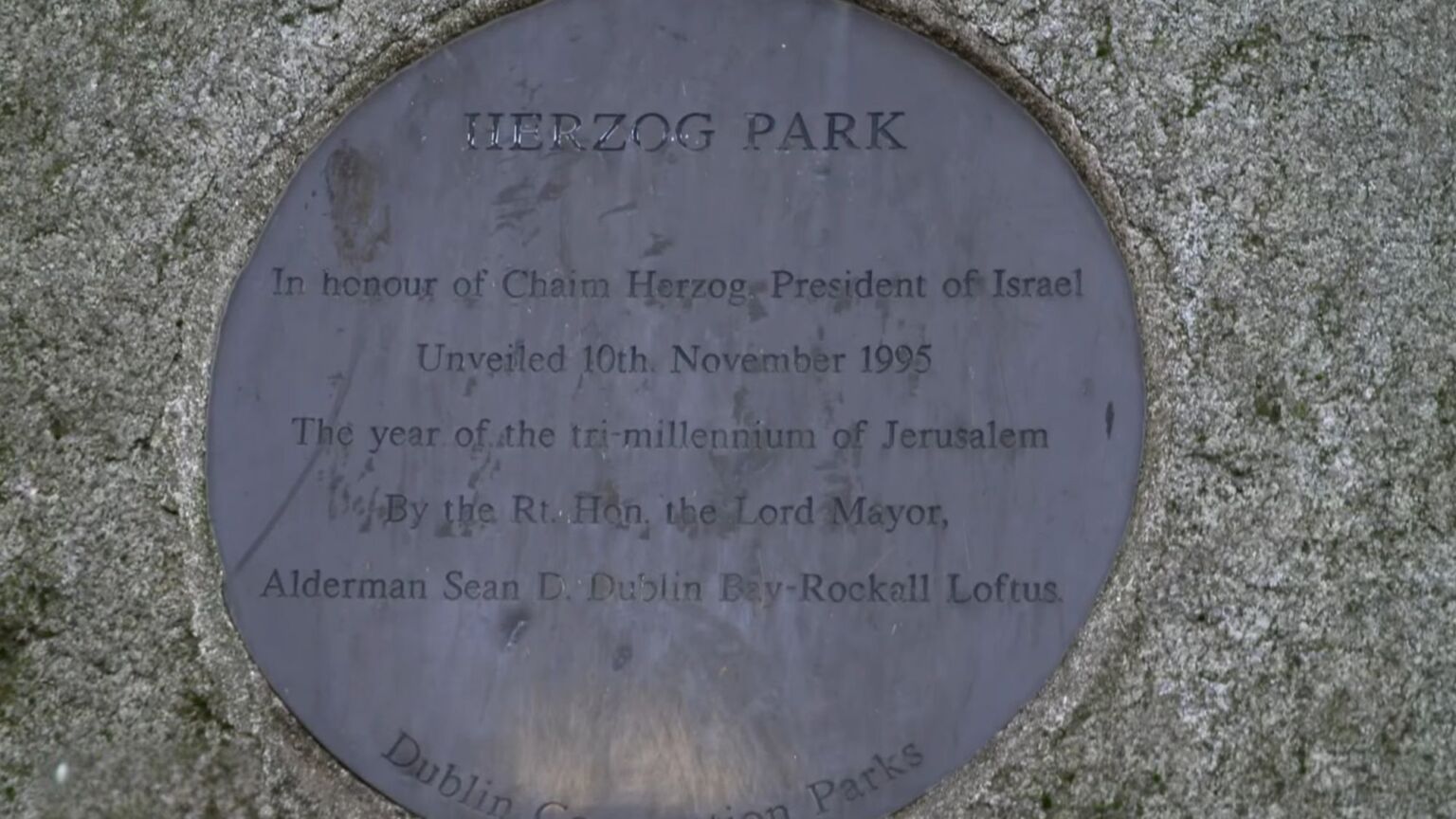
Why does Ireland have such a problem with the Jews? In the light of recent attempts to rename Herzog Park in Dublin, which honours Chaim Herzog, the sixth president of Israel, who was born in Belfast and grew up in Dublin, this question bears consideration.
In the end, the move proved too much. At the beginning of the week, Dublin City Council, under mounting political pressure, backed down. Even the taoiseach, Micheál Martin, described it as ‘overtly divisive and wrong’ and something that ‘will without any doubt be seen as anti-Semitic’. Who’d have thought?
Nonetheless, the episode was another indication of Ireland’s Israelophobia, which flows from its deep-seated hatred of ‘colonialism’, born from its own experience of domination by the British.
Of course, Israel is not a colonial state, but a post-colonial one. It was created by indigenous Jews who ejected imperial Britain from Palestine. These Jews had no mother country other than the one for which they were fighting and they were in control of no empire.
Initially, Herzog – whose son, Isaac, serves as Israel’s current president – would have been venerated by Irish republicans. After emigrating to Palestine in 1935, he joined the Haganah, a paramilitary organisation resisting British rule. This Jewish insurgency was viewed with favour on the Emerald Isle, as it was taken as a struggle for self-determination against the colonisers. There were even celebrations in Dublin when, in 1946, the Jewish underground militia retaliated to humiliating floggings by meting out the same punishment to British officers.
‘We received congratulations from Irishmen’, Israeli leader Menachem Begin recalled in his memoirs. ‘They had witnessed an episode which restored their dignity and self-respect.’
Herzog, however, fell out of favour. In 1942, he enlisted to serve as an intelligence officer in the British Army, joining other courageous Irishmen who abandoned their country’s neutrality to fight Hitler. To Herzog, as to many other Jews, Nazi Germany was the greatest foe.
Such are the complexities of Irish national identity. When the British are your principal enemy, everyone who stands against them looks like an ally. Even, in some cases, Adolf Hitler.
It’s not just Ireland. With the notable exception of Germany, many countries that flirted with the Führer in the 1940s – often because of his enmity towards Britain – tend to harbour a particular hatred of Israel, now a Western ally, today. This is certainly true of great swathes of the Arab world, which, after being steadily dominated by Britain and France in the lead-up to the Second World War, threw in their lot with the Führer when he rose to power.
‘We were racists, admiring Nazism, reading its books’, the Syrian Ba’athist politician Sami al-Jundi recalled in his autobiography. ‘We were the first to think of translating Mein Kampf… Whoever lived during this period in Damascus would appreciate the inclination of the Arab people to Nazism, for Nazism was the power which could serve as its champion, and he who is defeated will by nature love the victor.’
So it was that the Syrians joined the Egyptians, Jordanians, Lebanese and others in attacking Israel repeatedly, both immediately after its establishment in 1948 and at intervals thereafter. To this day, opinion polls in these countries show eyewatering levels of Israelophobia.
Although officially neutral, Ireland covered itself in ignominy during the Second World War, particularly when its president, Éamon de Valera, notoriously offered his condolences to Germany after Hitler’s suicide. Charles Bewley, the Irish envoy to Germany in the 1930s, was a well-known anti-Semite. He expended great efforts ingratiating himself with the Nazi regime, minimised its ill treatment of the Jews and even praised Hitler as representing the ‘national rebirth of Germany’.
Other Irish officials, such as the Secretary of the Department of External Affairs, Joseph P Walshe, were also early supporters of Nazism. This sympathy was particularly evident in Republican circles, where revolutionaries saw Germany as a bulwark against British influence and a prospective ally in their struggle for independence.
It is in this context that Ireland’s reputation as the most Israelophobic country in Europe should be viewed. Indeed, last year, Israel closed its embassy there after Dublin supported South Africa’s dubious legal action against the Jewish State at the International Court of Justice and unilaterally recognised a Palestinian state.
On Holocaust Memorial Day in January, the hard-left Irish president, Michael Higgins, who has since stepped down, caused outrage when he brought the Gaza war into a speech at a ceremony of remembrance for the dead of the Shoah. Higgins had been requested not to attend the event – pleas he ignored. As he spoke, several Jewish members of the audience stood up and silently turned their backs. They were then violently dragged out by security.
One of the burdens of being Jewish in 2025 is that of being a cipher in somebody else’s politics. Wherever you turn, somebody hates you – not because of your personhood, but because of what you represent in their political self-fashioning.
The Irish elites have no more interest in learning the names of the ‘river’ and the ‘sea’ than any of the other cretins who take to the streets of London or New York dressed in keffiyehs and crop tops. They have no interest in the Holocaust aside from appropriating it as a metaphor to suit their own political ends. Their loathing of Israel is really a sublimation of their loathing of the British, upon which so much of their identity is still built.
Jake Wallis Simons is author of Never Again? How the West Betrayed the Jews and Itself.
You’ve hit your monthly free article limit.
Support spiked and get unlimited access.
Support spiked and get unlimited access
spiked is funded by readers like you. Only 0.1% of regular readers currently support us. If just 1% did, we could grow our team and step up the fight for free speech and democracy.
Become a spiked supporter and enjoy unlimited, ad-free access, bonus content and exclusive events – while helping to keep independent journalism alive.
Monthly support makes the biggest difference. Thank you.
Comments
Want to join the conversation?
Only spiked supporters and patrons, who donate regularly to us, can comment on our articles.