Why was a Christian street preacher arrested for saying ‘We love the Jews’?
The British state's war on so-called hate speech is totally demented.
Want unlimited, ad-free access? Become a spiked supporter.
The rallying cry for those who are alarmed by the police arresting thousands of Britons for social-media posts has long been, ‘Police our streets, not our tweets’. But the way officers have been policing our streets recently is proving equally as authoritarian.
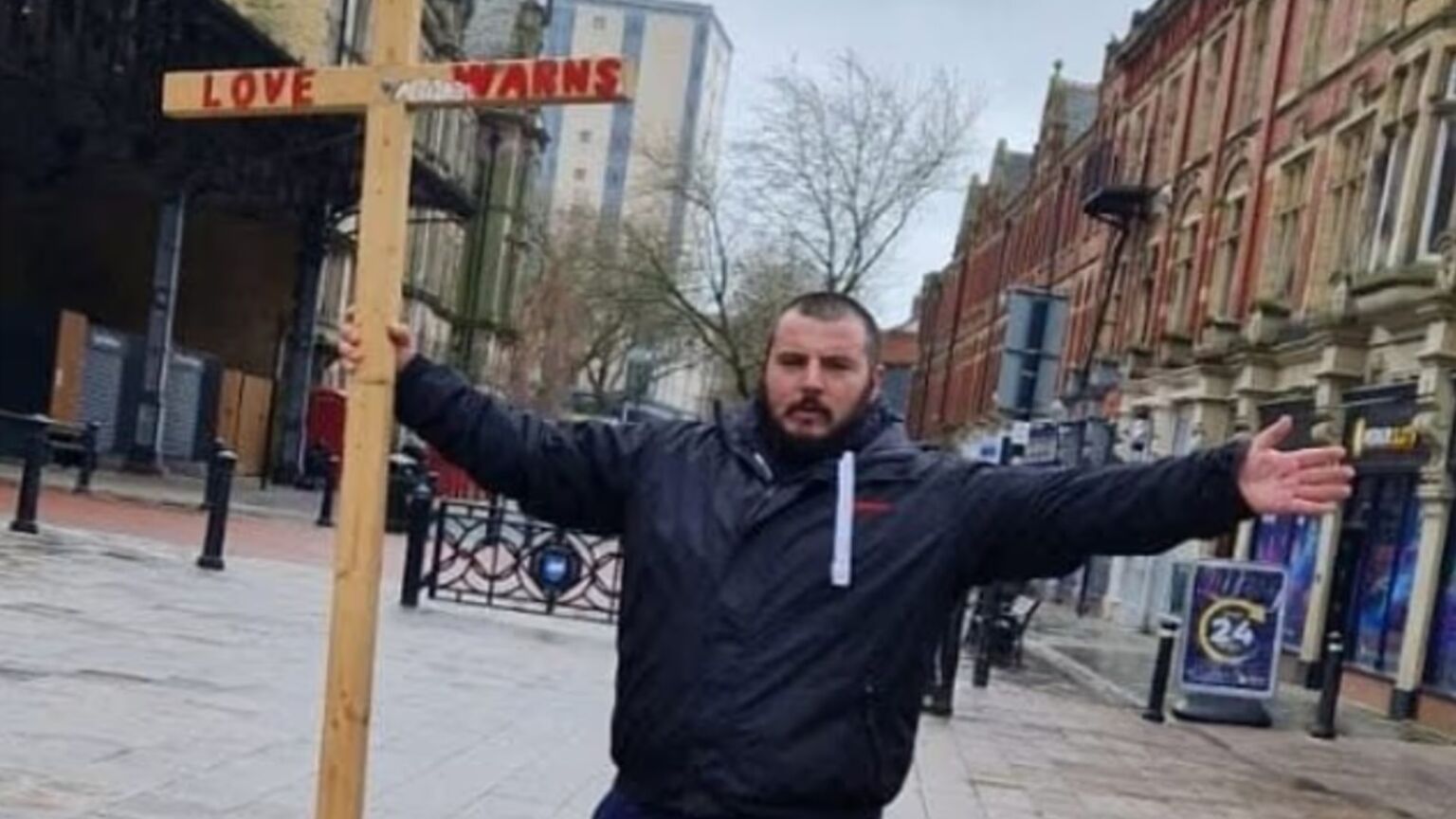
We had an example of this at Swindon Crown Court last Monday, when Christian street preacher Shaun O’Sullivan was acquitted of religiously aggravated intentional harassment. His crime? Allegedly saying, ‘We love the Jews’, ‘Jew haters’ and ‘Palestine lovers’ to a Muslim family in Swindon town centre in September last year.
The family said they felt ‘targeted’ because they were wearing hijabs. During their 999 call, the complainant told the operator: ‘We just felt very unsafe… calling us Jew haters, Palestine lovers.’ On the recording you then hear the officer on the other end of the line, apparently speaking to someone else in the room, say: ‘No, I’ll put a hate claim on.’ In policing jargon, that means flagging the report as a ‘hate’ incident there and then. And once that label is attached, the whole case is channelled through the state’s hate-crime machinery, ultimately transforming a few seconds of preaching into a charge. In O’Sullivan’s case, the charge – religiously aggravated harassment – carried a maximum penalty of six months in prison.
Before a judge and an impartial jury, the weaknesses in the prosecution case quickly became clear. There was no audio or video recording of the alleged remarks. CCTV showed the family passing O’Sullivan in seconds with no confrontation – in other words, there was no objective evidence of harassment. As for the family’s testimony, the complainant admitted under cross-examination that she hadn’t heard the full message and that her recollection had been shaped by her strong views on Gaza. What had really bothered her, she conceded, was simply that O’Sullivan ‘spoke directly to us’.
The defence argued, rightly, that whatever was said formed part of a broader theological and political message addressed to the public at large. O’Sullivan’s comments did not amount to a targeted campaign of abuse. To prosecute such speech, they said, was to criminalise participation in public debate, and to collide head-on with freedom of thought and expression. Given all that, O’Sullivan’s acquittal was hardly a surprise.
Of course, none of this should ever have needed a six-day Crown Court trial. Effectively, O’Sullivan was charged because someone claims to have had their feelings hurt. This is a breathtaking waste of money (it cost £20,000) and time, as well as being a flagrant attack on free speech.
Despite O’Sullivan’s acquittal, a deeper problem remains: the sheer scope of the offence category itself. A law written for serious, malicious harassment is now being stretched to cover a fleeting moment of street preaching. Of the alleged words uttered by O’Sullivan, ‘We love the Jews’ is, on any view, an expression of opinion. The others – ‘Jew haters’ and ‘Palestine lovers’ – may well be provocative when directed at Muslims, but they still sit at the mild end of the spectrum of invective hurled across Britain’s streets over the past two years. Jewish individuals, for instance, have endured targeted chants of ‘Zionist pigs’, ‘fascist Zionist scum’, ‘Nazi’ and ‘war criminal’ – none of which resulted in arrests or public-order prosecutions.

The point of this whataboutery is not to argue that those expressions should be criminalised too, but that none of them should be. Hate will always be in the eye of the beholder, shaped by his or her various prejudices.
So from now on, let’s stop saying ‘police our streets, not our tweets’. A far better, though admittedly less catchy, rule would surely be: police crimes, not feelings.
Freddie Attenborough is the communications officer for the Committee for Academic Freedom.
You’ve hit your monthly free article limit.
Support spiked and get unlimited access.
Support spiked and get unlimited access
spiked is funded by readers like you. Only 0.1% of regular readers currently support us. If just 1% did, we could grow our team and step up the fight for free speech and democracy.
Become a spiked supporter and enjoy unlimited, ad-free access, bonus content and exclusive events – while helping to keep independent journalism alive.
Monthly support makes the biggest difference. Thank you.





Comments
Want to join the conversation?
Only spiked supporters and patrons, who donate regularly to us, can comment on our articles.