Why this corruption scandal is a disaster for Zelensky
The Ukrainian president has lost most of his top team – and could soon lose the trust of his European backers.
Want unlimited, ad-free access? Become a spiked supporter.
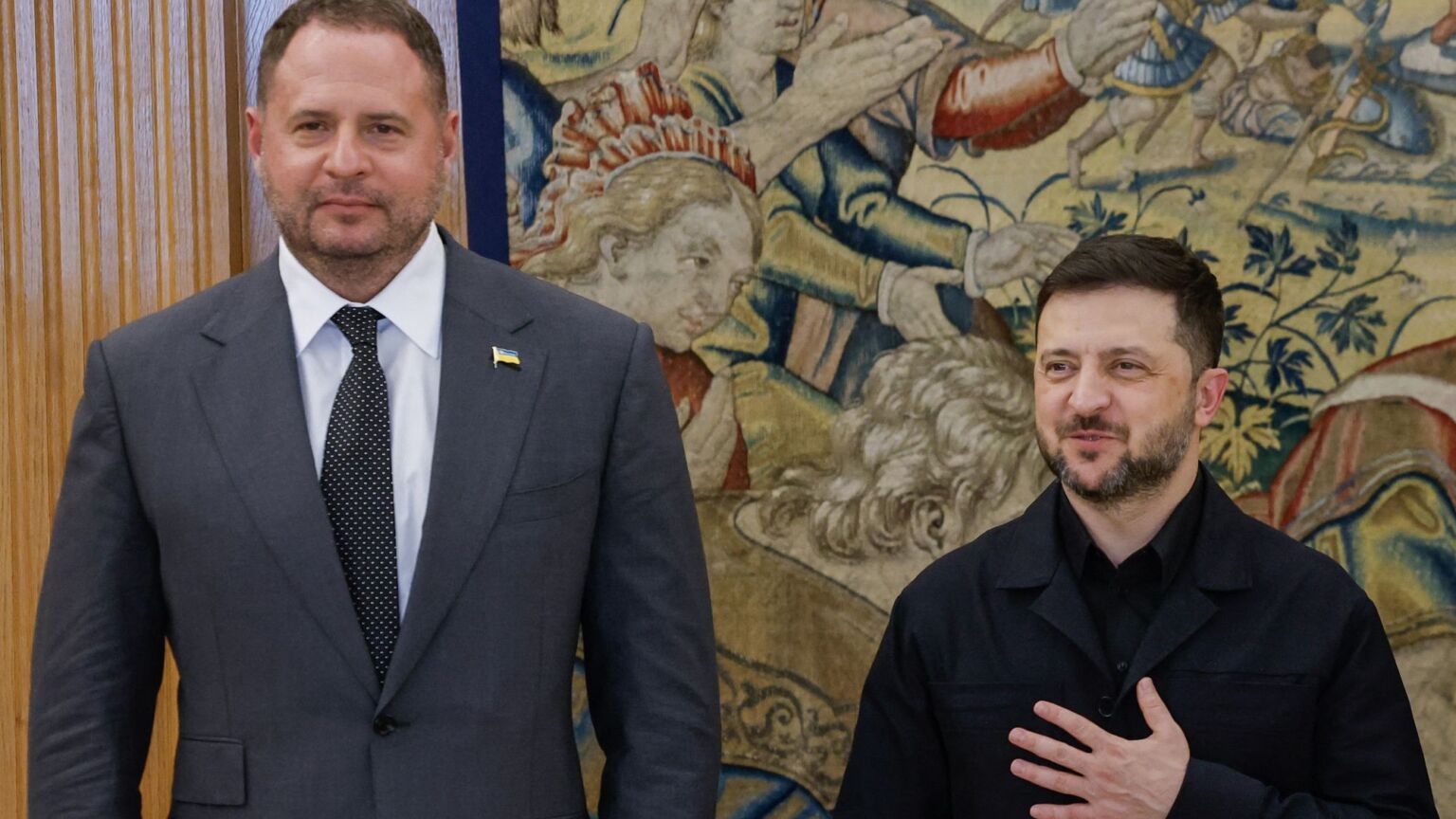
Volodymyr Zelensky cuts almost as lonely a figure today as he did on the first day after the Russian invasion nearly four years ago, when he vowed not to leave the country, but to fight. But there is a big difference. Then, Ukrainians rallied to the cause, rushing to join combat units, showing enormous resilience and social solidarity. Now, Russia’s military advance in the east is accelerating, Ukrainians are deserting or avoiding mobilisation and a big corruption scandal has deprived Zelensky of his hitherto most loyal lieutenants.
The latest to depart was also the most significant and potentially debilitating to Zelensky. At the end of last week, his long-standing chief of staff and recently appointed chief war negotiator, Andriy Yermak, a big character in every possible way, resigned – or was pushed. This came after his Kyiv residence was searched by police, apparently in connection with a still unfolding energy-corruption scandal. Yermak, loudly protesting his innocence, was gone before any findings were disclosed. In a neat touch, intended perhaps to limit the political damage to Zelensky, and certainly to himself, he said he would be joining up and leaving for the war front.
Ukrainian public opinion had been unfavourable towards Yermak for a while, and personal enemies had been aiming to bring him down. There had been a growing feeling that he had become too big for his boots and exerted too much influence, practically to the point of being the ‘real’ president. As a result, few have mourned his departure, with some cynics noting that there are war fronts and war fronts, with some more comfortable and further from Russian fire than others. Where Yermak turns up next remains to be seen.
But Yermak’s departure was significant not only because of his closeness to Zelensky and his recent key role in negotiations with Europe and Ukraine. He could also be described as pretty much the last member of Zelensky’s close team standing, following the revelations last month about several senior officials and presidential associates creaming off as much as $100million from contracts with Ukraine’s state nuclear-power company, Energoatom.
One of the first and most significant to depart – just before news of the scandal broke, it is said – was Timur Mindich. Zelensky’s business partner from when he was an entertainment entrepreneur, whose behind-the-scenes influence in commercial deal-making had reportedly grown since Zelensky became president in 2019. He is said to have fled via the United States to Israel. Other prominent figures to have resigned or been dismissed include the energy and justice ministers – who declared their innocence – and a deputy minister. Five people are reported to be under arrest as a result of the corruption investigation.
The defence minister and security adviser, Rustem Umerov, was also mentioned at one point, with rumours swirling to the effect that he had fled to the United States, where his family lives. It then turned out that he had actually been engaged in secret negotiations with US officials. He was swiftly named Ukraine’s chief negotiator following Yermak’s removal.
These troubles at home could not have come at a worse juncture for Zelensky. With Donald Trump pushing new peace initiatives, the pace of negotiations has been speeding up almost by the day. The Europeans, anticipating the possible end of US support for Ukraine, have been scrambling to put together the money to finance Ukraine’s economy and military into next year.

The most obvious and immediate harm from the corruption scandal – so sensitive as to have gone largely unmentioned in public by European officials – is to those same European financial and diplomatic efforts. Why would or should European taxpayers underwrite more spending for Ukraine if a proportion of it vanishes into already well-padded pockets?
Such a big corruption scandal additionally threatens Ukraine’s efforts to be fast-tracked into the European Union. And the fact that the scandal has been exposed in Ukraine’s long-tainted energy sector only reinforces popular resentment among Ukrainians, especially in Kyiv – there they are suffering extensive power cuts, almost daily, as a result of Russian air-raids on energy infrastructure.
At such a time, it is inevitable that speculation about connections and ulterior motives goes into overdrive. One theory is that the United States timed the exposure of the corruption scandal to gain leverage or weaken Zelensky as it prepared to launch a new peace plan that gives Russia a lot of what it wants. Against this, US funding for Ukraine’s independent anti-corruption bureau, Nabu, and the Specialised Anti-Corruption Prosecutor’s Office is said to have ended with Trump’s closure of USAid, with funding since provided by the EU.
Another theory is that a failed move by Zelensky back in July to curb the independence of Nabu, which prompted the first popular protests to erupt since the 2022 Russian invasion, was intended to pre-empt the very exposé that has now cut a swathe through his administration.

Whatever the merits of any of these theories, it has also to be said that Zelensky still commands sufficient authority, in the echelons of power, if not in the country at large. This allowed him to deal with the fallout about as deftly as was possible. Yermak has gone to the war front, and Umerov has quickly been moved up to replace him.
This has not prevented some of those tipped to be angling for Ukraine’s top job piping up from the sidelines in recent days. One of these, Zelensky’s former military chief, Valerii Zaluzhnyi, wrote in the Telegraph about the prospects for a positive new start in Ukraine after the war. Others include the former president, Petro Poroshenko, beaten by Zelensky in the 2019 presidential election, and former boxer Vitali Klitschko, the popular mayor of Kyiv. For the time being, though, Zelensky remains in charge, and Umerov, as a defence and security official, may in fact be better suited to negotiating, at least with the US, than was Yermak.
A former military man and US army secretary, Daniel Driscoll, was recently in Kyiv, attending the hastily arranged US-Ukraine-European talks in Geneva last week. He is now the US chief negotiator and may also accompany Trump’s special envoy, Steve Witkoff, to Moscow this week for further talks with Russia. Witkoff will presumably be equipped with whatever came out of what US secretary of state, Marco Rubio, called difficult, but productive, talks with Ukraine’s negotiating team in Miami this past weekend.
If, as it would appear, military professionals are now playing a bigger role in the talks, this could be a sign that the state of the battlefield is looming larger in considerations on all sides. An end to the conflict could just have been brought a little bit closer.
Mary Dejevsky is a writer and broadcaster. She was Moscow correspondent for The Times between 1988 and 1992. She has also been a correspondent from Paris, Washington and China.
You’ve hit your monthly free article limit.
Support spiked and get unlimited access.
Support spiked and get unlimited access
spiked is funded by readers like you. Only 0.1% of regular readers currently support us. If just 1% did, we could grow our team and step up the fight for free speech and democracy.
Become a spiked supporter and enjoy unlimited, ad-free access, bonus content and exclusive events – while helping to keep independent journalism alive.
Monthly support makes the biggest difference. Thank you.
Comments
Want to join the conversation?
Only spiked supporters and patrons, who donate regularly to us, can comment on our articles.