Do Europe’s populists have a Trump problem?
Giorgia Meloni’s brief spat with The Donald has only boosted her standing among Italians.
Want unlimited, ad-free access? Become a spiked supporter.
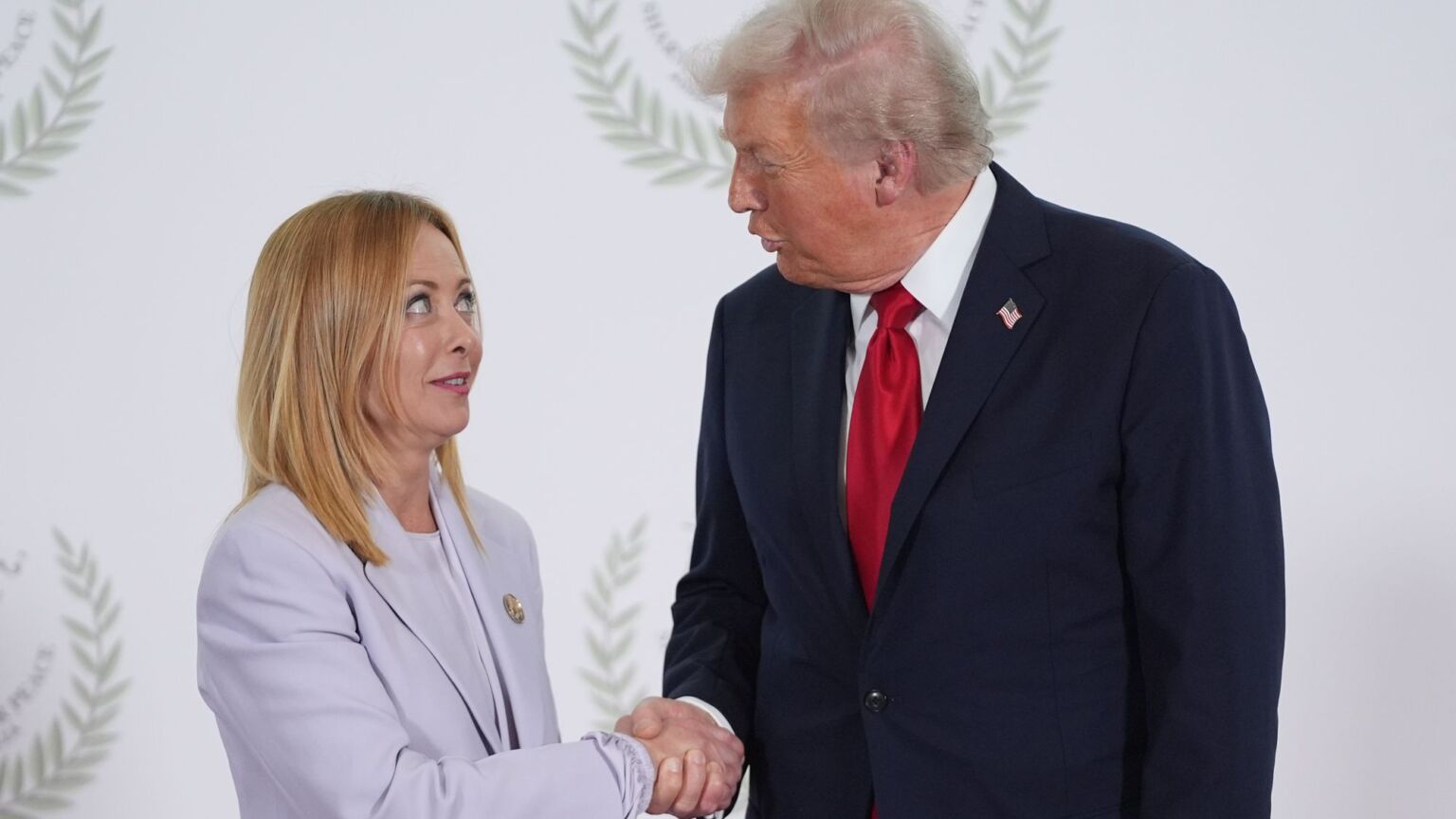
It seems incredible that what could be described as a ‘he said / she said’ between US president Donald Trump and Italian prime minister Giorgia Meloni has become an international incident. In the aftermath of Trump claiming Meloni ‘begged’ him for a photo at last week’s G7 summit in France (a claim categorically denied by the Italian PM), Italian foreign minister Antonio Tajani cancelled his scheduled meeting with US counterpart Marco Rubio next month. The rhetoric between the two countries has only escalated since, with Trump accusing Italy of being an ungrateful ally.
The war of words between these once closely allied leaders stems from Meloni’s refusal in March to allow the Americans to use Italy’s air bases in Sicily, from which they could launch attacks over Iran. This refusal is a first in the history of the postwar alliance between the two countries. Indeed, the Italians had no issue in the 1990s allowing the US Air Force to use its bases from which to launch attacks against Serbia during the Balkans conflict.
Modern Italy has long had an undercurrent of anti-Americanism. Mostly, it comes from the left, although some on the right have had reservations with the US since the Iraq War. The Italian left has also, like its Anglo-Saxon counterparts, expressed solidarity with the ‘Free Palestine’ cause – in which animosity towards America goes hand-in-hand with Israelophobia.
A spat with Trump – who is highly unpopular in Italy – might be a blessing in disguise for Meloni. Since her election in 2022, she has run a pragmatic government based on classic centre-right principles: fiscal prudence, tough on illegal immigration, anti-woke. On her watch, Italy’s export earnings have improved significantly and unemployment has fallen.
However, this year, Meloni has faced some serious political challenges. At around the same time as the veto on the Sicilian air bases, her government was campaigning for a referendum to reform the judiciary, which failed. While it would have been a sensible and long-overdue reform (Italy’s judges have long cleaved to the left and have frustrated the policies of elected governments), this was seen by many as a distraction from pressing economic issues. Despite Meloni’s successes, many Italians still believe not enough has been done by the government to ease cost-of-living pressures – exacerbated by the Iran War, given Italy imports nearly all of its oil. Several commentators saw Meloni’s air-bases veto as a way of galvanising support.
Right now, she needs it. Many on the right in Italy have been disappointed by Meloni’s record. Some have lamented what has come to be termed ‘Melonisation’ – that is, campaigning as a right populist in opposition, while governing closer to the centre. Most notably, despite her past criticism of EU diktats, she has become close to the president of the European Commission, arch-technocrat Ursula von der Leyen.
Meloni is now facing a serious challenge from the right. Roberto Vannacci, a former special forces commander, split from the Lega Nord (Northern League), one of the coalition partners to Meloni’s Brothers of Italy. Vannacci has lured four MPs away from his former party and Meloni’s other coalition partner, Forza Italia, doubling his number of MPs to eight.
Vannacci’s new party, Futuro Nazionale (National Future), is capitalising on the right’s disappointment, particularly on immigration, arguing that Meloni’s coalition has become too mainstream and too pliant towards Brussels, selling out Italy’s national interest. While Meloni has cut illegal immigration (indeed, the European Parliament recently approved an offshore-processing model for illegal immigrants long championed by her), legal immigration levels are still high. Vannacci has argued for ‘remigration’ – that is, deporting even legal migrants, including those born in Italy – and for capping legal immigration at four per cent of the population.
The new party is polling at six per cent, higher than the Northern League, with fears it will split the vote on the right and hand power to the left opposition. We’ll know for sure in September next year, when Italians head to the polls.
Amid these woes, the feud with Trump has turned Meloni into something of a symbol of resistance. This week, she met members of the Alpini, the elite forces regiment of the Italian army, who showered her with praise. ‘Brava Giorgia’, ‘Don’t give in, keep strong’ and ‘Keep it up’, cheered the crowd. Meloni was visibly moved by what she termed a ‘much-needed display of patriotism’.
And so, as nonsensical as the war of words with Trump may seem, it actually comes at the best possible time for the Italian PM. It has solidified support from her governing coalition-party allies and has boosted her standing among Italians. Meloni is the clear victor here.
Rocco Loiacono legal academic, writer and translator based in Perth, Australia.
You’ve hit your monthly free article limit.
Support spiked and get unlimited access.
Support spiked and get unlimited access
spiked is funded by readers like you. Only 0.1% of regular readers currently support us. If just 1% did, we could grow our team and step up the fight for free speech and democracy.
Become a spiked supporter and enjoy unlimited, ad-free access, bonus content and exclusive events – while helping to keep independent journalism alive.
Monthly support makes the biggest difference. Thank you.


Comments
Want to join the conversation?
Only spiked supporters and patrons, who donate regularly to us, can comment on our articles.