There is nothing inevitable about the north’s decline
Deindustrialisation is a political choice. It can and must be reversed.
Want unlimited, ad-free access? Become a spiked supporter.
In some boroughs of Lancashire, it is said that when a southerner next turns their attention to the economic fortunes of the north, then the Gates of Heaven shall open, and the end times will spill out upon all the world above Solihull. If I were a young man or young woman from the north, and I wanted to bet my deliverance from the apocalypse on something, betting it on Whitehall not caring about my hometown would look pretty sound to me.
Then again, looking around, I could be forgiven for thinking the apocalypse had already arrived. Because if I’m young and I live in Doncaster, if I should land a minimum-wage job, I’ll already be making 82 per cent of my region’s median salary. That means the wage gap between me, fresh in the door, and the grafter with 15 years of experience comes down to a few pence an hour. I, at the outset of my career, have almost peaked. At the bottom.
If I’m in Sunderland, the minimum wage is 80 per cent of the median. Wigan, a fraction of a per cent above that, maybe. And if I were from Burnley, Huddersfield or Middlesbrough, the Centre for Cities Outlook 2025 would tell me I lived in one of the lowest-paid towns in the country, where the average annual salary now sits about £20,000 below London’s. If I were from the north-east more broadly, my median weekly pay would be approximately £200 below the London median. If I were from Middlesbrough specifically, roughly 30 per cent of my working-age neighbours would be NEET (not in education, employment or training), and the closure of the SSI steelworks at Redcar in 2015 would still be the local economic event most likely to come up in conversation.
None of these numbers is news to anyone who lives in any of these places. They were the entire point of the Tory canard of ‘Levelling Up’, which must seem like the cruellest punchline yet of a very long joke in these places, a joke that just gets sadder every time.
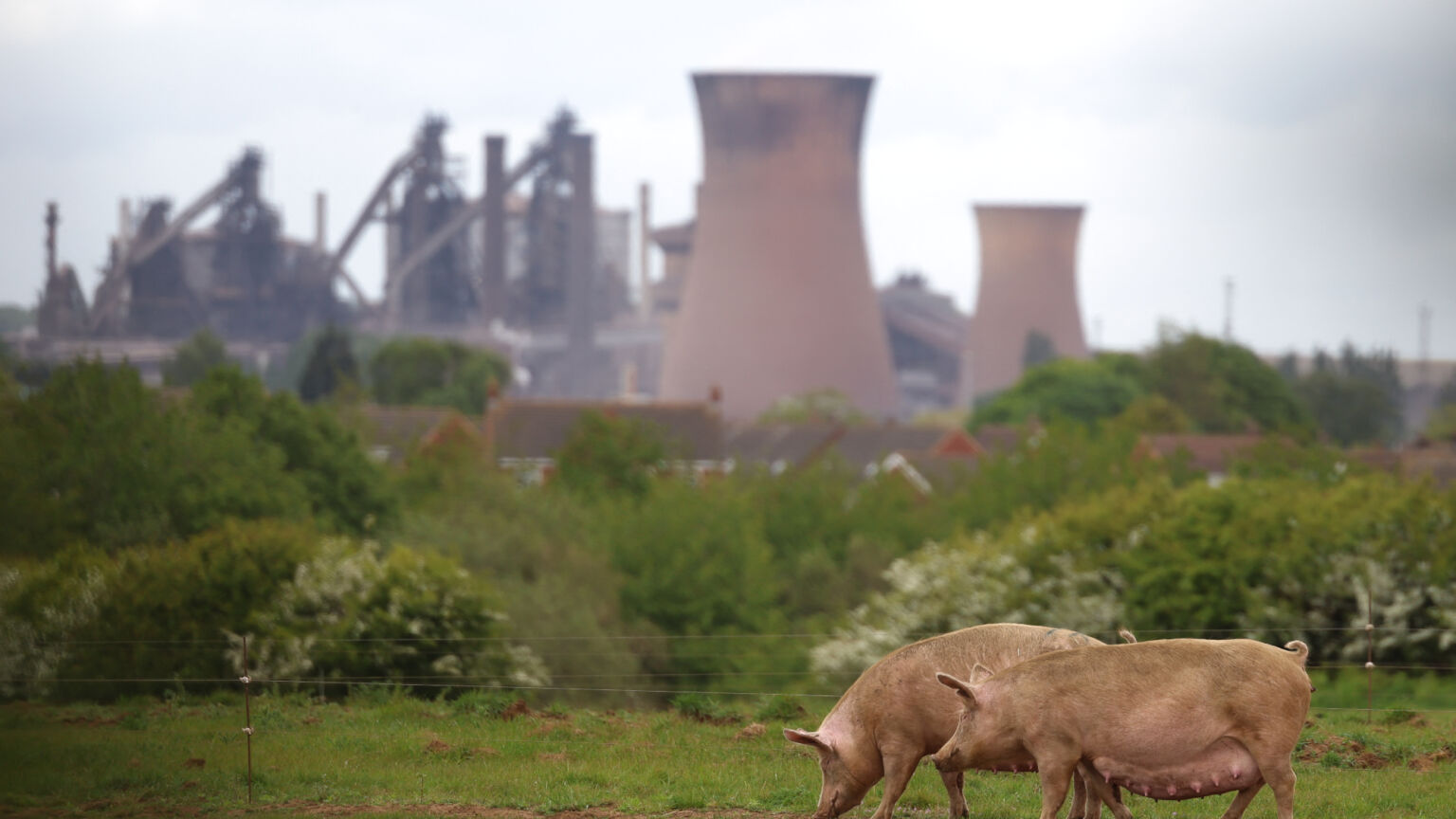
It’s not difficult to see how it got this way. All these towns lost their industries in two recessions, and by deliberate policy – namely, the pursuit of Net Zero, and the consequent green deindustrialisation of Britain. More than six million manufacturing jobs have disappeared since the mid-1960s. The coal industry declined from 240,000 workers in 1981 to 6,000 by 2011. British Steel has shrunk from 268,000 employees in the 1960s to its present rump of 3,500. Ravenscraig, the last Scottish steelworks, closed in 1992. What grew in the gaps was logistics, care work and retail – sectors that pay at or near the legal minimum.
And then, of course, there is the almighty wage depressant of unchecked migration, that miracle phenomenon which puts downward pressure on wages below the 20th percentile of wage distribution.
The economic demise of the north has become a multi-generational fact of life. But facts of life can have solutions.
What is needed is what has been in absence since the start: profound economic imagination and industrial will. The north of Britain has not been Chernobylised. There is no reason why industry cannot still flourish there. South Korea, Singapore and Bavaria each took a region that had been written off and rebuilt it within a generation. The recipe was the same in each: special economic zoning anchored on specific sectors, technical colleges training for the industries in those zones, and a state willing to back the result against a financialised economy’s preference for distribution warehouses.

Nor is there any greater method of investment in youth than this. Sod youth clubs, I want a million apprentices trained a year across hundreds of recognised occupations, with two-thirds offered jobs by the firms that trained them. The Germans can do it. We have a history of equalling them, don’t we? And with it all must also come a permanent reduction in low-skilled migration, so the labour market tightens and wages rise on their own, without an act of parliament every April to raise the wage floor.
Of course, Whitehall comes into this again not merely because its industrial strategy is dead on arrival, but because what were once both the engine of our industry and the wellspring of our skills base were public works. In the 1960s, public-works investment and entitlements were an equal share of GDP. Now, we spend £10 on entitlements for every one pound we spend on infrastructure. Our decline is etched into these figures. It can be revised out again.
That’s how The North Gets Its Own Back – the industries, the wages, and the right of a young person in Burnley or Doncaster to make a living where they come from. Neither the vision nor its fulfilment will come from the players currently on the board. But it is not written in any book that the immiseration of all those above the Watford Gap must be permanent. Those who want to work for Britain’s revival should look north first.
Maxi Gorynski is an engineer and founder of Progress, an organisation dedicated to a brighter future for Britain. He also maintains Heir to the Thought on Substack.

You’ve hit your monthly free article limit.
Support spiked and get unlimited access.
Support spiked and get unlimited access
spiked is funded by readers like you. Only 0.1% of regular readers currently support us. If just 1% did, we could grow our team and step up the fight for free speech and democracy.
Become a spiked supporter and enjoy unlimited, ad-free access, bonus content and exclusive events – while helping to keep independent journalism alive.
Monthly support makes the biggest difference. Thank you.




Comments
Want to join the conversation?
Only spiked supporters and patrons, who donate regularly to us, can comment on our articles.