Something is rotten in the state of Spain
The corruption charges against Pedro Sánchez’s wife are merely the tip of the iceberg.
Want unlimited, ad-free access? Become a spiked supporter.
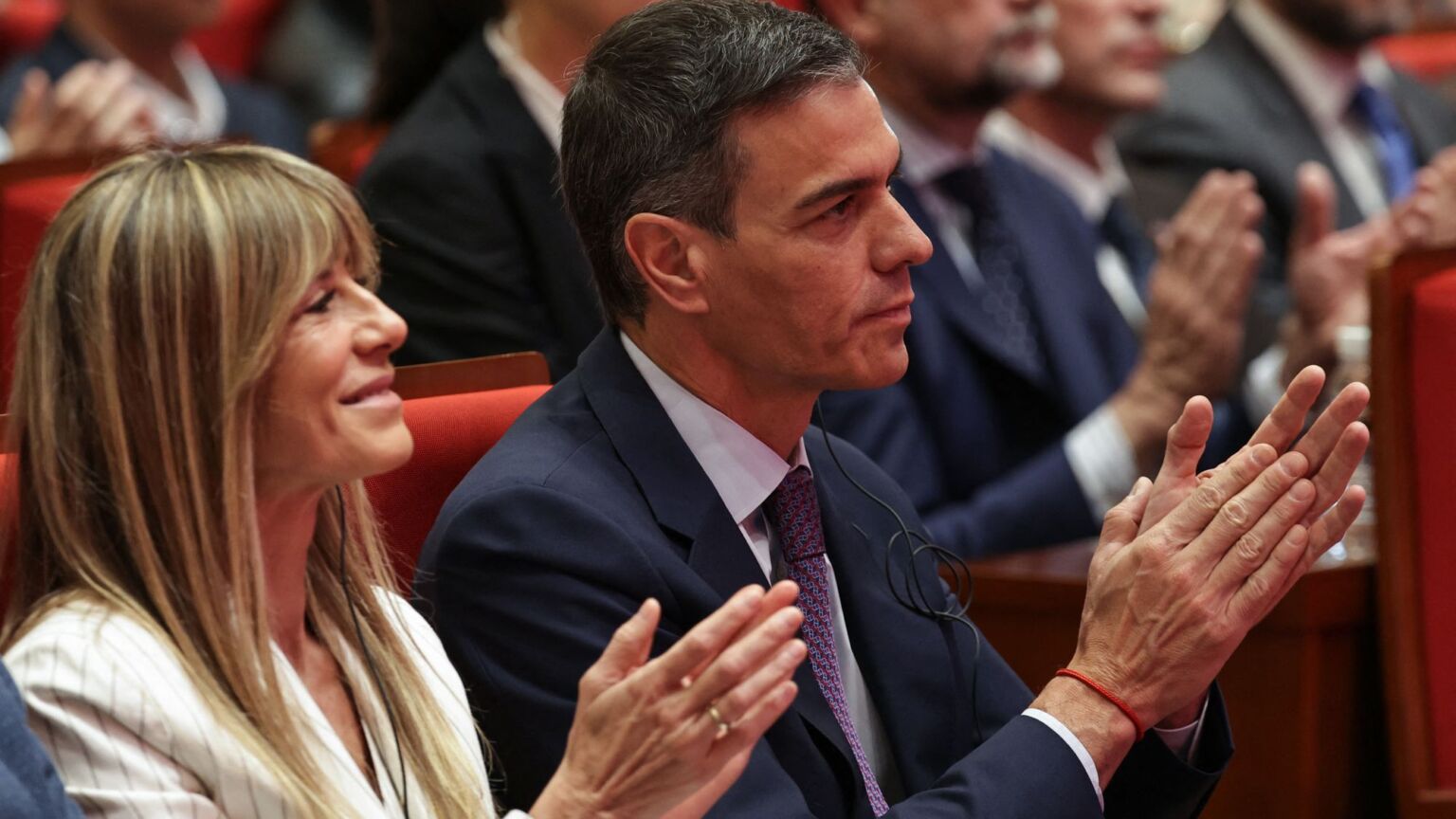
Spain’s government, helmed by prime minister Pedro Sánchez, leader of the Spanish Socialist Workers’ Party (PSOE), is looking more sordid by the day. Last week, Sánchez’s wife, Begoña Gómez, was charged with four alleged crimes: embezzlement, influence peddling, corruption in business and misappropriation of funds. She is the latest member of Sánchez’s inner circle to have attracted the interest of prosecutors.
Just as disturbing as the latest allegations has been the response of the government. It has effectively dismissed this attempt to hold the government and the prime minister’s family to account as politically motivated lawfare. Spain’s justice minister, Félix Bolaños, targeted Juan Carlos Peinado, the judge overseeing the investigation into Gómez. He claimed the investigation had brought ‘shame upon Spanish citizens and judges’ and caused ‘irreparable damage’ to the justice system. The judicial authorities have hit back, warning that such public criticism from political figures undermines trust in the courts.
The saga captures well the degradation of Spanish democracy under Sánchez. The charges against Gómez are serious. She was appointed to direct an academic programme at the Complutense University in Madrid, despite having no relevant qualifications. She worked as a university professor despite not being one, and ended up directing masters programmes for which she would not have been eligible as a student. Ultimately, prosecutors allege, she exploited her position as the prime minister’s wife to establish a professional career out of thin air.
These allegations are all the more significant because the prime minister’s brother, David Sánchez, is also facing a criminal trial over alleged nepotism. The investigation has focussed on how he obtained a lucrative position at a local government in western Spain – again, his only ‘qualification’ appears to be his relation to the prime minister. David Sánchez’s response has also been to attack those investigating him, dismissing the charges as a plot by ‘far right’ political opponents. But this is unlikely to wash. Like Gómez, David Sánchez also appears to have a job made for him out of thin air – in his case, a position as a director of public music schools in the Badajoz council, led by the governing Socialists.
The cases involving Sánchez’s wife and brother have sparked an intense public debate. They highlight what many perceive to be a broader culture of nepotism in Spain, where personal connections and proximity to power can open doors that remain closed to hard-working, qualified individuals, the likes of which are currently leaving the country in droves. While each case must be judged on its own legal merits, together they suggest a country rotting in corruption. Indeed, many people consider the charges against Sánchez’s wife and brother to be merely the tip of the iceberg.
And no wonder. José Luis Ábalos, the former Spanish minister of transport and a senior figure in the PSOE, is also standing trial for allegedly profiting from public contracts during the pandemic. Ábalos, too, denies any criminal wrongdoing. But he has serious charges to answer: he remains a man who is not only alleged to have engaged in corruption in the midst of a pandemic that killed more than 100,000 Spaniards, but also to have used public funds to pay for prostitutes. All under the banner of ‘the most feminist government in the world’, no less.
For Spain, these cases encapsulate a general sense of corruption and national decline. Óscar Puente, the current transport minister, is facing serious questions over the Adamuz train accident in January, in which 45 people died. The government has launched a website to counter what it calls ‘misinformation’ about the accident, which is beginning to look like a desperate attempt to cover its own backside. Spain’s railway unions have accused Puente of ignoring multiple warnings about the safety of the track on which the tragic accident occurred, including shooing away concerned union representatives.

But not everyone is bristling with indignation. That is because, put simply, there remain some among the Spanish public who do not consider nepotism to be corruption. It’s simply deemed a useful way to thrive.
Fittingly, Sánchez was nowhere to be seen when his wife had the book thrown at her. Instead, he was cosying up to autocrats in China – virtue-signaling and calling for the ‘reform’ of the global order. He is clearly angling for a position in an international organisation, which, as the ultimate globalist golden boy, he probably sees as a safe exit ramp.
One thing is certain: Pedro Sánchez is more welcome in China than in Spain, where people are increasingly eager to bring his catastrophic reign to an end.
Maria Reglero is a consultant on women’s rights based in Barcelona.

spiked summit 2026
10am-5pm, Saturday 27 June
Emmanuel Centre, London, SW1P 3DW
With Lionel Shriver, Brendan O'Neill, Katharine Birbalsingh, Toby Young, Allison Pearson, Paul Embery, Tom Slater, Andrew Doyle, Fiyaz Mughal and more
Become a spiked supporter to get a discounted ticket
£80 or £50 for supporters
You’ve hit your monthly free article limit.
Support spiked and get unlimited access.
Support spiked and get unlimited access
spiked is funded by readers like you. Only 0.1% of regular readers currently support us. If just 1% did, we could grow our team and step up the fight for free speech and democracy.
Become a spiked supporter and enjoy unlimited, ad-free access, bonus content and exclusive events – while helping to keep independent journalism alive.
Monthly support makes the biggest difference. Thank you.







Comments
Want to join the conversation?
Only spiked supporters and patrons, who donate regularly to us, can comment on our articles.