NASA’s return to the Moon is the reboot we need right now
Can the Artemis mission reignite our yearning to push back the final frontier?

Want unlimited, ad-free access? Become a spiked supporter.
We should perhaps not be surprised that a mission called Artemis is to fly in the footsteps of Apollo and take astronauts back into deep space.
After all, in a year in which a new instalment of The Lord of the Rings, another Star Wars spin-off and another Star Trek-inspired TV show are in the works, why would the powers-that-be overlook the greatest fantasy epic of them all, the 1969 Apollo mission itself? What better to reboot than what were, for a few glorious years, the most famous boots in the world, those setting foot for the first time on an extra-terrestrial surface, on mankind’s eternal guardian and sentinel, no less – the Moon.
The mission, which launches today, even follows the playbook that governs Hollywood reboots. While not challenging Star Trek: Starfleet Academy’s near-final form of ‘diversity’, with virtually no men of recognisably European extraction at all, the lunar mission will return in a gender swap for the ages: Apollo has been replaced with Artemis, the Graeco-Roman god’s girl-boss twin sister. Artemis is Rey to Apollo’s Luke, Galadriel to Apollo’s Aragorn, Nahla Ake (captain of the USS Athena, funnily enough) to Apollo’s Kirk.
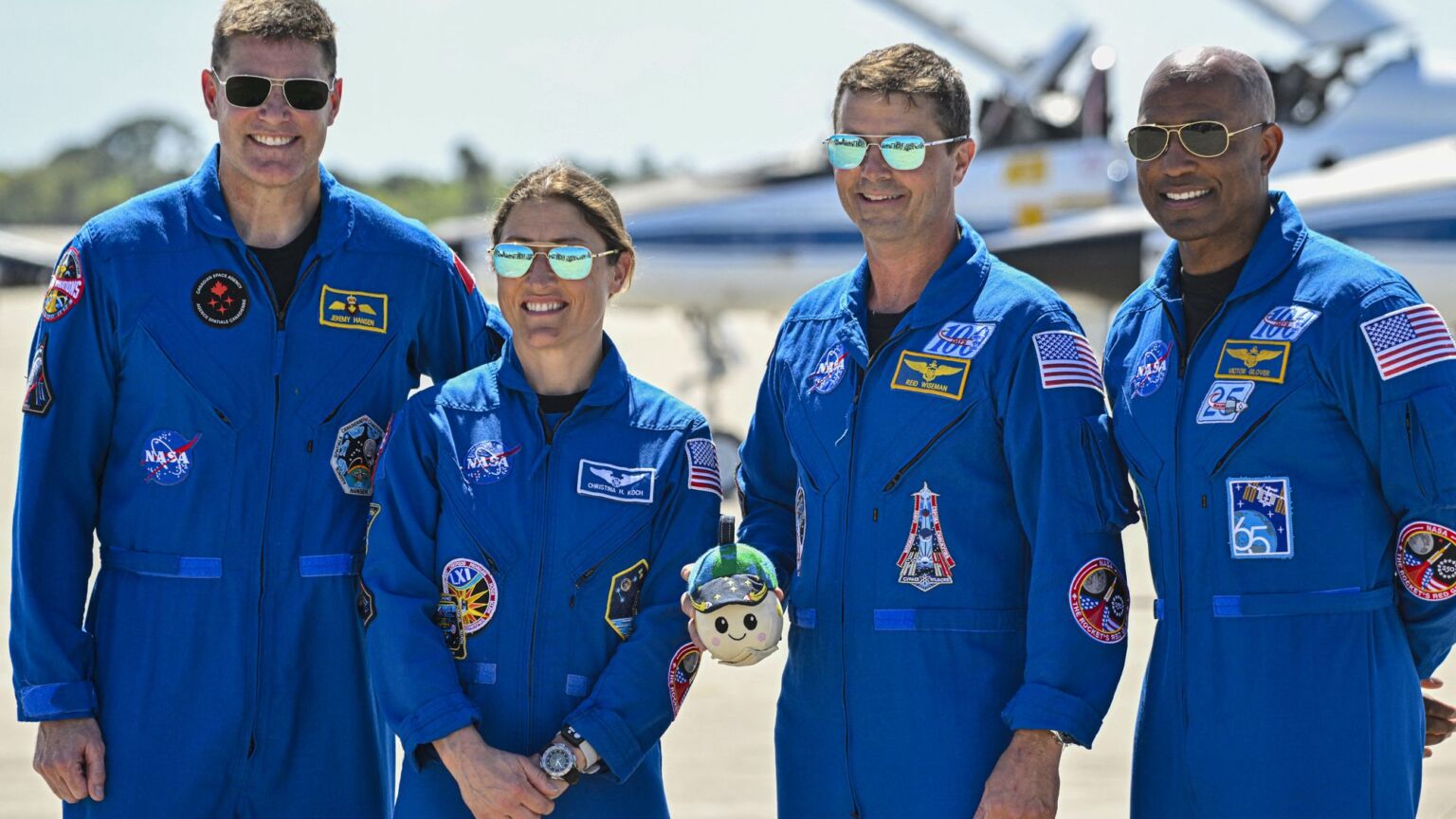
In some regards, the NASA mission is not quite as eccentric as Hollywood. DEI considerations are clearly visible in the four-strong squad actually riding in the warhead, but all are well qualified in traditional terms and, on the ground, NASA is at least still staffed by top scientists and engineers. And unlike the new Lord of the Rings proposal, which will adapt scenes from the books that didn’t appear in Peter Jackson’s trilogy, Artemis is at least intended to retell the whole story, and then start layering in sequels.
Still, however much they might try to emphasise that, this time, the mission is to build a base with a view to opening up Mars, this still feels like the dampest squib since Katy Perry and the girls enjoyed ‘crewing’ Jeff Bezos’s Blue Origin ‘mission’. And it’s sad to realise that one feels so little anticipation. When did I get so jaded?
I was just four years old in 1969. Apart from rolling a Moroccan-style pouffe down the stairs and watching it burst through the large glass panel next to our front door, the first Apollo mission is the first real memory I have. And it’s a good one.
I remember watching all the BBC coverage on TV. I remember Cliff Michelmore, Patrick Moore and, especially, the maestro of rocket-science explainers, James Burke. I remember the famous use of Richard Strauss’s Also sprach Zarathustra (which I later realised the BBC had nicked from Kubrick’s prescient 2001: A Space Odyssey, released the year before).
And on the big night, in the early hours of 21 July 1969, I remember being woken up and being taken next door in my pyjamas to watch the landing, because they had a colour telly. In my pyjamas. The defining transgression, the signature of an eruption of world historical events into a young life. This was the world I was being born into.
No one was much interested in the purpose or the justification of the mission then. The point was self-evident. Mankind was making a giant leap, pushing through, entering the next stage of his development, his ‘self-overcoming’.
The prevailing mood was a mixture of awe and sheer excitement. This was the sublime on a scale that Keats, Coleridge and Caspar David Friedrich could scarcely imagine. Man standing so far above the sea of fog that the Earth itself was reduced to a slowly spinning marble in space. New possibilities crowded in on our imagination. A paradigm shift was happening in real time. The revolution was being televised after all.
I would be flattering myself to suggest that I had mastered the vocabulary to formulate any of this back then, of course. But I sensed it, or rather sensed the adults’ wonder, their ‘wild surmise’, staring at the Sea of Tranquillity, silent, in a sitting room in Dunstable. We knew something special had been accomplished. The sky was no longer the limit.
The sense of this actually being a cul-de-sac took many years to arrive. I remember visits to the Science Museum, and being fascinated as much by the rubber splashdown capsule as space suits and the propulsion systems involved. The Saturn V rocket remained iconic throughout my youth. Amid the readily available war paraphernalia – gas masks, toy guns – that we used to re-enact battles in the slowly disappearing scrubland between housing developments, it stood high and unapproachable, a gleaming spire, a testament to the sacred as much as to power. It stood for Tomorrow.
I built my first Airfix model, a Saturn V rocket with a detachable landing module. I remember my dad, who had built hundreds of 1/72 scale aircraft, showing me how to peel the gold foil off the back of Benson and Hedges cigarette packaging to apply as gold leaf to the relevant surfaces.
But gradually over the ensuing decades, it began to dawn on us that nothing much was happening any more. Tomorrow never came. Instead, after Apollo, the new projects, from the International Space Station to reusable shuttles, all felt somewhat domestic in scope. We had gone from the Flying Scotsman to a local bus service. And when the Challenger’s O-rings failed in January 1986, a new iconic image was born – that of catastrophe, defeat and with it the introduction for the first time of grim, mordant humour, familiar from the trenches. NASA needed another seven astronauts. We all desperately needed a new dream.
That was 40 years ago. The spur, of course, for today’s great leap was Elon Musk. While NASA’s big rival in the Sixties was the Soviets’ space programme, which threatened to prove that their ethos of collectivism could make faster progress than the American way of free men, free enterprise (and of course, free Nazis), Musk emerged in the 21st century as part Bond villain, and part John Galt. That Sixties narrative is now in danger of being reversed, with SpaceX taking the role of Ayn Randian, square-jawed enterprise and individual heroism, and NASA looking like the clumsy, over-burdened, over-regulated state-sector attempt, with more being spent on HR than R&D.
It has been Musk who has urged us to revive our interest in becoming a multi-planetary species, after a 50-year Earth-bound trajectory had all but suffocated our instinctive yearning to be pioneers pushing back the final frontier. And while each new Star Trek iteration has explored space less and less, and intersectional grievance dynamics more and more, Musk alone has kept the Dan Dare flame alive.
This struggle between competing visions was in evidence even in the first flush of Apollo’s pomp. In 1969, activists, comedians and protest singers drew plaintive attention to the fact that, while Uncle Sam was putting a man on the Moon, there was poverty not far from his front door. That while he was frittering away our tax dollars on some massive willy-waving competition with the Russians, Americans were starving.
This attitude occasioned more eye-rolling and irritation than serious moral engagement at the time. But from the standpoint of 2026, we can see that this redistributive, maternal instinct has largely won out. Since Neil Armstrong’s boot made that immortal impression on the Moon’s windless dust, it is welfare spending that has gone sky high, not the astronauts. The annual NASA budget stands today at $24 billion. A hefty chunk of cash, to be sure. But social security alone in the US is now $1.5 trillion dollars per annum. And the poor, like the Moon, are with us still.
If you want a picture of the last 50 years, imagine a boot hesitating to take a decisive step forward, seemingly forever. It looks as if it is once again ready to do so. I just wish I felt four years old again.
Simon Evans is a spiked columnist and stand-up comedian. Tickets for his tour, Staring at the Sun, are on sale here.
You’ve hit your monthly free article limit.
Support spiked and get unlimited access.
Support spiked and get unlimited access
spiked is funded by readers like you. Only 0.1% of regular readers currently support us. If just 1% did, we could grow our team and step up the fight for free speech and democracy.
Become a spiked supporter and enjoy unlimited, ad-free access, bonus content and exclusive events – while helping to keep independent journalism alive.
Monthly support makes the biggest difference. Thank you.


Comments
Want to join the conversation?
Only spiked supporters and patrons, who donate regularly to us, can comment on our articles.