Jürgen Habermas: a voice of reason and humanity
The Frankfurt School leftist turned liberal democrat remained a vital advocate of Enlightenment values to the last.
Want unlimited, ad-free access? Become a spiked supporter.
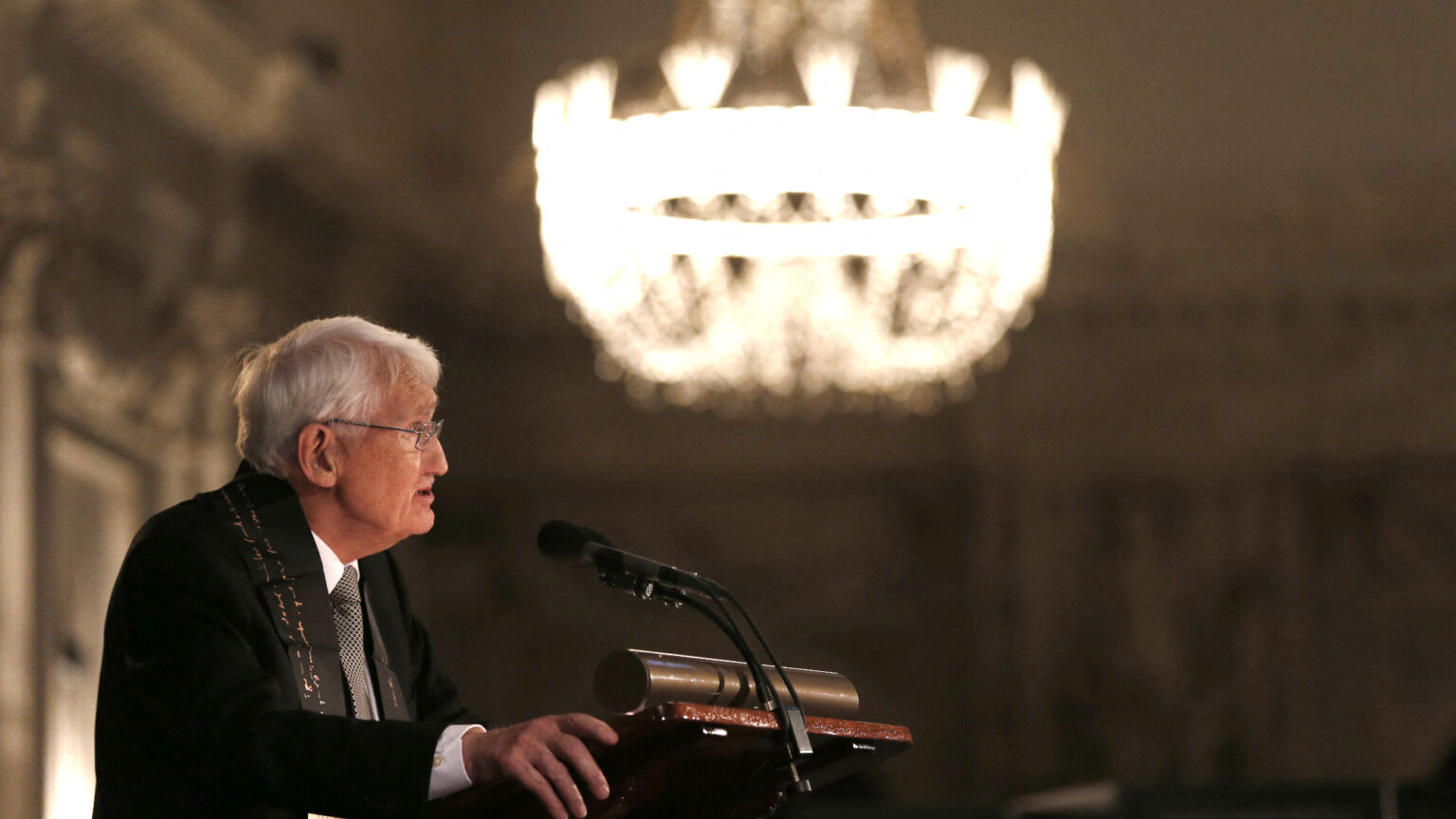
The great German political philosopher, Jürgen Habermas, died last week at the age of 96, at home in Starnberg, Bavaria.
Born in 1929, he lived through one of Germany’s most tumultuous eras. He was a member of the Hitler Youth as a boy and was sent, as a 15-year-old, to the western front to man anti-aircraft defences in the final months of the Second World War.
After the war, he became a left-wing student firebrand while studying philosophy at the universities of Göttingen, Zurich and Bonn – from the last of which, he earned a doctorate in philosophy in 1954. Two years later, he became philosopher and critic Theodor Adorno’s research assistant at the University of Frankfurt’s Institute for Social Research, otherwise known as the Frankfurt School. Initially too radical in his views for Adorno, Habermas came to reject what he saw as the messianic strain in revolutionary Marxism in favour of a vision of liberalism and democracy, grounded on mutually respectful dialogue.
The Germany Habermas grew up in had been through a catastrophic succession of events, from fascism to war to defeat and division, that ruined most of its establishment figures and intellectuals. The future of thought in Germany, both in the East and West, drew heavily on a left that had not been compromised by fascism. It meant that many who had been radicals in the 1930s, and exiled during the war years, came back to rebuild Germany after the fall of the Third Reich.
Among those heading back to postwar Germany were Adorno and Max Horkheimer. They were the two leading members of the Frankfurt School when it was established in the early 1920s, before it was relocated to New York during the war. Many important radical thinkers taught at the institute, both in Frankfurt and in New York – including Herbert Marcuse, Franz Neumann, Otto Kirchheimer, Paul Mattick and Karl Korsch. However, Adorno and Horkheimer fell out with most of them.
While working at the institute during its US phase, Adorno and Horkheimer established a philosophical, sociological approach known as ‘critical theory’, which challenged the positivist sociology then dominant in American academia and beyond. Adorno and Horkheimer saw it as their task, as ‘critical theorists’, to critique existing institutions and ideologies, including liberalism and Communism, rather than merely to describe them.
Returning to the University of Frankfurt in 1951, the project of critical theory was tested by the student radicalism of the 1960s. Left-wing activists started disrupting Adorno’s lectures, and publicly denouncing him as a sell-out and an apologist for the West. They were particularly critical of his refusal to embrace the anti-colonial revolt in Indochina and elsewhere. Adorno, in turn, accused the student radicals of ‘left-wing fascism’, and of being as intolerant as their counterparts on the right.
Although he was Adorno’s research assistant during the 1950s, Habermas was closer to the radicals during the 1960s. In 1959, with Horkheimer pushing for Habermas’s sacking, he had wisely jumped ship to Marburg University, where, in 1962, he completed his habilitation dissertation (qualifying him for a professorship), The Structural Transformation of the Public Sphere, under veteran Marxist and labour historian Wolfgang Abendroth.

The Structural Transformation of the Public Sphere was a significant contribution to the understanding of modernity. It drew on critical theory, but in an important sense went beyond it. Habermas reconstructed the emergence of the public sphere as an area of social life that was free of the authority of the nobility and the court. It developed among the urban propertied classes in salons, coffee houses and literary schools, and through letters and an ever-growing publishing industry. This bourgeois realm of public opinion, otherwise known as civil society, was rational and liberal, explained Habermas. In the second part of the book, he looked more critically at the challenges to the public sphere brought about by the emergence of mass society, and the difficulties of developing a common outlook across a divided and unequal society.
Two decades later, Habermas published The Theory of Communicative Action, a two-volume work in which he settled his differences with Leninist Marxism. He proposed a theory of social interaction focussed on ‘communicative action’, whereby mutual, reciprocal recognition and consensus could be forged through open, rational and non-coercive dialogue. He rejected what he saw as the ‘implicit connection of the theory of Marx with the utopia of self-activity – emancipation from heteronomous labour’ (ie, work dictated by external forces and imperatives). Like Adorno and Horkheimer, Habermas thought Marxism was mired in ‘productivist bias’ and rooted in the belief that mastery over nature would emancipate mankind.
In response, Habermas set out what he called the ‘ideal speech situation’, in which all parties recognised each other as rational beings and engaged in a model of mutually respectful exchange. His ideal of rationality was not instrumental, or embodied in a collective subject. It was based instead on the free interaction between individuals. Like much of his work, there was quite a bit of jargon, which made his meaning hard to pin down, but it was still a valuable intervention.
Not everyone was convinced. Many Marxist thinkers set about critiquing Habermas, from István Mészáros (The Power of Ideology) to Terry Eagleton (The Function of Criticism). They alleged that his ideas of civil society, and of the ‘ideal speech situation’, were really just idealised versions of capitalist society. His critics argued that what seemed to Habermas to be a universal drive towards reciprocity, whereby individuals come to recognise each other as equals, was really just the sectional outlook of the metropolitan bourgeois elite. And they pointed out that Habermas openly elevated Western civilisational values over so-called subaltern challenges, whether from the developing world or minorities in the West. In his defence, Habermas insisted that civil society was universal and could be for everyone.
A lot of the criticism aimed at Habermas missed the mark. It came from Marxists outlining where Habermas’s theory deviated from Marxism – which was part of the point of Habermas’s project. The criticisms could be well made, but the actual decline of the socialist opposition to capitalism in the 1980s and 1990s tended to render them shrill and pointless. More importantly, the brutal suppression of rights and democracy in the Eastern Bloc made smart remarks about the limits of Habermas’s concept of civil society seem redundant.
As he rose to become the grand old man of German political philosophy during the 1980s and 1990s, his politics started to border on centrism. As I wrote in a 1997 LM magazine review of Habermas’s Between Facts and Norms, his emphasis on procedure over outcomes lent itself to the emerging juridification of policymaking that was to characterise the technocratic era.
Yet, throughout this period, his theoretical contributions to public life were well made. Throughout the 1980s, he defended the Enlightenment as a noble advance for humanity in the face of mounting counter-Enlightenment criticism from postmodernist thinkers. And in 2003, he and French philosopher Jacques Derrida co-wrote a piece opposing the Iraq War, linking their opposition to a defence of the European Union.
Habermas made himself the quintessential public intellectual. His last public intervention was a letter co-written by several prominent German intellectuals shortly after Hamas’s pogrom on 7 October 2023. They condemned ‘Hamas’s massacre with the declared intention of eliminating Jewish life in general’; defended Israel’s right to exist and to defend itself; and warned that ‘standards of judgement slip completely when genocidal intentions are attributed to Israel’s actions’. He and his fellow signatories warned, too, of the danger of rising anti-Semitism, insisting that it cannot be justified by Israel’s actions.
The response to Habermas’s intervention was predictable. Countless anti-Israel activists alleged that his idea of ‘civil society’ was racially selective, and that the letter was just a wordy apology for ‘settler colonialism’. Some of the criticisms were familiar, having been levelled against his work since The Structural Transformation of the Public Sphere was published. The big difference was that his present-day critics were invoking not the workers’ revolution as an alternative to bourgeois society, but the retrograde and obscurantist death cult of Hamas. One such critic, a tenured ‘radical’, claimed that Habermas had ‘been entirely consistent with the incurable tribalism of his philosophical pedigree, which had falsely assumed a universal posture’. And just like that, any moral objection to Hamas’s rape and slaughter of Israeli Jews was dismissed.
Now, as we mark Jürgen Habermas’s passing, his commitment to civil society and mutual respect ought to weigh better in the scales than the fevered millenarianism of his critics.
James Heartfield is the author of Britain’s Empires.
You’ve hit your monthly free article limit.
Support spiked and get unlimited access.
Support spiked and get unlimited access
spiked is funded by readers like you. Only 0.1% of regular readers currently support us. If just 1% did, we could grow our team and step up the fight for free speech and democracy.
Become a spiked supporter and enjoy unlimited, ad-free access, bonus content and exclusive events – while helping to keep independent journalism alive.
Monthly support makes the biggest difference. Thank you.



Comments
Want to join the conversation?
Only spiked supporters and patrons, who donate regularly to us, can comment on our articles.