Why they attack Churchill
The wartime hero is a potent symbol of the civilisation culture warriors revile.
Want unlimited, ad-free access? Become a spiked supporter.
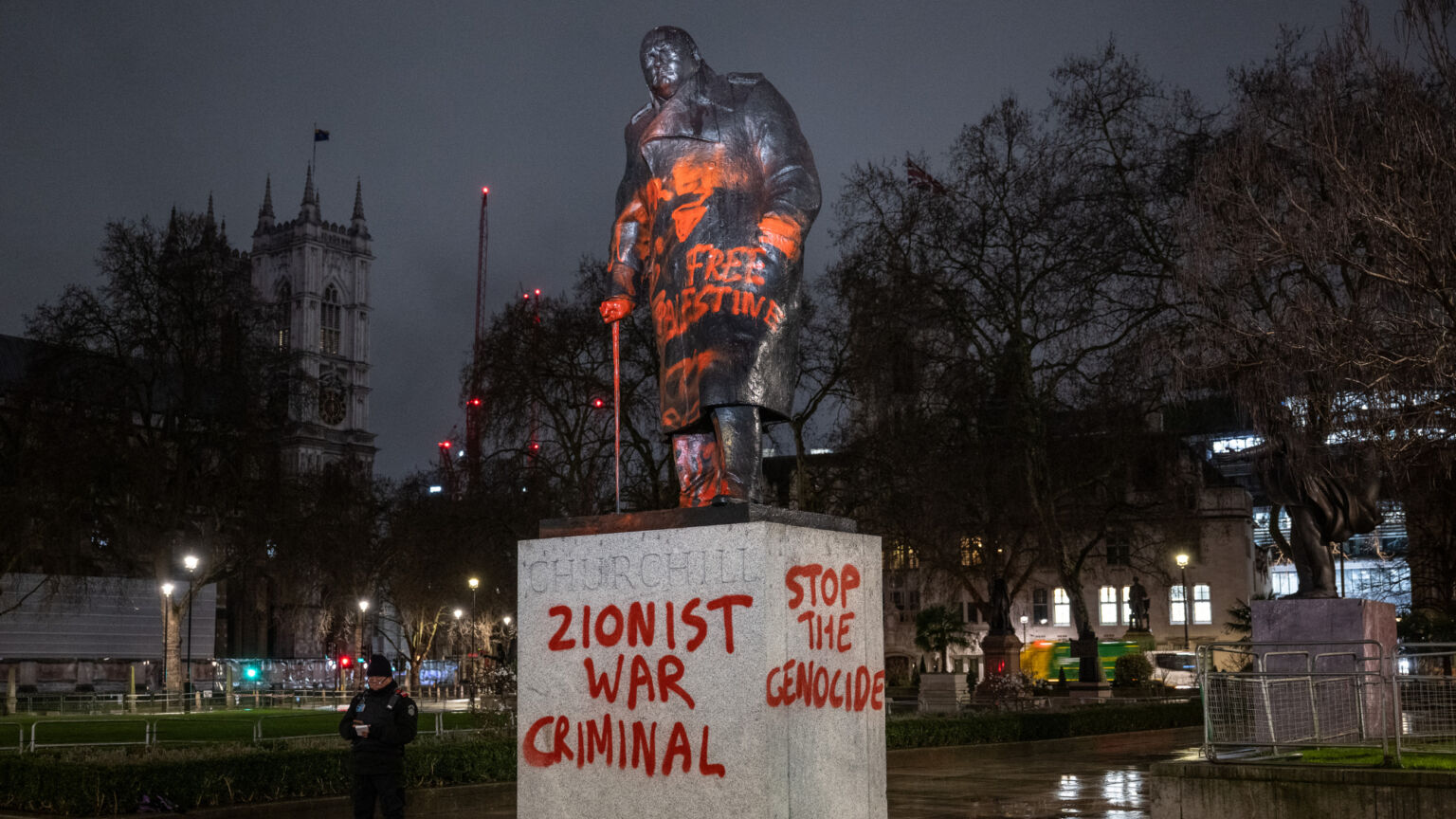
Once again, the statue of Sir Winston Churchill in Westminster’s Parliament Square has been vandalised. On Friday, red graffiti was sprayed on the memorial of Britain’s wartime leader, stating, ‘Never Again is Now’, ‘Free Palestine’, ‘Zionist War Criminal’ and ‘Globalise the Intifada’. According to the Metropolitan Police, a 38-year-old man has been arrested on suspicion of racially aggravated criminal damage.
Churchill’s statue has been a favourite target for culture warriors for some time. Back in June 2020, it was vandalised by Black Lives Matter protesters. Last October, an Extinction Rebellion demonstrator defaced the statue by painting ‘racist’ on its plinth during a climate protest. Such has been the regularity of the vandalism that in May 2025, the government announced that it will add Churchill’s statue to the list of monuments it is a crime to climb, with offenders facing up to three months in prison and a £1,000 fine.
The constant targeting of Churchill’s statue is symptomatic of a wider campaign designed to render the reputation of Britain’s heroic leader toxic. A veritable anti-Churchill crusade now envelops schools and universities. Numerous academics cannot resist the temptation of depicting Churchill’s ideals as similar to those of Adolf Hitler.
You don’t need to look far. In 2018, the historian David Olusoga blamed Churchill for war crimes in Africa as well as the Bengal famine of 1943-44 in India. A few years later, academic and professor of postcolonial studies at Cambridge University, Priyamvada Gopal, wrote, ‘[J]ust because Hitler was a racist does not mean Churchill could not have been one. Britain entered the war, after all, because it faced an existential threat – and not primarily because it disagreed with Nazi ideology.’ Numerous books, such as Tariq Ali’s Winston Churchill: His Times, His Crimes (2022), present Churchill as a racist criminal, whose crimes were comparable to those of the Nazis. With a stroke of pen, the man who played a central role in the defeat of Nazi Germany is turned into an admirer of the despicable ideology peddled by Hitler.
One consequence of the campaign of vilification targeting Churchill is that young people in Britain have been systematically miseducated about his accomplishments. An unforgettable example of this happened on Remembrance Day in 2021. Visitors to London’s Imperial War Museum, to mark the sombre occasion, were taken aback by a rap song performed by a group of teenagers. One girl shouted:
‘Why, when some remember, do they see the same faces, the white faces from Western places. This was the Second World War, yet how many remember that it wasn’t only Churchill who fought. The same man who had a hand in famine in 1943, wiping out three million Bengalis, denial, displacement, malnutrition, starvation, without any apologies.’
For culture warriors, Churchill is big game. If they can take down the wartime leader, then nothing can seemingly stand in the way of their ultimate goal: destroying the moral authority of Britishness itself. It isn’t enough to dishonour the reputation of one man – the collective spirit of the people Churchill symbolised must be discredited, too.

It goes without saying that Churchill made many mistakes throughout his long political career. His unwavering support for British imperialism – Churchill notoriously opposed Indian independence – is rightly questioned. But whatever his faults, more than any individual in the modern world, Churchill exemplified the historical significance of moral courage. He became prime minister of Britain in 1940, in what was the darkest hour of his nation’s history. The British army had suffered a series of defeats, and it seemed that it was only a matter of time before the German military would occupy Britain. In what many saw as a hopeless situation, Churchill refused to yield to powerful pressure to sue for peace with Hitler. Instead, he decided to carry on the fight against the Nazis. As historian John Lukacs observed, ‘then and there he saved Britain and Europe, and Western civilisation’.
At a time when the historical legacy of Britain and of European civilisation is constantly attacked by the decolonising brigade and the cultural elites, upholding the reputation of Churchill is more important than ever.
Back in the 1930s, Churchill recognised the importance of not giving up on the values that underpinned European civilisation without a fight. Other members of Europe’s ruling classes did not. It is fair to say that the same spirit of compromise and equivocation dogs Europe’s cultural and political institutions today.
Above all, Churchill understood that the fight against Nazism wasn’t just a war for territory. It was a war for a civilisation. In a 1947 speech at the Royal Albert Hall, Churchill praised a piece written by journalist Gordon Sewell in the Southern Daily Echo. Quoting Sewell, Churchill said:
‘In the rich pattern of [European civilisation] there are many strands; the Hebrew belief in God; the Christian message of compassion and redemption; the Greek love of truth, beauty and goodness; the Roman genius for law. Europe is a spiritual conception. But if men cease to hold that conception in their minds, cease to feel its worth in their hearts, it will die.’
‘These are not my words, but they are my faith’, Churchill added.
He had no doubt about the unique contribution that Western civilisation made to the welfare of humanity. It was this ‘faith’ that provided him with the moral resources needed to challenge those who would appease Hitler, and which gave Churchill the power to forge ahead on the long and difficult road that led to the defeat of Nazi Germany.
That is why it is so important to stand up to the anti-Churchill vandals. It isn’t just about upholding the reputation of a national icon – it is also about protecting the soul of Europe and its civilisational accomplishments.
Frank Furedi is the executive director of the think-tank, MCC-Brussels.
You’ve hit your monthly free article limit.
Support spiked and get unlimited access.
Support spiked and get unlimited access
spiked is funded by readers like you. Only 0.1% of regular readers currently support us. If just 1% did, we could grow our team and step up the fight for free speech and democracy.
Become a spiked supporter and enjoy unlimited, ad-free access, bonus content and exclusive events – while helping to keep independent journalism alive.
Monthly support makes the biggest difference. Thank you.



Comments
Want to join the conversation?
Only spiked supporters and patrons, who donate regularly to us, can comment on our articles.