The BBC is lost in the fog of war
Its coverage of the Iran school bombing shows why the Beeb has a credibility problem.
Want unlimited, ad-free access? Become a spiked supporter.
On Saturday, the BBC led with the following headline: ‘At least 153 dead after reported strike on school, Iran says.’ It provoked a storm of controversy.
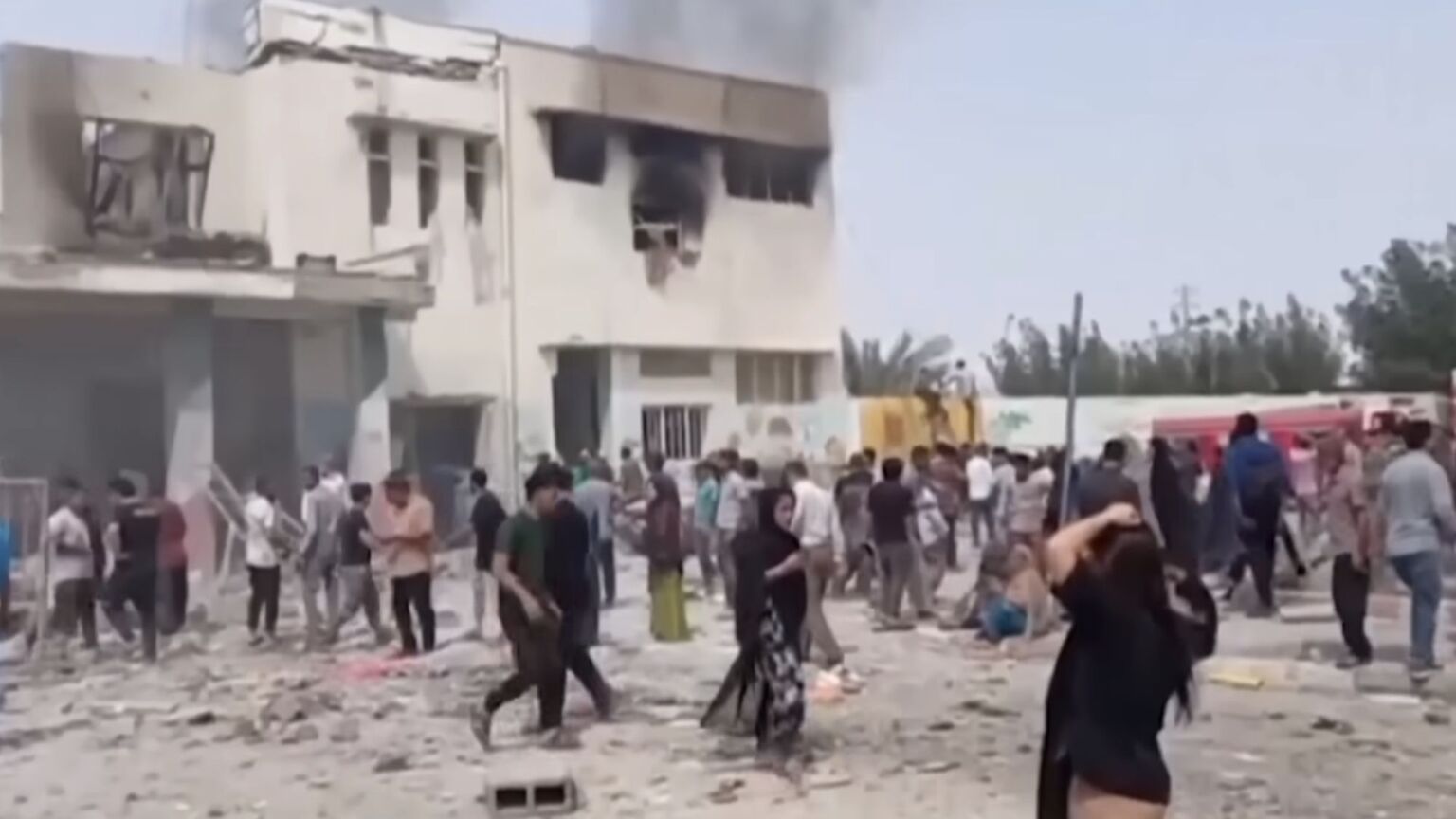
As part of Israeli and American joint operations in Iran, a girls’ school in Minab, in Iran’s southern Hormozgan province, was struck over the weekend. The death toll is ongoing and cannot be independently verified, although footage shows a collapsed building, smoke and bodies being taken from the rubble. Whatever the final toll, this appears to be a civilian catastrophe.
However, the public response has not been uniform grief. Instead, it has been narrative warfare over who was responsible. Within hours, social media were filled with debunkings and counter-debunkings. There were claims that the footage was old, or that a failed Iranian missile – rather than an Israeli one – was responsible. Open-source investigators proved that a widely shared clip used to support the ‘failed Iranian missile’ story originated from about 1,300 kilometres away, and found there was no supporting evidence for the theory at that time.
Reports also suggest that the school was situated next to, or possibly on the grounds of, an Iranian Revolutionary Guard Corps (IRGC) facility. Proximity does not negate civilian protection: a school remains protected unless it is being used for military purposes, and even then, proportionality and precautions are required. But this theory makes a mistaken strike on the base more plausible than not.
However, the debate about the strike highlights the crisis the BBC has helped create. ‘Reported’ and ‘according to officials’ no longer inspire trust. After two years of politicised, deeply biased and credulous war reporting on Gaza, many now believe atrocity stories are simply propaganda – particularly when the BBC is the source.
The al-Ahli hospital strike in Gaza in October 2023 marked a turning point for many in their relationship with the BBC. In those first hours, Hamas-controlled authorities released a ‘definitive’ account: Israel had deliberately bombed a Palestinian hospital. Later investigation showed that the damage – which was mainly limited to the hospital’s car park – was caused by a misfired rocket, launched by Palestinian Islamic Jihad. However, the initial impression – that Israel was to blame – persisted.
Jeremy Bowen, the BBC’s international editor, played a key role in misreporting the hospital bombing. Bowen later admitted he got key details wrong, including his description of the hospital building as ‘flattened’. Incredibly, he later said he ‘doesn’t regret one thing’ about his coverage of the incident. Coming from someone so senior, this can only be viewed as a clear sign of the BBC’s real editorial policy: speed is more important than accuracy, and errors are of no consequence.

Bowen’s reckless indifference to the facts was not isolated. In 2025, the BBC’s own review found its Gaza documentary, How To Survive A War Zone, breached its own editorial guidelines by omitting critical information – namely, the bit about the narrator’s father being a Hamas official. Using sources in Hamas-controlled territory may be unavoidable, concealing their true identity is not.
So why does the BBC keep doing this to itself? Because being first is still regarded as a professional virtue, in spite of the obvious dangers of this mindset. Disinformation succeeds because initial claims stick, particularly if they are of a tragic or controversial nature. Subsequent corrections rarely reach the same audience. People favour information that bolsters their opinions, and manipulative actors are only too happy to provide them with it – increasingly, through the easily-seduced medium of a BBC reporter.
The BBC’s own editorial guidelines emphasise accuracy and a duty not to mislead audiences. That should mean leading with what can be verified and the limits of its knowledge. At the very least, it should mean treating death tolls proclaimed by the Iranian regime and Hamas as contested claims, not definitive facts.
If the BBC wants to rebuild trust, it should begin at the source of the damage: the headline and the push alert, which it uses to broadcast ‘breaking news’. It should always place the source first and include qualifying facts in the same sentence. Above all, it should stop turning the propagandist’s preferred number into the story. Trust is declining because the pattern is clear: dramatic figures first, questions later. Until that changes, the BBC will not be a neutral referee in the information war, but rather an amplifier of it.
When legacy outlets damage trust, audiences defect to platforms that feel more direct. Increasingly, that means X – and X is a swamp. During the initial hours of the Iran war, hundreds of viral posts spreading misattributed footage, altered or AI-generated images and dubious ‘expert’ opinions flourished. The public was swimming in falsehoods from the moment the first missile was launched.
That is why the strike on the girls’ school in Minab is more than a horror story from the front – it is a live demonstration of what happens when journalism erodes its credibility. The facts that can be responsibly stated are already stark: reported casualties well above 100, a building filmed in ruins, and credible indications that the school sat adjacent to, or was intertwined with, an IRGC facility. Yet even these facts are difficult to independently verify because Iran restricts access to information.
In a healthier media ecosystem, a public broadcaster’s cautious phrasing would mark the start of shared understanding. Instead, audiences conditioned by years of politicised reporting interpret every ‘according to officials’ as code for ‘propaganda’. Increasingly, they rush to X to work it out for themselves in an attention economy that favours the loudest certainty. Confirmation bias and motivated reasoning do the rest, and repetition solidifies speculation into ‘truth’.
What happened at the girls’ school in Minab appears to be a tragedy. However, in the fog of war, there is much we simply don’t know. A responsible news organisation would accept this fact. Unfortunately, the BBC has proved itself time and again to be anything but responsible.
Andrew Fox is a former British Army officer and an associate fellow at the Henry Jackson Society, specialising in defence and the Middle East.
You’ve hit your monthly free article limit.
Support spiked and get unlimited access.
Support spiked and get unlimited access
spiked is funded by readers like you. Only 0.1% of regular readers currently support us. If just 1% did, we could grow our team and step up the fight for free speech and democracy.
Become a spiked supporter and enjoy unlimited, ad-free access, bonus content and exclusive events – while helping to keep independent journalism alive.
Monthly support makes the biggest difference. Thank you.


Comments
Want to join the conversation?
Only spiked supporters and patrons, who donate regularly to us, can comment on our articles.