Trump’s tariffs are a self-destructive assault on democracy
The US president’s imperious imposition of tariffs is damaging the economy – and his prospects at the midterms.
Want unlimited, ad-free access? Become a spiked supporter.
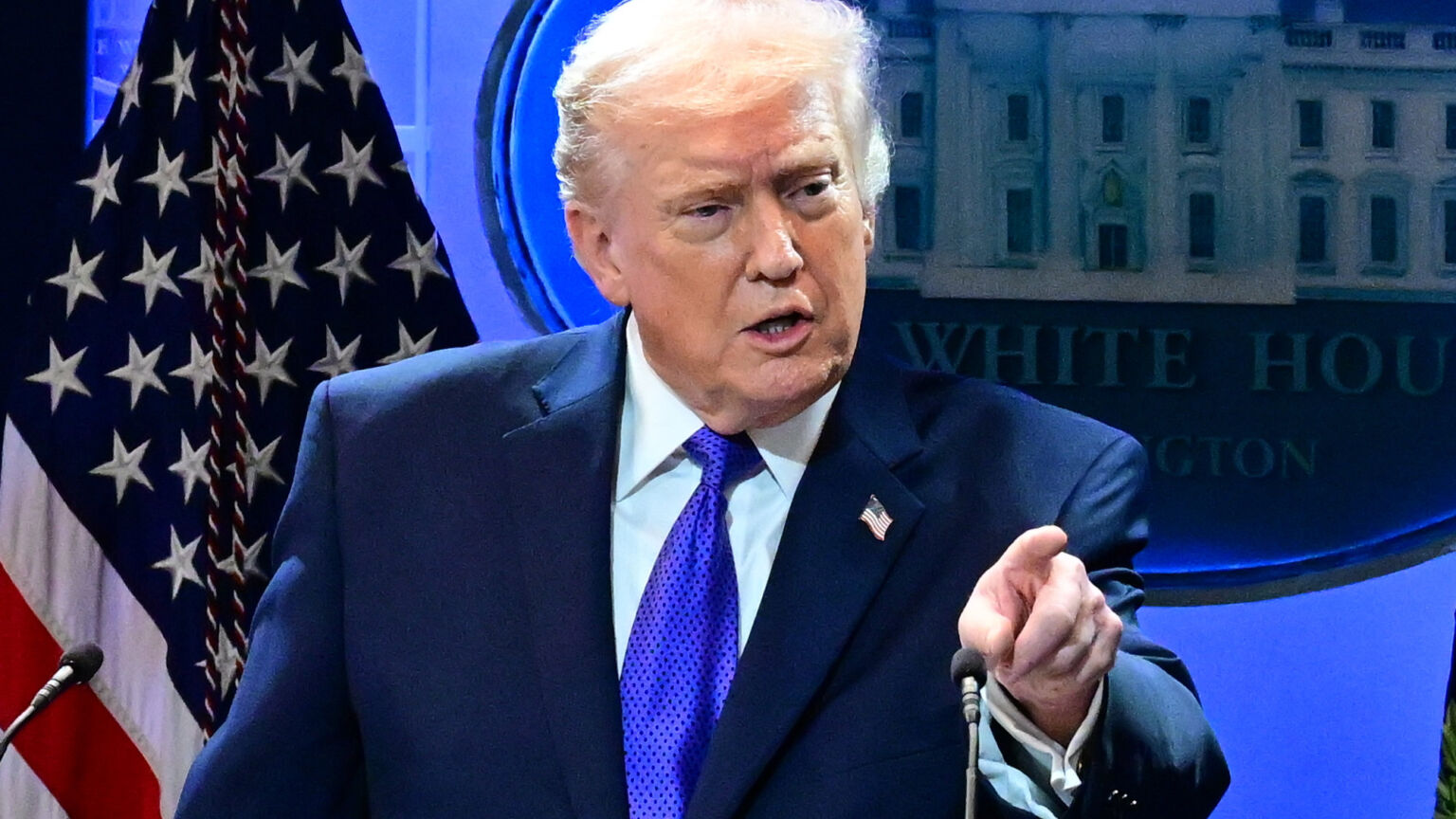
In his second term, Donald Trump’s most prominent and aggressive economic policy has been to impose tariffs on nations across the world. But last week, the US Supreme Court struck down most of those tariffs.
This is a big blow to the US president’s signature policy and, as per usual, he’s taking it personally. The ruling provides an opening for Trump to pivot away from his misguided over-reliance on tariffs as a tool of trade and diplomacy, but instead he’s doubling down. Calling the ruling ‘ridiculous, poorly written and extraordinarily anti-American’, Trump vowed to pursue his tariff policy via other legal avenues.
In February 2025, Trump imposed tariffs on Canada, China and Mexico, claiming that these countries were not doing enough to stop fentanyl and other drugs from entering the US. Then, in April, Trump announced ‘Liberation Day’, slapping a general 10 per cent tariff on imports globally, plus higher taxes on specific countries. According to the Trump administration, the legal authority for both the February and April tariffs derived from the International Emergency Economic Powers Act (IEEPA).
In its six-to-three decision, the US Supreme Court effectively ruled that, no, the IEEPA does not provide Trump a legal basis for his policy. Tariffs are a form of taxes, and the US Constitution gives the power of taxation to congress alone, not the president. An exception is when congress votes to delegate some of its taxing power to the president, and that is what the administration argued that the IEEPA does.
The Supreme Court, rightly, disagreed. The IEEPA speaks of the president’s authority to ‘regulate’ economic transactions, but nowhere does it mention tariffs. The scope of Trump’s tariffs is vast, extending worldwide and raising huge revenue (the administration projected that tariffs would reduce the national deficit by $4trillion). It’s hard to imagine that congress’s intent with IEEPA was to hand over almost unlimited taxation power to a president.
Moreover, the IEEPA is meant to be an ‘emergency’ power, but that’s not how Trump is using it. Trump argues that fentanyl trafficking and the trade deficit represent ‘emergencies’, but that is stretching the definition. Also, an emergency is typically time-bound, while Trump’s tariffs are potentially permanent.
In response to his tariff defeat, Trump went on a rant. He called the judges ‘fools and lapdogs’. Even worse, he questioned their patriotism, going as far as to say they had been ‘swayed by foreign interests’. This insult was bad even by Trump’s standards, and his talk of ‘foreign Interests’ – without any evidence – can only fuel online conspiracy theorising.
The Supreme Court justices were doing their job. On many occasions in the past, including when it came to the president’s personal immunity, the majority has ruled in Trump’s favour. The separation of powers, which places limits on the power of the presidency, is a key principle of the US Constitution. In this regard, the court has been consistent under both Joe Biden and Trump. Indeed, the Supreme Court rebuffed Biden’s overreach on student-loan forgiveness, workplace vaccine mandates and other areas. In seeking unilateral power he does not have under the US Constitution, Trump is following Biden in an anti-democratic fashion.
Shortly after the Supreme Court’s ruling, Trump declared he would not be denied his use of tariffs. ‘We have very powerful alternatives’, he said. He deployed one right away, by imposing a 15 per cent across-the-board tariff, this time relying on a different trade law, known as Section 122. However, these alternative legal pathways for tariffs come with more restrictions on Trump’s powers – for example, Section 122 can only be used for 150 days, after which the president would need congress’ approval.
Trump’s tariffs are unwise as economic policy. A recent study from the Federal Reserve of New York found that in 2025, ‘nearly 90 per cent of the tariffs’ economic burden fell on US firms and consumers’, not foreign exporters. When American companies absorb some of the higher costs from tariffs, they have less money available to invest, including in hiring more people. When Trump haphazardly sprung his ‘Liberation Day’ tariffs on friends and foes alike in April, it caused significant uncertainty among companies, which was also a deterrent to investment. Things settled down over the course of last year, but now with Trump’s new, post-Supreme Court tariffs, business leaders are again facing unstable conditions of this administration’s own making.
You don’t have to be a free-market absolutist to recognise that broad-based tariffs aren’t a solution to economic problems. No country has taxed or tariffed its way to dynamism. Instead, tariffs have usually been a drag on growth. It’s one thing to be supportive of the Trump team’s desire to put the interests of American companies and workers ahead of the multinational elites, and to address trade imbalances and reorient the economy towards domestic production and job-creation. But it does not necessarily follow that sweeping tariffs make economic sense or help the cause of greater economic autonomy.
There are other, more effective ways to promote industry and safeguard supply chains. Indeed, Trump’s wider economic programme, which includes tax reform, deregulation and the promotion of energy supply, is much more growth-enhancing, and would be more impactful if the economy did not also have to contend with the headwinds from tariffs.
Trump’s tariffs work against him politically as well. They are unpopular: 63 per cent disapprove of Trump’s handling of tariffs, according to a Fox News poll. A New York Times / Siena University poll backs that up, finding that 54 per cent of independent voters are opposed. Inflation increased dramatically under Biden – some 22 per cent across his four years in office – undermining people’s living standards. Voters turned to Trump in the 2024 election, but have remained in a sour mood over the economy ever since, as they don’t feel he has adequately made up for the losses under Biden. Even while the inflation rate remains historically low (2.4 per cent annually as of the end of January), Americans don’t understand why Trump would single-mindedly pursue a policy that increases the cost of goods. The administration may have a better story to tell when it comes to their other economic initiatives, but it’s not getting through, as all Americans hear is Trump’s obsession with tariffs, tariffs, tariffs.
In an alternative universe, Trump would view the Supreme Court’s decision as a gift that enables him to change course, especially before the midterm elections in November. He would use the ruling to impose tariffs more selectively, targeted at the most pressing trade imbalances, while easing up on the US’s allies. He would adjust the messaging on the economy, reassuring Americans that he ‘feels their pain’ and stressing the steps his team has taken so far to help them. He would refocus on delivering for the working class. But that’s not going to happen.
A broader lesson for American politics in the Supreme Court’s brushback on Trump is that congress needs to step up and assert itself. It needs to reclaim the lead on trade policy, and in other areas of politics. Trump should not be the sole actor in American political life. It’s worth noting that nearly all of Trump’s positive moves to ending the Democrats’ craziness – from getting a handle on the border to ending their divisive race and gender initiatives – have come from his presidential executive orders, not new laws. Hence, a future Democrat president can reverse them with the stroke of a pen.
A Republican congress may not be able to persuade Trump to give up his obsession with tariffs, but it could at least pass some laws to entrench what good Trump has done so far for ordinary Americans. Trump’s domineering tendencies are his own worst enemy.
Sean Collins is a writer based in New York. Visit his blog, The American Situation.
You’ve hit your monthly free article limit.
Support spiked and get unlimited access.
Support spiked and get unlimited access
spiked is funded by readers like you. Only 0.1% of regular readers currently support us. If just 1% did, we could grow our team and step up the fight for free speech and democracy.
Become a spiked supporter and enjoy unlimited, ad-free access, bonus content and exclusive events – while helping to keep independent journalism alive.
Monthly support makes the biggest difference. Thank you.



Comments
Want to join the conversation?
Only spiked supporters and patrons, who donate regularly to us, can comment on our articles.