Ukraine is bowed but unbroken
Four years on from Russia’s invasion, Ukrainians are still determined to fight for their freedom.
Want unlimited, ad-free access? Become a spiked supporter.
On the fourth grim anniversary of Russia’s full-scale invasion of Ukraine, the war has revealed itself as the rock on which every geopolitical delusion has been shattered.
For the West as a whole, it has put to bed the delusion that the era of nation-state power was over. For all the globalisation of trade and labour, national borders, those stubborn lines on a map, became more important than anyone had foreseen. The end of the post-national delusion has forced a rethink in almost every area, from military spending to supply chains, IT infrastructure to party politics.
America has the special honour of creating and labouring under three delusions. There was delusion that Ukraine would collapse immediately, fed by the ghosts of its own chaotic collapse in Afghanistan. Then came the delusion that American weapons and tactics would resolve the war quickly, which was exposed in the failed 2023 ‘counter-offensive’ – an American-modelled military move that is now being spun as Ukraine’s fault. And third, there was Donald Trump’s delusion that peace was simply a matter of talking to Putin, something that could be delivered in 24 hours.
Of course, for Russia, many Eurasianists and quite a lot of Western commentators too, the most obvious delusion was that Ukraine itself was ‘not a real country’. That Moscow thought it could buy off the Ukrainian military, steamroller the nationalists and be received with adulation on the streets of Kyiv shows how far Putin’s regime lost its grip on reality.
The messy reality of Ukraine – its tumultuous intra-elite squabbles, the corruption, its unruly civil society, the presence of hardline nationalists – was fundamentally misread. These have certainly hindered Ukraine taking on the feeling of a normal country destined to be enveloped in the firm-yet-comforting grip of the supranational European Union. But in many ways these characteristics are downstream from the unruly, stubborn, Cossack attachment to freedom that ultimately proved so decisive in the early stages of the war, as Ukrainians bravely forced Russia back towards its own borders.
But Ukraine suffered from its own delusion as well. For too long, the West, and Western Europe in particular, had been synonymous, at least in polite Kyiv society, with everything healthy and good. But not any more. The Western world’s deficiency – in weapons, in determination, in unity – has led many to start thinking that ‘We’re on our own’. That the West cannot be relied on. To many, even President Zelensky’s tireless – and remarkably successful – work to cohere Ukraine’s Western partners appears more and more as mildly deluded.
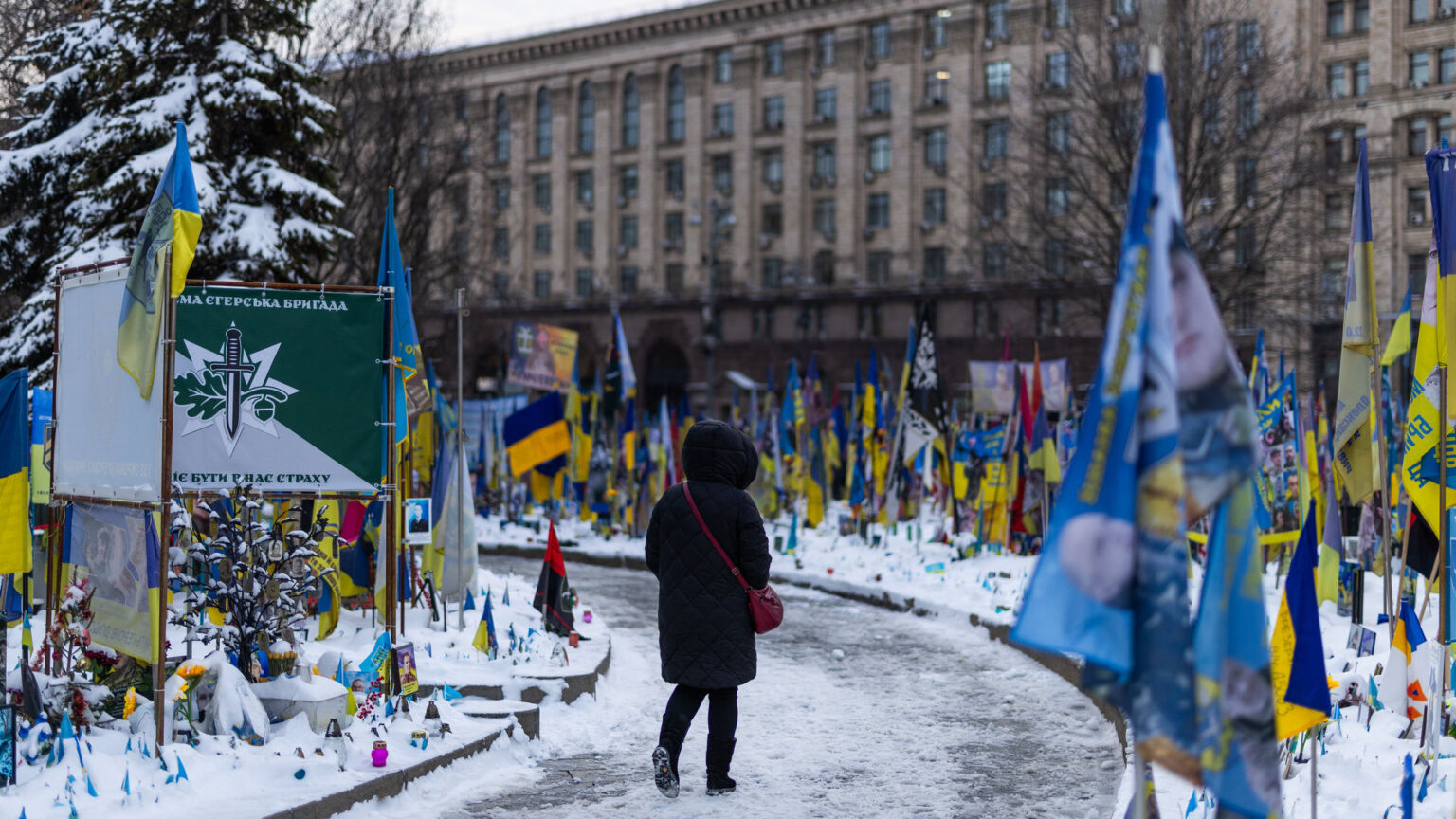
There is no optimism any more in Ukraine, but there is no collapse either. The mood of the country best resembles resignation. Ukrainians are resigned to what they have lost. They are reconciled to the pain. And yet they are determined to struggle on.
Still, one cannot but wonder how long this can go on. Russia’s latest attempt to break what remains of Ukrainians’ will – a merciless campaign against basic infrastructure that has left many without heat and power during the thick of winter – has not worked. But it has contributed to the rising sense that things cannot continue indefinitely. Ukraine’s well-documented struggles to mobilise enough men, and the accompanying grim practice of mobilisation officers snatching people from the street, point to a society at the limit of what is tolerable.
Indeed, few now even cheer the news of a successful counter-offensive, such as the one Ukraine has recently executed around Zaporizhzhia. The news just blends in with the deadening pattern of the conflict, as an endless exchange of territory between Russia and Ukraine. No military achievement is ever decisive. This is a war that increasingly appears to be without end.
At the negotiating table, progress is just as elusive as is on the battlefield. It’s true that talks are more serious now than they have been since very early in the war. Yet nothing seems to happen to shift either nations’ red lines – red lines that make compromise impossible. Russia insists on territory that Ukraine refuses to surrender; Ukraine insists on security guarantees that Russia considers a threat to its own security. Almost no one, inside or outside of Ukraine, doubts that this war must end, that it cannot go on. Yet at the same time, almost no one seems to be able to stop it.
There are reasons for the impasse of course. European elites, desperately unpopular with their own publics, seemingly need this war to continue to provide them with a sense of purpose. And Putin needs to wage it in order to provide his regime with a mission.

But it’s different for Ukrainians. This is a war that has been imposed on them by Russia at enormous, unjustifiable cost. Yet they are continuing to fight, not for the tepid promise of some kind of second-tier EU membership that Europe’s elites are now offering them. They are fighting for a messy, incomplete, but unmistakeable freedom. It is a fight from which they cannot and will not back down.
Jacob Reynolds is a writer based in Brussels and London.
You’ve hit your monthly free article limit.
Support spiked and get unlimited access.
Support spiked and get unlimited access
spiked is funded by readers like you. Only 0.1% of regular readers currently support us. If just 1% did, we could grow our team and step up the fight for free speech and democracy.
Become a spiked supporter and enjoy unlimited, ad-free access, bonus content and exclusive events – while helping to keep independent journalism alive.
Monthly support makes the biggest difference. Thank you.

Comments
Want to join the conversation?
Only spiked supporters and patrons, who donate regularly to us, can comment on our articles.