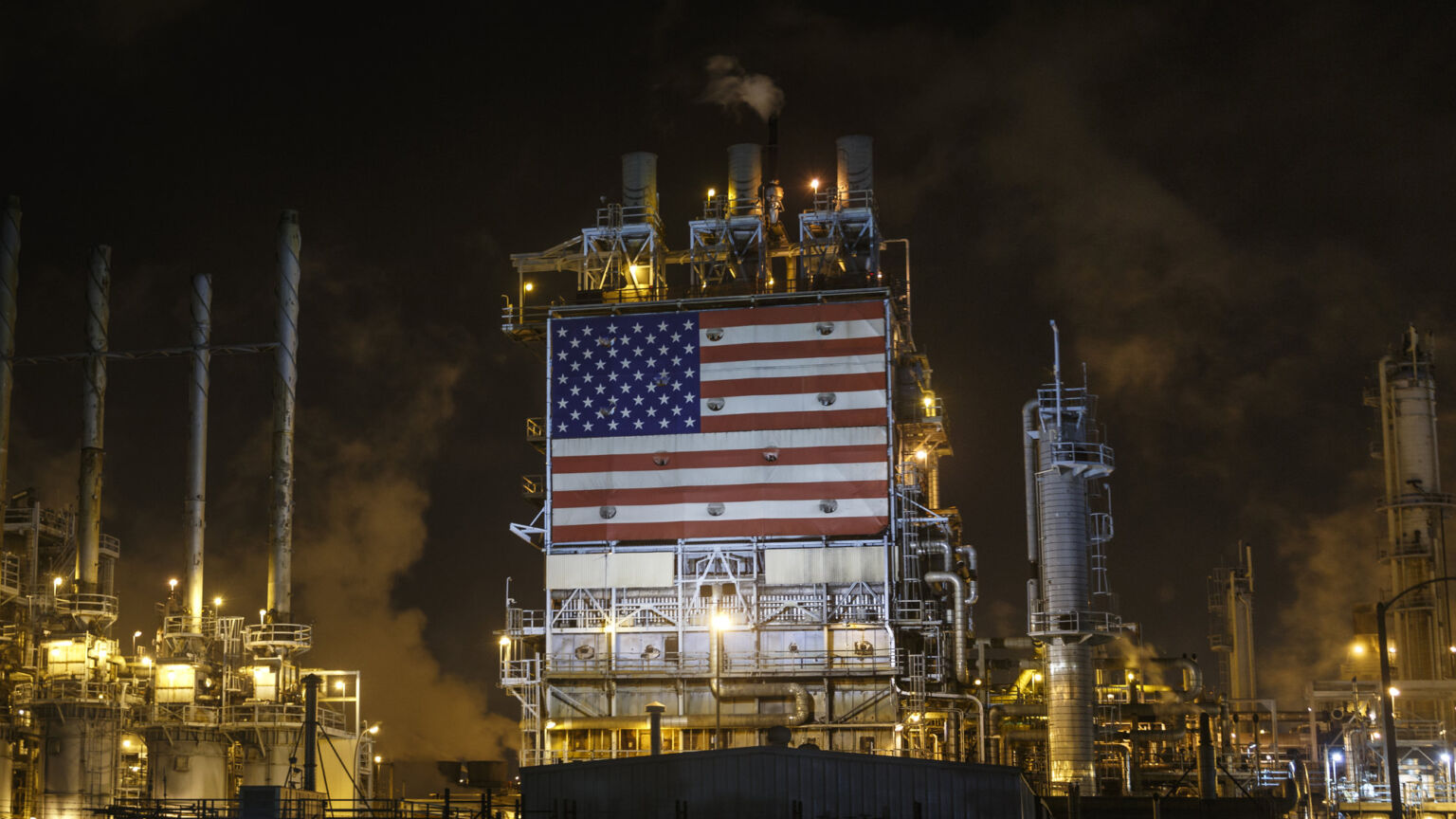
America is enjoying an industrial renaissance
But Trump and his tariffs can’t take the credit.
Want unlimited, ad-free access? Become a spiked supporter.
At the tail end of the Biden years, the US Navy released a YouTube advert promoting manufacturing jobs over those in the so-called gig economy. The now-deleted advert showed a young woman cycling through the low-pay and precarity of various gig economy roles, from rideshare driver to food delivery, before finding meaning in a new job building submarines. More than just a recruitment drive, the advert was also symbolic of the American economy’s shift to physical production and its revival of industrial capacity.
That revival has been gathering pace for a decade now. The initial victory of Donald Trump in the 2016 election was, in large part, put down to the decline of America’s manufacturing economy. That election year coincided with the publication of the influential ‘China Shock’ paper from the National Bureau of Economic Research, charting the scale of decline of American manufacturing jobs in the wake of China’s entry to the World Trade Organisation in 2001.
The loss of such jobs was, it has been argued, behind the opioid epidemic and the rising rates of so-called ‘deaths of despair’ among America’s working class. Books such as Amy Goldstein’s Janesville: An American Story charted the lives of residents in rust-belt towns losing their jobs at car-manufacturing plants and finding new, lower-paid roles at delivery-fulfilment centres.
It wasn’t just the social fallout of deindustrialisation that was finally being noticed by America’s leaders. It also became clear that the loss of industrial capacity would have consequences for American geopolitical power. By 2020, China accounted for almost 30 per cent of global manufacturing output vs America’s 17 per cent. As useful as America’s immense power over the global financial system is, the relative decline of its industrial strength compared with its primary geopolitical competitor is a major source of weakness. America, after all, ascended to global dominance in the 20th century owing to its ability to outproduce the rest of the world. While the 1990s free-trade enthusiasm brought real, albeit diffuse, economic benefits, it came with non-economic costs and risks, which were increasingly being recognised.
Trump brought this to the fore of American politics. His 2016 election campaign tapped into the social dysfunction wrought by the decline of manufacturing, while his attitude and rhetoric toward China was driven by a sense of loss of national power. Policy, however, was light. The Tax Cuts and Jobs Act, passed in his first year in office, provided tax cuts and brought in accounting changes to encourage capital investment. He also unleashed his first trade war against China, concluding with the ‘phase one’ agreement, which included a commitment from China to increase its purchasing of American goods.
However, the industrial revival didn’t really get going until the election of Joe Biden. While the Biden administration kept, and expanded, tariffs on China, it was its explicit turn to industrial policy that changed the trajectory. Through both the CHIPS and Science Act and the Inflation Reduction Act, the focus moved to subsidies and tax credits aimed at rebuilding domestic manufacturing capacity in semiconductor chips, battery plants, clean-energy equipment, electric vehicles and grid infrastructure. This set off a manufacturing boom, with total construction spending on manufacturing roughly tripling between 2020 and 2024.
Trump’s return to the White House has been a mixed bag. The Inflation Reduction Act has been partially rolled back. Although it’s been dismissed by the Trumpian right as money wasted on ‘green boondoggles’, that isn’t the full picture. Whatever one thinks about Net Zero, battery manufacturing, for instance, is vital for national security in the age of mass drone warfare.

Meanwhile, Trump’s tariffs have likely already led to shedding of US manufacturing jobs. After all, domestic factories often rely on imports for their inputs. At the same time, Trump’s energetic commitment to individual ‘deal making’ has led to several large commitments from individual companies to boost manufacturing investment in the US, from drug companies to chipmakers.
Other initiatives have included increased scrutiny of the scale spent by US defence companies on share buybacks and dividends. These mechanisms for returning money to shareholders are seen by the Trump administration as coming at the expense of investment in production capacity. In theory, future Pentagon contracts will depend on more being spent on production and less on returning money to shareholders. Rebuilding America’s industrial capacity in defence is also outlined as a key focus of the Pentagon’s latest National Defence Strategy.
Beyond politics, there is another leg to the industrial revival: artificial intelligence. The launch of ChatGPT not only rocketed AI’s capabilities into public consciousness, but also strengthened its commercial case. In response, America’s large tech companies have entered into an AI arms race, building out data-centre infrastructure on a vast scale.
Earlier this month, several of America’s largest tech companies announced their capital-expenditure figures for the year ahead. Meta, Google, Microsoft and Amazon are expected to spend a combined $660 billion. Not only is the figure itself enormous, so too is its increase from the past few years’ already gargantuan capital expenditure. The planned $660 billion spend represents a 60 per cent increase on 2025 and a 165 per cent increase compared with 2024. According to some estimates, this AI capital expenditure alone is expected to provide a 1.4 per cent boost to US growth in 2026 and a 1.5 per cent boost in 2027.

The data centres themselves do not count as manufacturing, as such. They are, after all, just warehouses for computers. But the boom in data centres sits within the broader revival of capital-intensive physical investment. As well as boosting demand for specialist equipment and materials, data centres are energy-intensive, and so they are driving renewed investment and growth in both energy production, and expansion and upgrades to the electricity grid. Indeed, we have started to see tech companies help drive a revival in nuclear energy, most notably with Microsoft agreeing to underwrite the restart of the infamous Three Mile Island power plant in Pennsylvania.
Ironically, the companies that once represented the abstract, asset-light, digital tech economy of the 2010s are now major drivers in the real, material economy. The platforms that enabled the gig-worker and app-based jobs of the previous decade are themselves now a major driver of America’s industrial revival.
We have, it would seem, entered into what one economist describes as the the ‘tangible ‚20s’ – a new era of investment in physical infrastructure and manufacturing. An industrial renaissance is now well underway.
Tom Bailey is a writer.
You’ve hit your monthly free article limit.
Support spiked and get unlimited access.
Support spiked and get unlimited access
spiked is funded by readers like you. Only 0.1% of regular readers currently support us. If just 1% did, we could grow our team and step up the fight for free speech and democracy.
Become a spiked supporter and enjoy unlimited, ad-free access, bonus content and exclusive events – while helping to keep independent journalism alive.
Monthly support makes the biggest difference. Thank you.








Comments
Want to join the conversation?
Only spiked supporters and patrons, who donate regularly to us, can comment on our articles.