This Wuthering Heights is a camp, loveless failure
Emerald Fennell has stripped Emily Brontë’s beloved classic of its joy, tragedy and depth.
Want unlimited, ad-free access? Become a spiked supporter.
Emerald Fennell’s new adaptation of Emily Brontë’s Wuthering Heights has had a huge amount of hype. The casting of Jacob Elordi as Heathcliff and Margot Robbie as Cathy, and their uber-flirty promotional tour, set tongues wagging. The trailers promised sex and glamour, complete with a Charli XCX soundtrack. And then of course, there was the small matter of Fennell’s previous directorial effort – the notoriously debauched black comedy, Saltburn. The question of how Fennell would interpret Wuthering Heights was at the very least intriguing.
Brontë’s Wuthering Heights, first published in 1847, is a story of love, cruelty and revenge. Set in the North York Moors, it centres on the life of Heathcliff, an orphan who, having been taken in by the Earnshaw family, falls in love with his foster sister, Cathy. The pair grow up inseparable, but social conditions, misunderstandings and vengeful scheming tear their lives apart. Playing on the wind-whipped wildness of the moors, it’s a glorious Gothic Romance, featuring ghosts, doomed passion and a descent into madness – plus a huge dollop of social commentary, too, as Heathcliff rises from poor servant to bitter master.
Many Brontë fans like myself were really looking forward to a 21st-century reimagining of one of the greatest love stories of all time. Brontë’s Wuthering Heights is breathtaking in its high drama. Heathcliff’s devotion to Cathy is every teenage girl’s dream. Who doesn’t want someone to love you so intensely he would dig you up once you’re dead, just to hold you? In our increasingly prudish times of reactionary feminism, incels and abstinent Gen-Zers, Fennell’s Wuthering Heights promised to be a welcome reminder of how much fun a bracing heterosexual romance can be. Especially with all that gorgeous scenery, those heaving bodices, and a topless Elordi to work with.
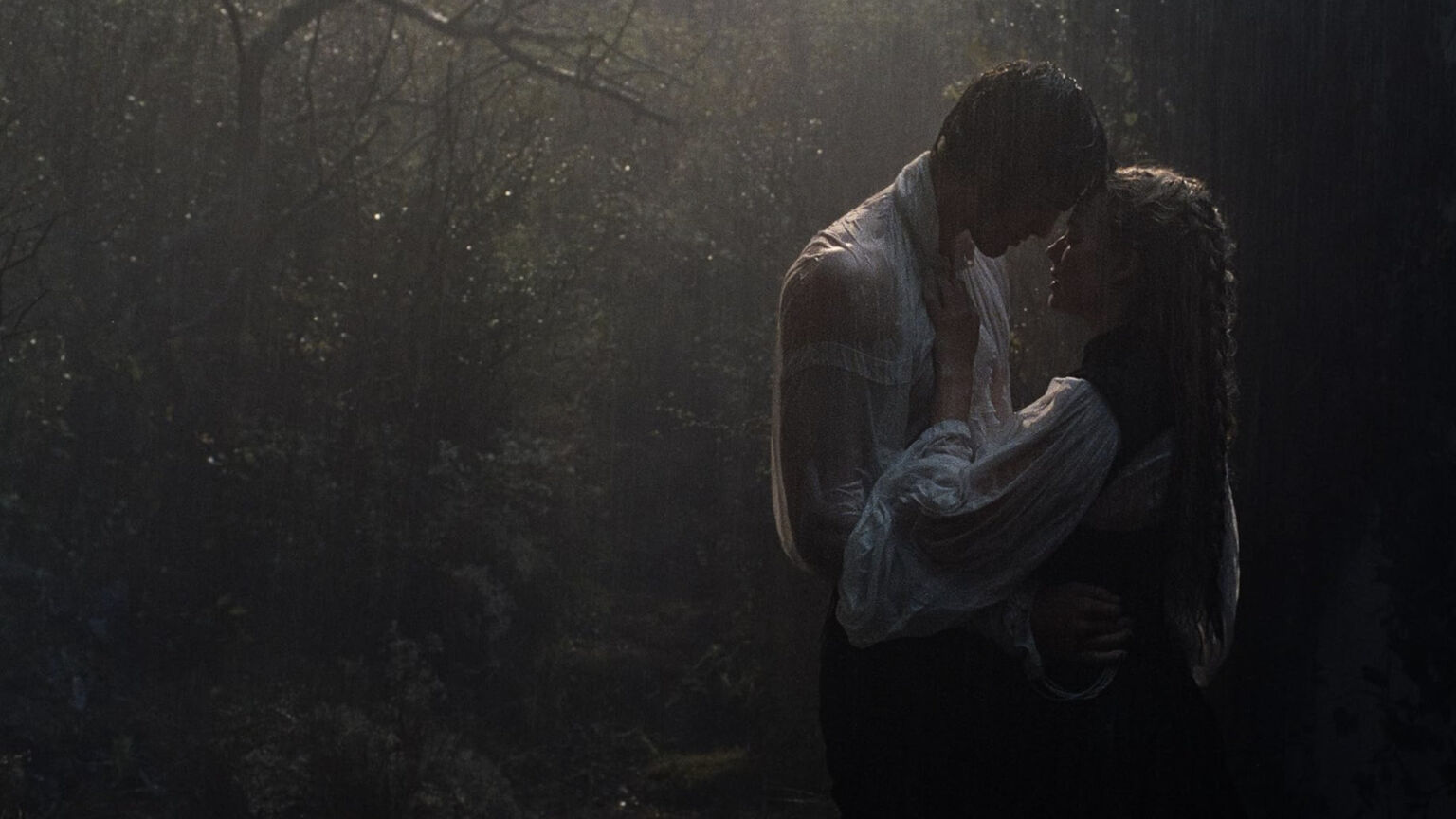
But despite its excessive Mills and Boon trappings, Fennell’s Wuthering Heights is a loveless failure. Elordi and Robbie may have been displaying something that looked like chemistry during the press tour, but they are wooden on screen. Their romantic scenes are laughable, including pantomime-style gasping and far, far too many sightings of Elordi’s tongue.
Fennell’s big-budget production looks like a cross between Beetlejuice and Poor Things, with the actors wearing what’s left of Adam Ant’s wardrobe. White face powder, lamé nightdresses and bejewelled crucifixes turn Robbie’s Cathy Earnshaw from wild Yorkshire lass into Barbie in a corset. Fennell’s camp vision has removed the gothic seriousness of the book entirely – she has even excised any reference to Cathy’s terrifying child ghost knocking at the window. This is Carry On Wuthering, and it is impossible to take seriously. Audience members at my screening heckled every appearance of Aussie actor Elordi with his shirt off, with a ‘g’day’.
Of course, literary adaptations are free to deviate from the source material, but Fennell’s decisions sacrificed Brontë’s high drama for tedious titillation. There are only so many scenes of Robbie fingering fish in jelly that one can watch without yawning.
Perhaps Fennell’s most grievous sin has been to reduce a story of love to a tale of lust. There are no sex scenes in Brontë’s Wuthering Heights, but the passion and depth of feeling with which she writes about these two lovers stirs the imagination. ‘If all else perished, and he remained, I should still continue to be’, says Cathy of Heathcliff, ‘and if all else remained, and he were annihilated, the universe would turn to a mighty stranger: I should not seem a part of it’.

And when considering the prospect of leaving Heathcliff and marrying her rich neighbour, Edgar Linton, Cathy tells her friend, Nelly:
‘My love for Linton is like the foliage in the woods: time will change it, I’m well aware, as winter changes the trees. My love for Heathcliff resembles the eternal rocks beneath: a source of little visible delight, but necessary. Nelly, I am Heathcliff!’
The entire novel turns on these lines. Heathcliff overhears part of the conversation, misunderstands it and promptly departs – a move that eventually spells his and Cathy’s doom. That Fennell chose to cut them tells you everything about her misunderstanding of the entire novel.
Perhaps we shouldn’t have expected anything more from socialite-turned-filmmaker Fennell. She has a directorial track record of superficial films that prefer to shock rather than transport the viewer. In many ways, Fennell’s Wuthering Heights is symptomatic of our times – a cold, mean take on true love. This cuts against the grain of Brontë’s original. Even in their nastiest, cruellest moments (of which there are many), the reader is left in no doubt that Cathy and Healthcliff love one another. As Heathcliff tells Cathy after her death:
‘Be with me always – take any form – drive me mad! Only do not leave me in this abyss, where I cannot find you! Oh, God! It is unutterable! I cannot live without my life! I cannot live without my soul.’

Fennell has massacred one of literature’s most passionate and tragic love stories. It is a cynical adaptation for our silly times. Watch at your peril.
Ella Whelan is the author of The Case For Women’s Freedom, the latest in the Academy of Ideas’ radical pamphleteering series, Letters on Liberty.
You’ve hit your monthly free article limit.
Support spiked and get unlimited access.
Support spiked and get unlimited access
spiked is funded by readers like you. Only 0.1% of regular readers currently support us. If just 1% did, we could grow our team and step up the fight for free speech and democracy.
Become a spiked supporter and enjoy unlimited, ad-free access, bonus content and exclusive events – while helping to keep independent journalism alive.
Monthly support makes the biggest difference. Thank you.


Comments
Want to join the conversation?
Only spiked supporters and patrons, who donate regularly to us, can comment on our articles.