The lie at the heart of Starmer’s ‘Brexit reset’
The data are in: the Project Fear predictions of economic doom have simply not come to pass.
Want unlimited, ad-free access? Become a spiked supporter.
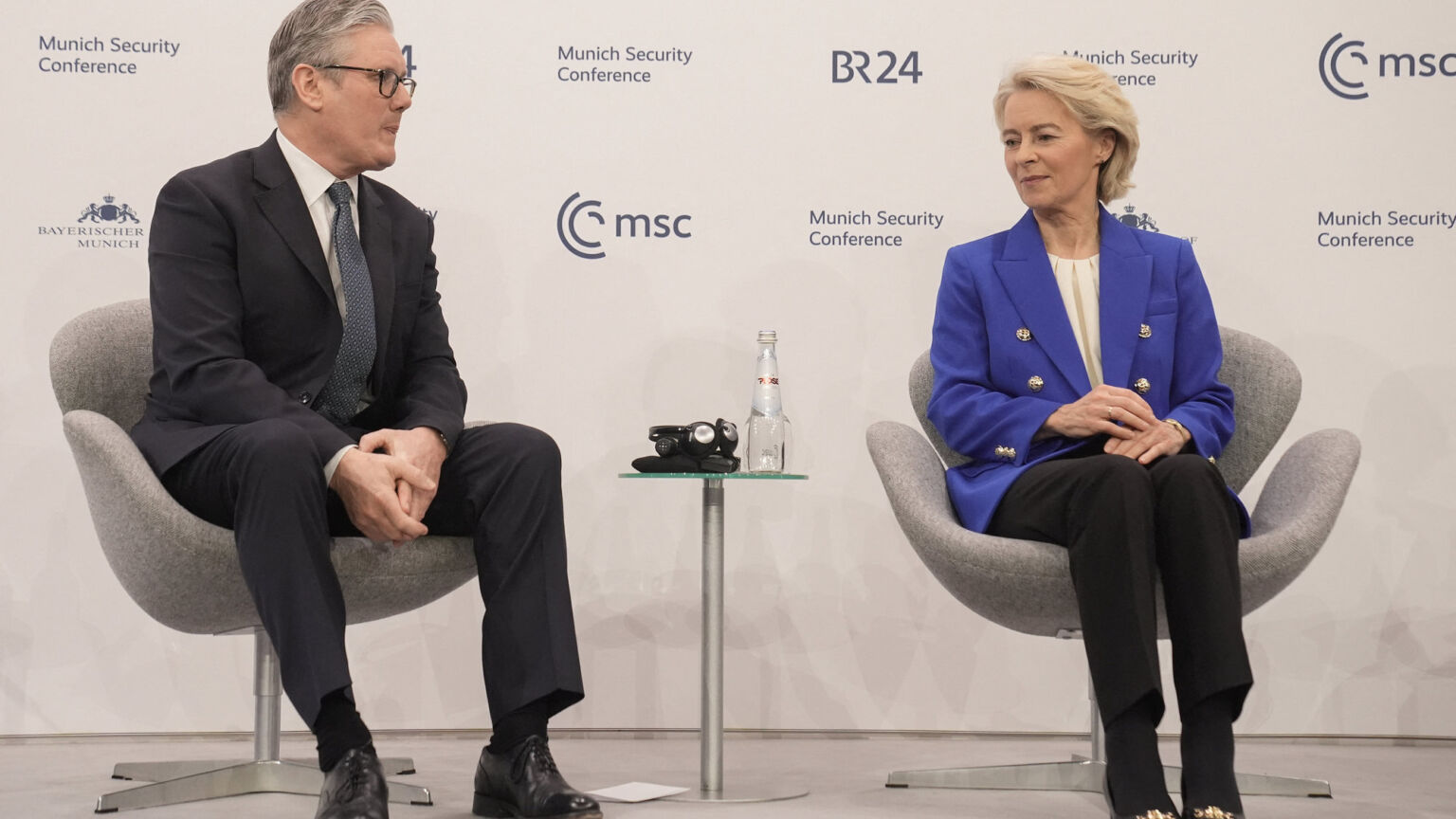
Keir Starmer is making no secret of the fact that his ‘Brexit reset’ is part of a longer-term plan to move the UK closer to the EU. Speaking at the Munich Security Conference last week, he said ‘We are not the Britain of the Brexit years anymore’. The so-called dynamic alignment being proposed by Starmer means committing to put EU regulations into UK law, without our elected representatives having any say on them.
Underpinning this policy is the assumption that Brexit continues to cause catastrophic losses to the UK economy. In particular, it seems to have become an article of faith among many politicians and commentators that Brexit has been disastrous for UK trade. There is just one problem with this claim: it is not true.
Last Thursday, UK trade data for 2025 were published, meaning we now have 10 years of data since the EU referendum and five years’ worth since Britain left the Customs Union.
The Office for Budget Responsibility (OBR) has consistently argued, even as recently as November 2025, that Brexit would cause a four per cent hit to UK productivity, based on the assumption that leaving the EU would cause total trade (imports plus exports) to be 15 per cent lower than if we had stayed in. So what do the latest trade data tell us about the OBR’s assumption?
All sides should acknowledge that working out the counterfactual of remaining in the EU is not easy. In the first place, it is not clear what is the best reference point for measuring any Brexit effect. One option is to use 2015, the year before the referendum. Another would be 2019, the year before we officially left the EU in January 2020. Perhaps when looking at trade, it would be better to use 2020 as the starting point, given we only left the EU Customs Union in January 2021. The difficulty there is that global trade in 2020 was significantly affected by Covid.
However, whatever starting point we use, the latest data show that total UK trade has actually increased since 2015, even allowing for inflation. Now you might expect trade to increase over time as the economy gets bigger. In fact, UK trade in real terms has grown faster than GDP. And this is true for both imports and exports.
Between 2015 and 2025, total UK exports in real terms increased by 23 per cent, compared to GDP growth of just 14.4 per cent. Since 2019, exports are 6.9 per cent up while GDP increased by just 5.2 per cent. And the 2025 data reveal exports have increased by two per cent since 2024 compared to a 1.3 per cent growth in GDP.

Might UK trade have increased even more had we stayed in the EU? If we look behind the total figures, we can see that exports in goods to the EU have dropped since Brexit. But that fall has been more than compensated by increases in services trade, particularly to non-EU countries.
In terms of establishing a causal impact from Brexit, it’s important to remember that we have maintained tariff- and quota-free trade in goods with the EU, under the terms of the UK-EU Trade and Cooperation Agreement. It is, however, true that some non-tariff barriers have increased, such as administrative checks for goods at the border. Thus, it is likely that some of the fall in goods exports to the EU is indeed due to Brexit. But we need to be cautious even on this point, as a number of factors unrelated to Brexit have contributed to the decline in UK goods exports.
High energy prices and carbon taxes have led manufacturers, particularly in the chemicals sector, to shift production away from the UK. At the same time, government policy has reduced North Sea oil production. As a result, exports have declined in both of those sectors. Exports to the EU have also been affected by weak demand in key EU countries such as Germany, which only narrowly avoided recession last year. Without doubt, UK goods exports would have decreased in recent years even had we stayed in the EU.
But there is another effect that is less well known. Since leaving the EU, changes in ‘rules of origin’ criteria, used to determine the ‘economic nationality’ of a product, mean that goods produced outside the UK, imported here and then exported to Europe, are now no longer classified as exports (tropical fruits and nuts, for instance, are often imported from the Commonwealth and then re-exported to the EU). In other words, some of the decrease in reported exports to the EU is due to how the data are now measured, rather than any actual reduction in exports. When you consider all of these factors, it is all the more notable that total reported exports have increased so much since Brexit.

And when it comes to services, a sector much more important to UK trade than goods, Brexit was followed by a demonstrable reduction in the OECD’s services-restrictiveness index. In part this is due to the many service-focused trade deals we have made with other countries, including with Australia, India and the 11 countries in the Comprehensive and Progressive Agreement for Trans-Pacific Partnership. Crucially, these trade deals would have been literally impossible had we stayed in the EU. Indeed, even rejoining the Customs Union, as potential Labour leadership contender Wes Streeting and deputy PM David Lammy have both advocated, would mean those post-Brexit trade deals would have to be abandoned.
Overall, the net impact of Brexit on trade is impossible to know for sure. But it seems likely that, if anything, Brexit has resulted in an increase in total trade. Certainly, the OBR’s assumption that Brexit would result in a 15 per cent hit to UK trade is simply implausible in the light of the real data.
And if Brexit hasn’t hit trade, it is hard to see how it could have significantly hit the UK economy. A recent working paper argues that Brexit has meant UK GDP is eight per cent lower than it would otherwise have been. But this outcome is just as inconsistent with the actual data as the OBR’s trade assumption.
In recent years, the UK’s GDP per capita has grown faster than many of our big rivals who stayed in the EU, most notably Germany. The real outlier is the US, where economic growth has far outpaced both the UK and the big EU countries. And the reasons for that divergence are nothing to do with Brexit. Instead, they include the fact that, unlike most of the EU and the UK, the US has largely refused to pursue climate policies that lead to disastrously high energy costs for industry.
If it were true that Britain’s GDP would have been eight per cent higher without Brexit, the implication is that UK economic growth would have leap-frogged the other EU countries and actually rivalled that of the US. Again, this is just implausible.
Given other factors such as Covid, energy prices and the Ukraine war, it is hard to be certain whether the net impact of Brexit on the UK economy so far has been positive or negative. But looking at how well UK trade and GDP has held up relative to our big EU rivals, we can be confident any negative effect has been small at worst.
Starmer’s EU reset has little chance of improving sclerotic economic growth in the UK. Dynamic alignment of food regulations might lead to a small increase in UK exports to the EU, but it will benefit EU farmers more than our own – not least as we import vastly more food than we export to the EU market. And by imposing EU regulations on the whole UK economy, there will also be costs: a higher regulatory burden for UK producers, higher prices for UK consumers as it becomes more difficult for us to import cheaper alternatives to EU products, risks to trade deals with countries like the US and, of course, the democratic deficit from us having to accept EU laws with no say from our elected representatives. Even worse, it seems likely that we will have to pay the EU significant sums of money for the privilege of following its laws. Good job the chancellor has plenty of cash to spare!
Keir Starmer’s policy of tying the UK to the EU’s regulatory orbit is not based on real-world data or on a solid analysis of likely benefits to the UK economy. The PM is blindly following Remainer dogma.
David Paton is professor of industrial economics at Nottingham University Business School. Follow him on X: @CricketWyvern.
You’ve hit your monthly free article limit.
Support spiked and get unlimited access.
Support spiked and get unlimited access
spiked is funded by readers like you. Only 0.1% of regular readers currently support us. If just 1% did, we could grow our team and step up the fight for free speech and democracy.
Become a spiked supporter and enjoy unlimited, ad-free access, bonus content and exclusive events – while helping to keep independent journalism alive.
Monthly support makes the biggest difference. Thank you.




Comments
Want to join the conversation?
Only spiked supporters and patrons, who donate regularly to us, can comment on our articles.