Sadiq Khan is gaslighting Londoners over crime
The mayor has dismissed complaints of soaring crime as a Trumpian myth. We can’t let him get away with it.
Want unlimited, ad-free access? Become a spiked supporter.
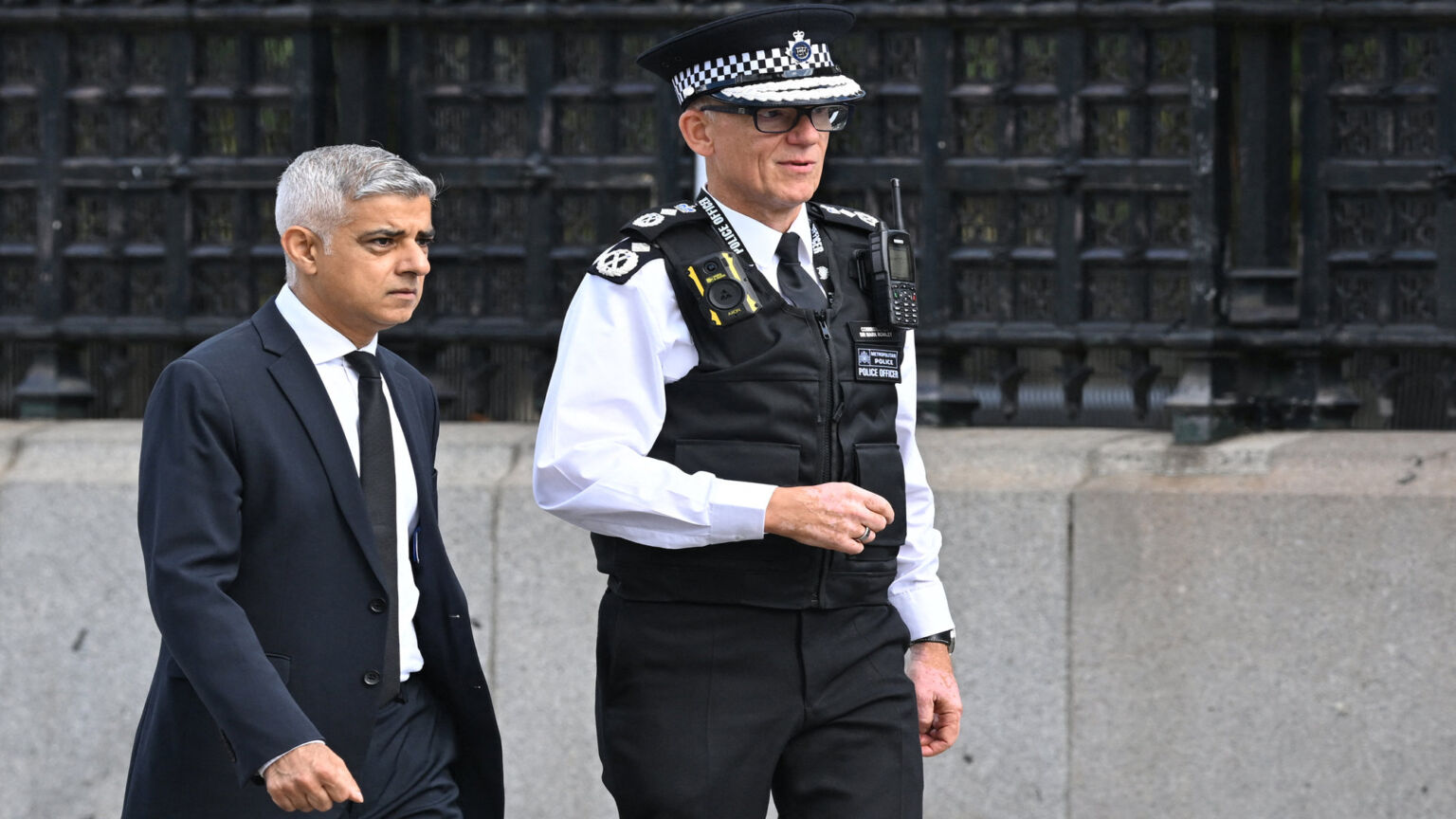
London mayor Sadiq Khan and Metropolitan Police commissioner Mark Rowley joined forces this week to take a swing at critics who accuse London of being unsafe. ‘An endless stream of distortions and mistruths’, Khan wrote in the Guardian, are ‘painting a dystopian picture of a lawless place where criminals run rampant’. Writing in The Times on Monday, Rowley echoed Khan’s complaint: ‘Some commentators promote a narrative that suits them, regardless that the facts tell a very different story.’ Were it not for the misinformed claims of Donald Trump and Nigel Farage, the pair are essentially saying, no one would have a bad word to say about London, other than the difficulty of buying a house.
The ‘fact’ Rowley was most keen to emphasise was London’s comparatively low homicide rates. The Met chief said that the 97 murders recorded in the capital last year were the lowest since 2014 – lower than cities such as Los Angeles, Berlin and Milan. ‘London is safer… This is not a matter of opinion or messaging; it is what the data show.’
Rowley and Khan are not alone in opposing the ‘narrative’ that the capital is unsafe. Deputy Met commissioner Matt Jukes was more insistent still. London ‘does not deserve the reputation it is sometimes given’, he told LBC this week. ‘The facts speak for themselves. London is safe and getting safer.’
But much to Rowley’s irritation, the media and the public have been reluctant to swallow his arguments. When he was challenged on Times Radio about the huge rise in phone thefts over the past year, he accused the presenter of being ‘allergic’ to positive news about London. ‘The fact that so much public debate is now more on rhetoric than facts is not my responsibility’, he complained.
Rowley and Khan might well be right that you are less likely to be murdered in London today than 10 years ago. This is certainly good news. But the truth is most Londoners have never been at especially high risk of being murdered. Thankfully, murder has always been a rare crime – and much of it recently has been gang-related. The average Londoner is less worried about being stabbed or shot on her way to work, than about other crimes that are not only far more common – they are also on the rise. All of which the Met and Khan appear to be indifferent towards.
Shoplifting offences, for instance, reached a record high in the year ending June 2025, when 94,783 incidents were recorded. That’s a 38 per cent increase from the previous year. Phone thefts, too, have risen massively over the past few years. Nearly 120,000 phones were stolen in 2024, an increase of 25 per cent on the figures for 2019.
Skyrocketing rates of petty theft are not the only thing that makes Rowley and Khan’s gloating so disingenuous. Many violent crimes have increased, too. The most disturbing of these is the substantial rise in sexual offences. There were more than 26,000 sex offences recorded in London last year – an increase of more than 10,000 on the 2015 figures. Last year, the BBC reported that sex offences on the London Underground were at their highest level since 2019.

Then there’s London’s as yet underexplored role in the grooming-gangs scandal. Despite Khan’s obfuscation on this issue (in January last year, when asked about it in the London Assembly by Conservative Susan Hall, he insisted she clarify ‘what is meant by grooming gangs’), it is clear that the Met has been failing at-risk children just as much as other police forces around the country. A few months later, Scotland Yard announced a review of 9,000 child sexual-exploitation cases on the grounds that grooming gangs are more ‘widespread, organised and under-reported than previously acknowledged’ in London. Whistleblowers have told the BBC that child grooming in London could be even ‘more catastrophic’ than anywhere else in the UK.
More widespread still are drug offences. Last year, they exceeded 50,000 – an increase of more than a third from the previous year. Drug dealing is so comically easy to get away with now that jobs are advertised on social media, particularly Instagram. As the Sun recently reported, anyone can get paid £200-a-day selling cocaine in west London. You even get a car and fuel provided. Meanwhile, drug dealers’ money-laundering fronts – from dodgy barbers to vape shops and off-licences, which somehow survive sky-high rents while getting next to no custom – are proliferating on every London high street.
Arguably, it is these aspects of London life, the degradation of law and order in plain sight, that make Londoners feel most unsafe. Or, if they don’t feel unsafe, they at least feel uncomfortable and unsettled. In April last year, when a man was filmed casually smoking crack on the Victoria Line, no one was running for their lives. But they weren’t exactly thrilled. At the very least, they were perplexed as to why the authorities didn’t bother to intervene. This might fit Rowley’s definition of a ‘safe’ city, but it isn’t how the rest of the population feel.
There’s no doubt that London is a great city. It is a testament to the capital’s stengths that so many people want to live here, regardless of the drawbacks. But that doesn’t mean we need to accept Rowley and Khan’s gaslighting. They can spin a few selective stats as much as they like, but they can’t pull the wool over Londoners’ eyes.
Hugo Timms is a staff writer at spiked.
You’ve hit your monthly free article limit.
Support spiked and get unlimited access.
Support spiked and get unlimited access
spiked is funded by readers like you. Only 0.1% of regular readers currently support us. If just 1% did, we could grow our team and step up the fight for free speech and democracy.
Become a spiked supporter and enjoy unlimited, ad-free access, bonus content and exclusive events – while helping to keep independent journalism alive.
Monthly support makes the biggest difference. Thank you.






Comments
Want to join the conversation?
Only spiked supporters and patrons, who donate regularly to us, can comment on our articles.