Why we love to hate luvvies
Beneath the ‘progressive’ preening of Olivia Colman and her ilk lies a thinly veiled contempt for ordinary people.

Want unlimited, ad-free access? Become a spiked supporter.
In 1862, the year after the emancipation of the serfs, there appeared in Russia a short story by Fyodor Dostoevsky in which the author scorned – as was his habit – his country’s liberals, who were then congratulating themselves on a new spirit of progressive thinking. ‘A Nasty Business’ takes place, as the narrator cynically relates, ‘when the renaissance of our beloved fatherland was beginning with such irrepressible force and such naive fervour’. It features a bumptious type called Ivan Ilyich Pralinsky, a man who pronounces with great ostentation at a dinner party: ‘In my opinion humaneness is the first thing, humaneness towards one’s subordinates, remembering that they, too, are people. Humaneness will save everything and set everyone on the right path.’
In the end, things turn out miserably for Ivan Ilyich. He is ultimately humbled and humiliated by his drunken behaviour, and by his uncontrollable urge to inform everybody ‘What a good and splendid person he was’, ‘what a progressive he was, how humanely he was prepared to condescend to everyone’.
Dostoevsky was, in many respects, a jaundiced reactionary, but his sentiments here still ring true – not least his wish to see pompous do-gooders get their comeuppance. Such sermonising condescension is certainly alive in Britain today.
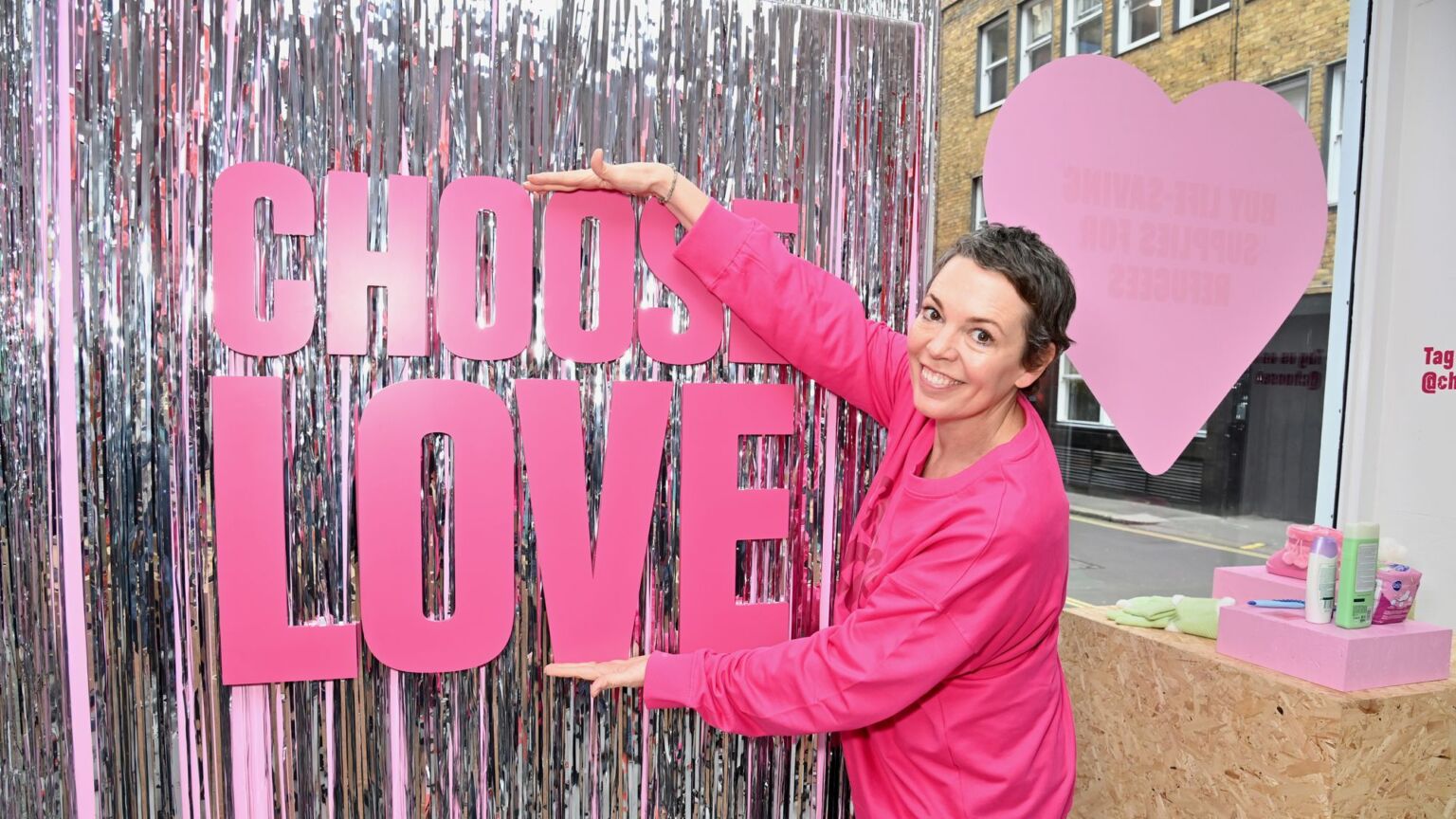
The showy humaneness of Britain’s acting fraternity on the issues of asylum and immigration was once again in the spotlight over the Christmas holidays. The fiasco over Alaa Abd el-Fattah, the Egyptian activist who once wrote on social media about how much he hated white people, illustrated how thespians will forever align themselves with a noble-seeming cause that makes them look good and feel important. An open letter demanding he be released from Egyptian prison and brought to the UK was signed by the same old roll of dishonour: Stephen Fry, Olivia Colman, Brian Cox and the like.
Meanwhile, as Charlotte Gill has also been highlighting on X, an increasing number of ‘celebrities are turning borders into a fashion statement’, through their support of the charity Choose Love, an organisation that calls itself ‘a movement of people who are using love to make the world a better place’. Louis Theroux, Nish Kumar, Chris Martin and Tamzin Outhwaite have literally paraded on Choose Love’s behalf to proclaim that ‘love has no borders’.
These individuals and institutions appeal to widespread sentiment today. While Corbynite outfit Novara Media fulminates against the ‘outright bullshit fuelling anti-migrant hate in Britain’, Choose Love repeats the same simplistic, ‘progressive’ message, only in more insipid language: ‘We need humanity now more than ever. Choose Love over hate. Stand with refugees.’ Of whatever hue, progressives propagate the myth that Reform UK supporters, and those who are ‘populist’ and patriotic by persuasion, are consumed with ‘hate’.
If any hatred abounds today, it is not so much directed at immigrants as at those preening middle-class liberals – luvvies who forever massage their egos in public, eternally seeking to impress their peers with meaningless platitudes about incomers ‘being people, too’. It is hatred towards an echelon who lives in cloistered, ethnically homogenous areas, a class who seldom feels the impact of unsustainable levels of immigration. It is the likes of Rowan Williams – whose latest vacuous homily implores us not to depict ‘every migrant either as an individual in search of security at all costs, or as a plain enemy’ – who raise the blood pressure. It is the naive and boastfully compassionate who are the real objects of most of our contempt.

Many of those who argue for less permeable borders do not ‘dehumanise’ asylum seekers. Quite the reverse. They recognise that many incomers are human beings exactly like them: people who act just as rationally and self-interestedly as they do, and who are drawn to a land offering greater opportunities and benefits. They also know that this country is ruled by self-centred and cosseted elites – by condescending do-gooders whose chief priority is to notify everyone else just what splendid people they are.
Stop treating men as defective women
In living memory, men have been incessantly exhorted to ‘open up’ and ‘share their feelings’ in order to become better and more balanced people. In more recent times, the failure to develop emotional intelligence has been blamed for a ‘crisis of masculinity’, spawning even the concept of ‘toxic masculinity’. At its worst, such ‘toxicity’ is now deemed inherent to masculinity itself.
As reported in The Sunday Times last weekend, a professor of anthropology at Durham University has found a remedy for our woes. According to a study conducted by Thomas Yarrow, the answer is simple: men do not like talking about their feelings and should not be encouraged to do so. They derive far greater satisfaction and self-fulfilment through hard work and banter.
‘There’s a discourse about men opening up, and we think that real connection and real friendships are about sharing our innermost feelings and emotions’, Yarrow says, reflecting on the prevailing narrative. ‘But I slowly realised that it wasn’t that they couldn’t, but that they didn’t want to.’ His findings suggest that men find far more support through ‘activities, doing things together, often in companionable silence’. The preferred form of dialogue among men, he concludes, is amiable piss-taking.
‘New academic research uncovers the blindingly obvious’ might be your reaction, as it was mine. Indeed, men would be in a much better place today if society had not laboured for decades under the delusion that the way women think represents the normal, default position of humanity – and that not behaving like a woman, not opening up, not talking about your feelings, not talking all the time full stop, represents some kind of dysfunction or aberration.
Men are not the ‘second sex’. Masculinity has never been in need of fixing.
The glorious bleakness of Blackadder
Today, 9 January, marks the 40th anniversary of the first broadcast of Blackadder II, possibly the finest British comedy series of the 1980s.
Over the years, many have attributed the success of the Blackadder saga to its grounding in perennial British frustrations over class. Like Basil Fawlty, Edmund Blackadder is a bright, lower-middle-class type. His plans and ambitions are forever thwarted by a stupid toff and an even more braindead prole.
But Blackadder also resonated because, like David Brent in The Office, Edmund’s life is a disappointment. ‘The path of my life is strewn with cowpats from the devil’s own satanic herd’, he laments in this classic series.
In an age in which so many are made miserable by comparing themselves to others on social media, convinced that everyone else’s life is perfect, Edmund Blackadder remains a valuable antidote. He is a reminder that life rarely works out as you thought it would.
Patrick West is a spiked columnist. His latest book, Get Over Yourself: Nietzsche For Our Times, is published by Societas.
You’ve hit your monthly free article limit.
Support spiked and get unlimited access.
Support spiked and get unlimited access
spiked is funded by readers like you. Only 0.1% of regular readers currently support us. If just 1% did, we could grow our team and step up the fight for free speech and democracy.
Become a spiked supporter and enjoy unlimited, ad-free access, bonus content and exclusive events – while helping to keep independent journalism alive.
Monthly support makes the biggest difference. Thank you.




Comments
Want to join the conversation?
Only spiked supporters and patrons, who donate regularly to us, can comment on our articles.