The Coalition of Wishful Thinking
Starmer and Macron’s plan for Ukraine is a reckless empty gesture.
Want unlimited, ad-free access? Become a spiked supporter.
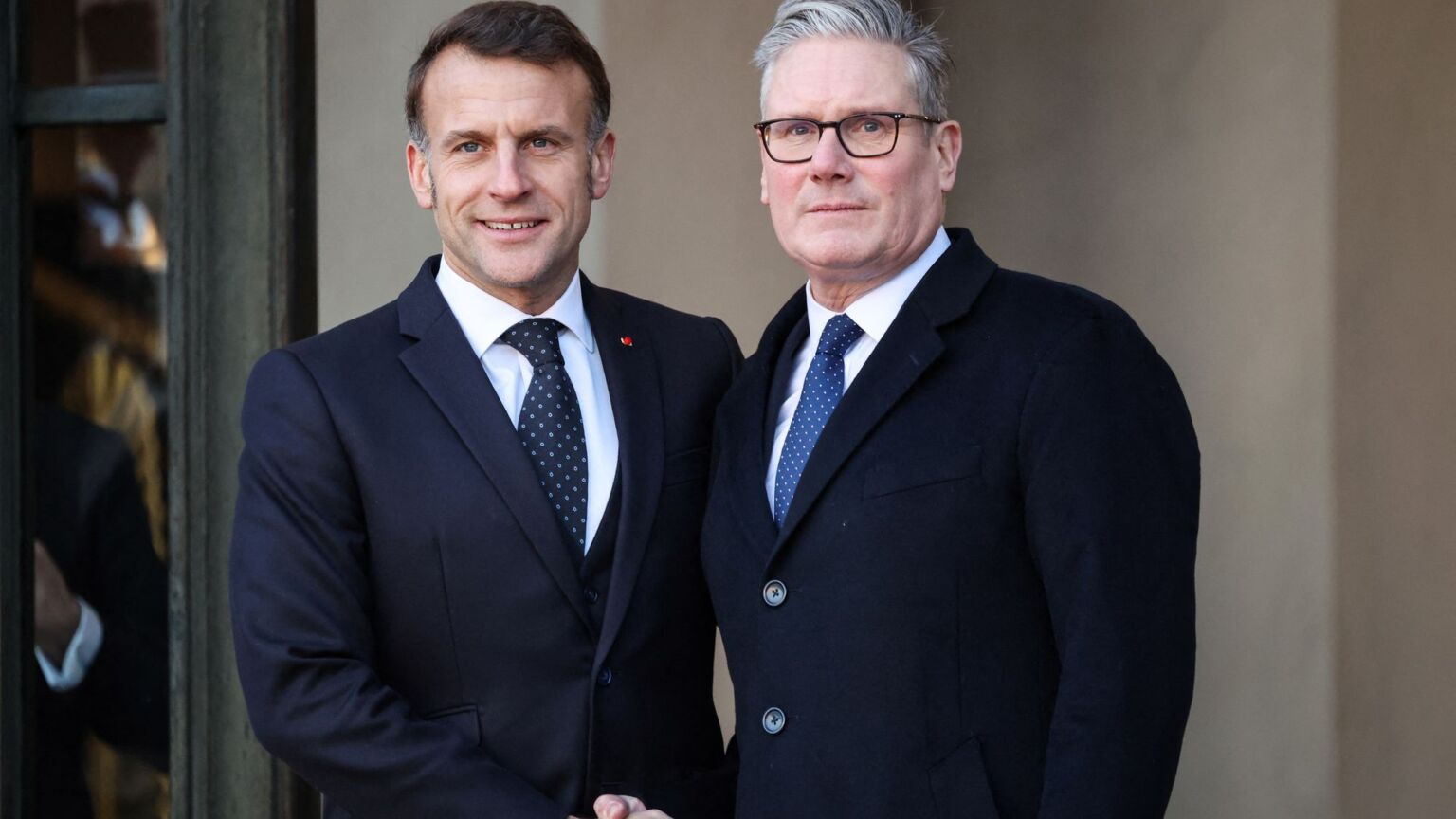
It was quite the performance at the Élysée on Tuesday afternoon. Nearly 30 European leaders, plus US envoys, were gathered for a suitably wintry summit on the war in Ukraine. This, the 15th meeting of the so-called Coalition of the Willing since its launch last March, had a different feel to the previous 14. And so it proved. After several hours of talks, the Anglo-French-led coalition backing Ukraine seemed to have actually produced something. A ’declaration of intent’, no less.
Striking statesmanlike poses, French president Emmanuel Macron and UK prime minister Keir Starmer announced that they had agreed to deploy troops to Ukraine and to build special military hubs and weapons facilities there, if and when a ceasefire is agreed with Russia. British, French and ‘partner forces’, said Starmer, will provide ‘reassurance measures in the air, at sea and on land’. And they will assist with the ‘regeneration of the armed forces of Ukraine’. What’s more, for the first time since the Coalition of the Willing started discussing Ukraine’s future security arrangements, the US – represented by special envoy Steve Witkoff and Donald Trump’s son-in-law, Jared Kushner – actually backed the proposals.
It looked and sounded like something had been achieved. It appeared as if Macron and Starmer had finally succeeded in turning the Coalition of the Willing – a ‘once-in-a-generation moment’ for European security, as Starmer had it last year – into something concrete: a multinational force, backed by the US, ready to step into Ukraine when the fighting stops. This was the future ‘security guarantee’ that Ukraine had been seeking for the past four years.
That, at least, was the impression given by Macron and Starmer yesterday. But look beyond the impression – beyond the diplomatic cavalcades, leader photocalls and grand declarations – and it’s difficult to escape the suspicion that the Coalition of the Willing is largely an empty, if still rather reckless, spectacle. A piece of geopolitical theatre staged by powers in long-standing decline. A sense that Macron and Starmer are all bouche and no pantalon.
For a start, the details of what these ‘reassurance forces’ might entail remain tellingly thin on the ground. Given the parlous state of the British Army (with just over 70,000 soldiers, it’s the smallest it’s been since the Napoleonic Wars), any potential troop deployments are unlikely to amount to much. Some commentators reckon Britain would struggle to muster more than ‘a brigade-size unit of 5,000’. And it seems unlikely France would be in a position to provide many more.
Macron and Starmer seemed keen to downplay the possibility of the multinational forces coming into contact with Russian forces. The French president said the goal of the coalition would be ‘to provide reassurance after the ceasefire’, making it sound more like an emotional-support animal than a serious military force. He was also keen to point out that any troops would be stationed ‘a long way behind the contact line’. In other words, out of harm’s way.
It’s also worth noting that other significant members of the Coalition of the Willing don’t seem very willing to participate at all. Germany’s chancellor, Friedrich Merz, said that German troops would only contribute to a force that would be based outside Ukraine. Other European nations shrunk back further. Italy’s prime minister, Giorgia Meloni, ruled out any Italian troop deployment. And perhaps most pointedly, both Finland and Poland, two states with more reason than most to feel threatened by Russia, refused to commit any soldiers at all, emphasising that they need them at home.

The more one looks at the Coalition of the Willing, the more performative it appears. Much like the approach of European leaders to the war in Ukraine in general, this plan appears to be mainly gestural. It is less a serious contribution to resolving this awful war than it is a PR vehicle for Macron and Starmer. A chance for two desperately unpopular politicians to demonstrate on the global stage what they lack domestically – namely, political purpose.
Of course even if this proposal actually had legs, even if Macron and Starmer were able to walk the walk, that wouldn’t mean that it was a good idea. The Coalition of the Willing’s Big Plan is more likely to guarantee Russia’s perpetual antagonism than Ukraine’s security. Little wonder many in Britain and France are understandably reticent about sending even the few soldiers their nations could spare over to Ukraine, where they would potentially face down what is a formidable, nuclear-armed power.
Then we come to the position of Russia itself. Moscow has consistently rejected the prospect of precisely this type of NATO-like security guarantee for Ukraine. As Sergei Ryabkov, Russia’s deputy foreign minister, put it last month, Russia ‘definitely will not at any moment subscribe to, agree to, or even be content with’ the presence of a NATO member’s troops in Ukraine. Russia seems unlikely to agree to any peace deal with this plan on the table. And – most crucially – this plan would only kick in after any peace is declared. Which would seem to make the Coalition of the Willing a nonstarter.
Ukraine deserves so much better. In any post-war future, it will need the capacity to defend itself. Now, as ever, its supposedly high-minded allies offer little more than hot air.
Tim Black is associate editor of spiked.
You’ve hit your monthly free article limit.
Support spiked and get unlimited access.
Support spiked and get unlimited access
spiked is funded by readers like you. Only 0.1% of regular readers currently support us. If just 1% did, we could grow our team and step up the fight for free speech and democracy.
Become a spiked supporter and enjoy unlimited, ad-free access, bonus content and exclusive events – while helping to keep independent journalism alive.
Monthly support makes the biggest difference. Thank you.



Comments
Want to join the conversation?
Only spiked supporters and patrons, who donate regularly to us, can comment on our articles.