The Cologne sex attacks should have changed everything
Ten years on, we are still failing to reckon with what the migrant crisis has meant for women.

Want unlimited, ad-free access? Become a spiked supporter.
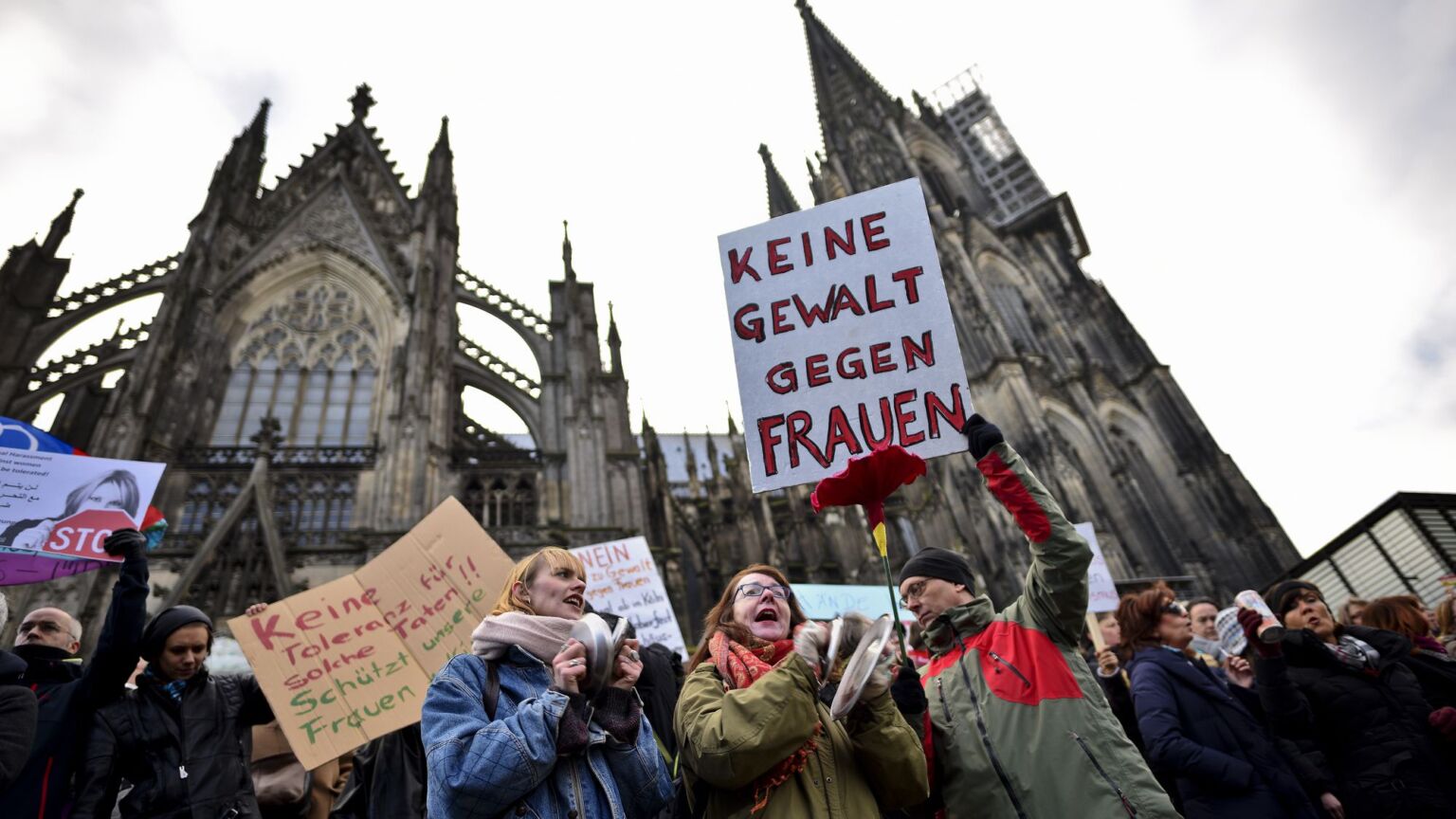
On New Year’s Day 2016, the world woke up to news that the night before around a thousand migrants had swarmed Cologne’s city centre and sexually assaulted hundreds of women. As the horrifying truth of what occurred that evening slowly began to emerge over the course of the following week, people both in Germany and beyond responded with shock. A decade on, it is now clear that the Cologne sex attacks were a pivotal moment in Europe’s history.
Throughout 2015, under Angela Merkel’s leadership, Germany opened its borders and welcomed over 1.1million migrants, primarily from Syria, Afghanistan, Iraq and North Africa. Merkel insisted that accepting refugees and asylum seekers was central to modern Germany’s political and cultural identity. She told citizens, ‘We can do it!’, and called on them to be ‘self-assured and free, compassionate and open-minded’. Critics were written off as bigoted, selfish and out of kilter with a diverse new Germany.
What happened in Cologne on New Year’s Eve shattered this cosy image. Nearly 500 women reported sexual assaults, carried out by roughly 1,000 drunk and aggressive young men described as being of Arab or North African appearance. The attacks took place in crowded areas around the train station, cathedral and Christmas market – places where people expected to be safe. Women, including a volunteer police officer, were groped, molested and robbed. Twenty-one instances of rape or attempted rape were reported. One woman had a firecracker put in the hood of her coat, and was left scarred for life.
These events shattered the myth that it is possible to simply throw open a nation’s borders and rapidly assimilate vast numbers of migrants. After Cologne, it became harder for Germany’s political class to argue that welcoming all-comers is simply an economic and social benefit to the nation, that diversity is an unalloyed good and that national culture and traditions are of no significance. It was impossible to argue that hundreds of thousands of young men from other cultures – from places where women are expected to be subservient to men and cover themselves up in public – can rapidly and seamlessly integrate into Europe.
The debate sparked by New Year’s Eve in Cologne spread far beyond Germany. It also exposed the weakness of Britain’s political class and its inability to confront problems created by a decades-old preference for multiculturalism over assimilation. It revealed a compulsion to close down discussion with accusations of ‘racism’, rather than face uncomfortable truths. Everywhere, women speaking out about their experience in Cologne on New Year’s Eve stood accused of exaggerating or succumbing to ‘hysteria’.
Nothing, not even genuine threats to women and girls, was to challenge the establishment’s consensus around diversity and inclusion. In an appearance on the BBC’s Question Time, Jess Phillips, Labour MP for Birmingham Yardley and a renowned campaigner against sexual violence, refused to acknowledge that uncontrolled migration had put women at risk. She proceeded to compare the Cologne attacks to the harassment, ‘heckling’ and ‘baiting’ women might experience on a typical night out in Birmingham, trivialising the rape and sexual assaults that had taken place that night.
As defenders of uncontrolled migration were exposed as cowards and hypocrites, the public increasingly saw the vacuousness of the slogans surrounding multiculturalism and diversity. The legacy of Cologne is that people across Europe began to question the impact of the continent’s open borders. In the UK today, brave victims of Pakistani rape gangs and protective mothers such as the Pink Ladies are at the forefront of challenging illegal migration and multiculturalism, and are confronting the state’s failure to keep women safe.

Germany has changed tack on migration since Angela Merkel left office in 2021. In 2024, Friedrich Merz urged then-chancellor Olaf Scholz to declare mass migration a ‘national emergency’. In 2025, after Merz became chancellor, police were ordered to turn back virtually all undocumented migrants at the border, and family reunification was temporarily suspended. Since 2023, the number of migrants arriving in Germany each year has halved and is now at the lowest level in more than a decade. However, the continued need to erect defensive bollards to protect Christmas markets from terrorism, or else close them altogether, suggests Germany still faces huge problems with its unassimilated communities.
Elsewhere, despite growing public anger, the political and cultural elite have completely failed to learn lessons from Cologne. In a spate of terrible incidents in 2025, women and girls in the UK were sexually assaulted, raped and even murdered by young migrant men. Rhiannon Whyte was stabbed 23 times with a screwdriver by a Sudanese asylum seeker who was staying at the hotel where she worked. In Essex, a woman and a 14-year-old schoolgirl were sexually assaulted by an illegal migrant from Ethiopia who had been in the UK for just eight days. Despite these high-profile cases, all too often, women who raise concerns about all this are still told to pipe down.
Last September, figures from politics and the arts, such as Diane Abbott and Paloma Faith, signed an open letter condemning attempts to link sexual violence in Britain to asylum seekers as ‘far-right’ misinformation. Labour ministers like Jess Phillips decided to diagnose schoolboys as suffering from ‘toxic masculinity’, proposing ‘anti-misogyny’ classes for teens instead of facing up to the problems caused by uncontrolled illegal migration. And who can forget Lucy Powell, now Labour’s deputy leader, dismissing the grooming-gangs scandal as a ‘dog whistle’? Time and time again, our politicians cast doubt on the experiences of women and girls when they involve the ‘wrong’ kind of perpetrator.
Ten years ago, the Cologne attacks made clear to the public the problem with open borders and illegal migration. Unfortunately, Europe’s political elite is still failing to catch up.
Joanna Williams is a spiked columnist and author of How Woke Won. Follow her on Substack: cieo.substack.com.
You’ve hit your monthly free article limit.
Support spiked and get unlimited access.
Support spiked and get unlimited access
spiked is funded by readers like you. Only 0.1% of regular readers currently support us. If just 1% did, we could grow our team and step up the fight for free speech and democracy.
Become a spiked supporter and enjoy unlimited, ad-free access, bonus content and exclusive events – while helping to keep independent journalism alive.
Monthly support makes the biggest difference. Thank you.


Comments
Want to join the conversation?
Only spiked supporters and patrons, who donate regularly to us, can comment on our articles.