Why the Democrats can’t quit the ‘progressive’ left
The Mamdani wing of the Dems is shaping the agenda, with catastrophic consequences for the party.
Want unlimited, ad-free access? Become a spiked supporter.
As the good ship MAGA flounders under the erratic hand of an increasingly unpopular captain, much media attention has focussed on the cracks in the GOP coalition. In the wake of the Venezuela gambit, these are sure to grow further. Yet the most consequential political battle of 2026 will take place within the opposition Democrats.
This struggle will determine the future contours of American politics. Trump will be gone in three years. Although his influence will linger, his likely successors seem ill-suited to expanding the GOP. By contrast, the future of the nation’s oldest party is genuinely up for grabs. There is a simmering contest between the ‘progressive’, neo-socialist left – now incensed by the fall of Venezuela’s dictator – and more reformist figures seeking to recreate the party’s traditional multi-ethnic base of working- and middle-class voters.
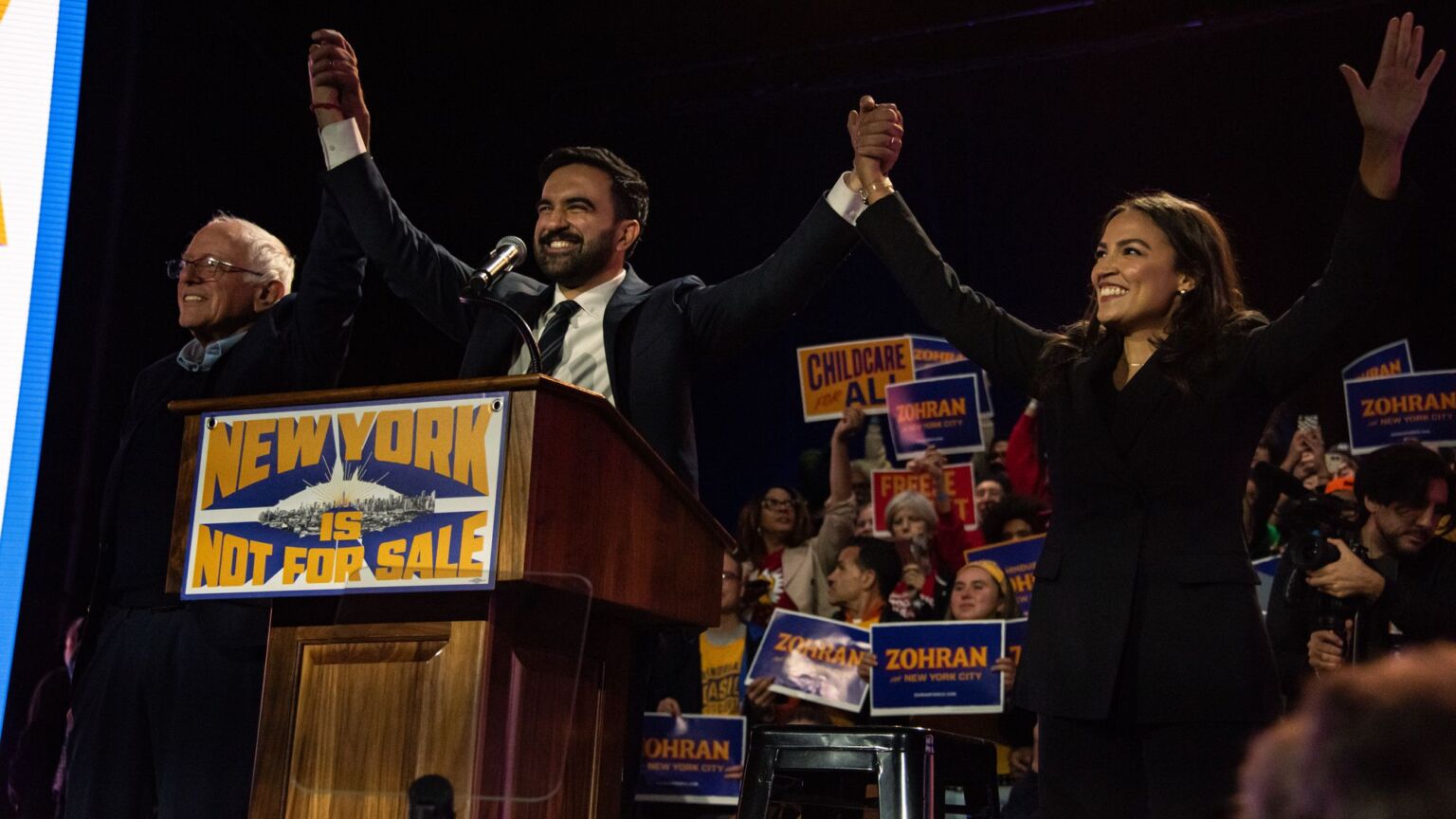
With the swearing-in of Zohran Mamdani as mayor of America’s premier city, the progressives’ drive for what he calls ‘warm collectivism’ clearly has momentum. The New York City mayor reflects a growing radical departure from the traditional Democratic belief in a well-regulated market system, liberalism and equality of opportunity. Progressives have now recruited candidates to run everywhere from California and Michigan to Kansas, largely challenging more traditional Democrats.
One key difference between the moderates and the progressive left lies in the power of the green lobby. Under its influence, many Democrats – particularly progressives – have lost interest in economic growth, focussing instead on redistribution. These progressives do not reflect the values of the Democratic Party of Jefferson, Jackson, FDR, Truman and Clinton, all believers in growth. For the neo-socialists, the party is simply a convenient vessel to occupy.
This is no mild social-democratic movement, as many in the media suggest. The Democratic Socialists of America (DSA), from which Mamdani and Alexandria Ocasio-Cortez emerged, does not embrace Scandinavian reformism – now out of favour on the left, as those countries retain vibrant market economies and have drifted rightwards for decades. Instead, the apple of its eye is Third World Marxist-Leninist dictatorships, such as Cuba and Venezuela, part of what it calls ‘solidarity that knows no borders’. It also has a soft spot for Islamist groups like Hamas. The DSA has also praised authoritarian Communist China.
Mamdani has even cited South Africa as a potential model. Neither the media nor the NYC mayor seem keen to discuss that country’s precipitous economic decline, high crime rates and debilitated infrastructure. The ANC’s descent over the past decade into ever more racialised politics in the post-Mandela era is rarely mentioned either.
Because the media tend not to report such hoary associations, the neo-Marxists have been able to sell themselves as something other than what they are, counting on near-total ignorance of the disasters of the Soviet era among the young. Almost a third of millennials claim to admire communism. Roughly half of young people say they want a ‘democratic socialist’ president, though it is likely they know little about the DSA’s long-term goals.

The socialist surge is also aided by the perception that the Democratic establishment is ineffective. Even as MAGA sags, Democratic approval ratings are now, as CNN pollster Harry Enten put it, ‘lower than the Dead Sea’. While damaging to the party overall, distaste for the old establishment sets the stage for the neo-socialist dream.
Socialists are already challenging – and often defeating – the liberal establishment in places such as Minneapolis, Boston, Seattle, Portland and Los Angeles. In these cities, DSA activists and allies already constitute, as one observer put it, ‘the second party’ after traditional Democrats. They continue to gain city-council seats in Los Angeles and New York, and appear to be regaining ground in San Francisco.
In almost all cases, the socialist’s ‘enemy’ is not the MAGA Republican but liberal Democrats in deep-blue districts. Among those targeted for extinction are representatives like Ritchie Torres and Dan Goldman – staunch New York liberals, but insufficiently militant or anti-Israel for the DSA scorekeepers.
The DSA enjoys a surprisingly strong financial base, thanks to its ties to left-wing nonprofits and public-sector unions, particularly teachers. Despite its Marxist rhetoric, its prime constituency is not the working class but educated professionals, especially those reliant on government funding – think environmental consultants, medical staff, educators and park rangers. Republicans, by contrast, remain concentrated in construction, energy and other private-sector industries.

For its shock troops, the left can draw on the roughly 271,000 recently laid-off federal employees – a political version of Marx’s ‘reserve army’ of the unemployed. This may work in deep-blue cities and the greater Washington area, but beyond that, angry ex-public-sector employees may not suffice. In the short term, DSA candidates outside core cities and college towns may even rescue Republicans from their own folly. This could occur in states such as Maine and Texas, where the moderately progressive James Talarico has a chance of winning a senate race, but activists seem far more enamoured with the ultra-woke, kamikaze drive-by politics of Congress’s resident obscenity queen, Jasmine Crockett.
In deep-blue states, however, the leftward tide appears inexorable. When not seeking to eject mainstream Democrats, progressives increasingly browbeat sitting office-holders into submission. Witness how supposedly centrist politicians like New York governor Kathy Hochul now appear willing to embrace higher taxes and an expanded welfare state to fend off a left-wing challenge.
In California, the Democrats’ dominant stronghold, the next governor will likely be more progressive than the ever-opportunistic Gavin Newsom. A recent Emerson poll showed the leading contenders all coming from the party’s left, including showboating congressman Eric Swalwell; former representative Katie Porter, a law professor and long-time Elizabeth Warren acolyte; and billionaire Tom Steyer, an environmental zealot and hard-line defender of California’s climate regulatory regime.
Arguably, the most critical issue in California will not be the gubernatorial race – the GOP has little chance – but a proposed wealth tax on billionaire assets now being placed on the ballot by unions. Rob Bonta, California’s attorney general and a potential frontrunner if he enters the race, has pushed this idea for years. Passage would not be welcomed by tech billionaires, as shown by threats from Anduril’s Palmer Luckey, venture capitalist Peter Thiel and Google co-founder Larry Page to leave the state. Over the past decade, capital flight has already cost California and New York a combined $1 trillion in assets lost to other states.
Pragmatic Democrats may indulge woke causes like the transgender agenda – such as Newsom, who has forced schools to provide all-gender bathrooms, for example. But they at least understand that radical redistribution would further drain both the state’s coffers and their own campaign war chests. Yet support for ever more draconian taxes on the rich continues to grow in an economy that, regardless of who occupies the White House, offers few long-term prospects for most workers. The currently booming stock market does little for the working class that backed MAGA. Even small businesses, the historic base of both the GOP and moderate Democrats, have lost ground to corporate giants.
An economically focussed populist campaign of ‘rage’, suggests former Clinton strategist James Carville, could keep Democrats in power ‘for 40 years’. Already close to a majority of Americans express distaste for MAGA.
This erosion could accelerate as nativists and Christian nationalists seek greater control of the GOP. Latinos, who often support MAGA positions on transgenderism, race quotas and deporting criminal aliens, appear increasingly turned off by Trump’s tone-deaf targeting of even law-abiding, economically successful undocumented migrants – often relatives, neighbours or employees.
Trump’s apparent successor, JD Vance, seems intent on further uglifying MAGA. He has been reluctant to distance himself from the party’s anti-Semitic Buchananite paleoconservatives. Once an empathetic and intelligent conservative, with credibility rooted in his remarkable personal story, Vance’s embrace of nativist and Christian-nationalist norms will not expand the GOP base as Trump once did. Hitler fans may lurk in cyberspace, but courting them is not a good look for a party already fending off exaggerated claims of incipient fascism.
If Democrats could rediscover their centre, MAGA would be flushed down the proverbial toilet. Such a return to pragmatism is possible. Democrats could highlight success stories such as San Jose mayor Matt Mahan, Baltimore’s Brandon Scott, Houston’s John Whitmire and San Francisco’s Daniel Lurie. Nationally, figures like Pennsylvania governor Josh Shapiro or Kentucky’s Andy Beshear, who govern states Trump has carried, show how reasonable Democrats can win in conservative territory.
We may never see the Democrats’ secret post-mortem of the 2024 presidential election, but recovery clearly requires separating middle-class-friendly economics from progressive obsessions with draconian climate policies, transgenderism, DEI, lax law enforcement and mass, unregulated immigration. Yet traditional Democrats currently lack any intellectual or policy infrastructure. There is no equivalent to the Democratic Leadership Council that once shaped Bill Clinton’s centrist appeal.
Without a counter-narrative, the left dominates Democratic memes and messaging, while moderates merely hum along in a slightly less hysterical key. The good news is that progressives lack a strong national candidate. Their former stars, Elizabeth Warren and Bernie Sanders, are well past their prime. Alexandria Ocasio-Cortez, the only young progressive with a genuine national following, may be too junior and inexperienced for a serious presidential run. She currently polls at just 7.7 per cent in the Real Clear Politics average, though she reaches double digits elsewhere. She is the clear favourite among young Democrats in a hypothetical 2028 primary. Her time may yet come – perhaps after she challenges, or simply shoves aside, Senate minority leader Chuck Schumer.
The temptation to follow the DSA line may prove irresistible in Democratic primaries. Among young Democrat voters, socialism beats capitalism by more than three to one. In that environment, the socialist left could easily drag mushy figures further leftward, such as the utterly opportunistic and media-savvy Newsom, pedestrian bumbler Kamala Harris (should she run), ineffective former transport secretary Pete Buttigieg and Illinois governor JB Pritzker, whose chief claim is a record even worse than Newsom’s.
By 2026 – and even more so in 2028 – cavorting with Marxist memes risks alienating both middle-of-the-road voters and elite donors. The oligarchs may loathe Trump and MAGA, even as they genuflect towards the White House, but they also want to keep their fortunes intact. Their loyalties may shift further if the economy performs better than expected, at least for people like them.
The trick for Democrats in 2026 and 2028 is to satisfy the populist mood without alienating independents, suburbanites and the well-off alike. For MAGA, Democratic capitulation to the progressive social and green agenda may yet be what rescues it from self-immolation.
Joel Kotkin is a spiked columnist, a presidential fellow in Urban Studies at Chapman University in Orange, California, and a senior research fellow at the University of Texas’ Civitas Institute.
You’ve hit your monthly free article limit.
Support spiked and get unlimited access.
Support spiked and get unlimited access
spiked is funded by readers like you. Only 0.1% of regular readers currently support us. If just 1% did, we could grow our team and step up the fight for free speech and democracy.
Become a spiked supporter and enjoy unlimited, ad-free access, bonus content and exclusive events – while helping to keep independent journalism alive.
Monthly support makes the biggest difference. Thank you.


Comments
Want to join the conversation?
Only spiked supporters and patrons, who donate regularly to us, can comment on our articles.