Why did people film the Swiss bar-fire tragedy?
We now treat unfolding disasters as a source of entertainment.

Want unlimited, ad-free access? Become a spiked supporter.
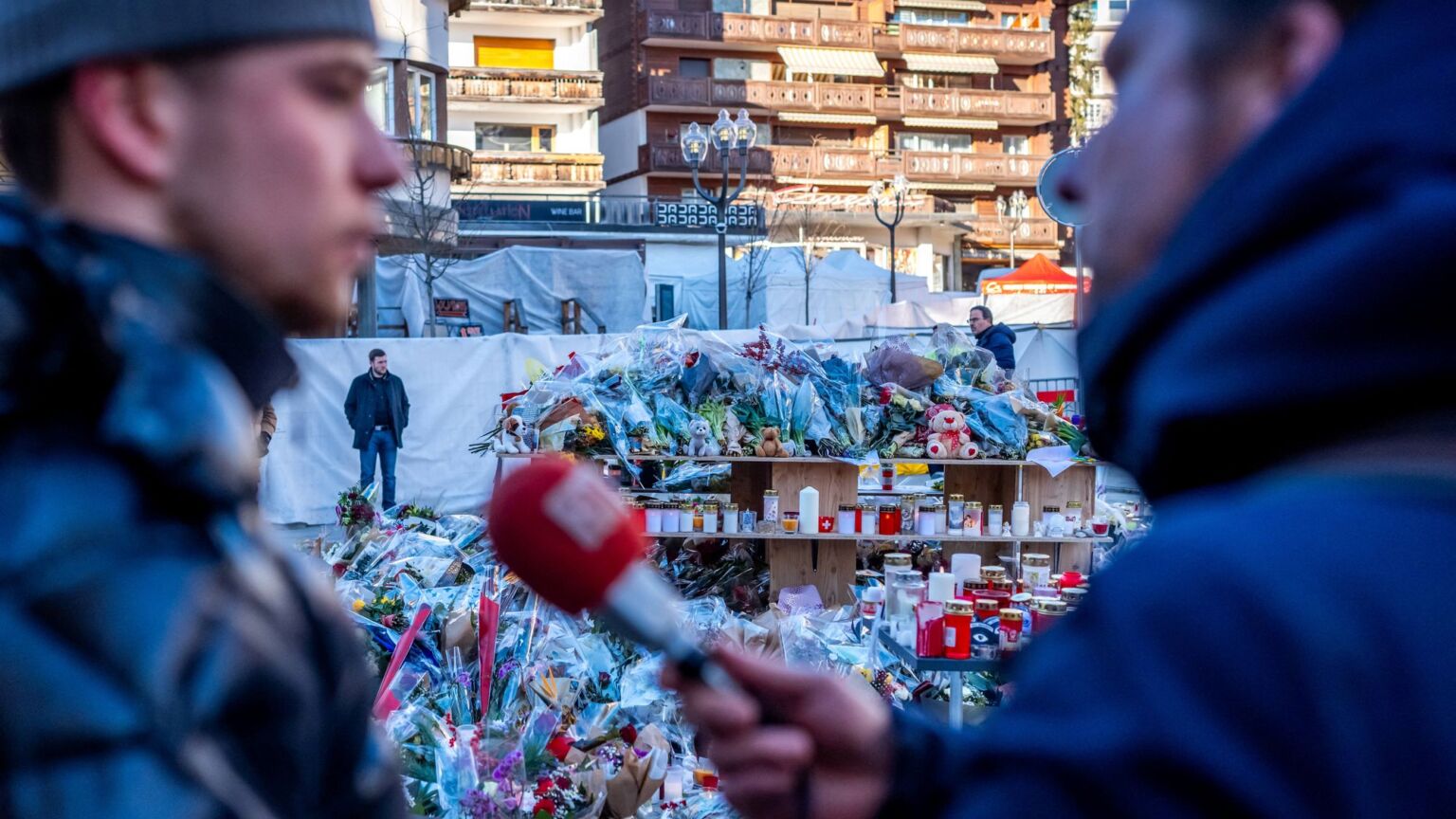
I reacted very personally to the fire at the Constellation bar in Crans-Montana, Switzerland, on New Year’s Eve. I skied in Crans-Montana in 2020 and spent some enjoyable afternoons and evenings in ‘Le Constel’. To learn that 40 people had lost their lives at a place I knew well was shattering.
I was particularly struck by the immediate response of some of those at Le Constel, as the fire took hold. There were individual instances of heroism. But too many there, instead of trying to help people to safety, decided to take out their phones and film the panicking partygoers.
One disturbing video circulating online shows young partygoers happily recording events as the ceiling caught fire. They didn’t try to get out. They remained in place, phones at the ready – some even continued to dance as the fire rapidly intensified. Perhaps they thought the flames engulfing the ceiling were part of some sort of pyrotechnic show. Perhaps they underestimated the seriousness of what was happening. But it certainly looked as if they seemed to regard an unfolding disaster as a source of entertainment.
When confronted with an accident or a violent attack on a passerby, too many today tend to voyeuristically distance themselves from what they are witnessing. They don’t involve themselves in what is happening, perhaps by trying to get help or even intervening to stop an attack. Instead, they record it. This places them at several removes from what is happening, while simultaneously making it all about them. It turns a violent attack, or a fire at a bar, into their ‘I was there’ story.
We have seen evidence of this culture of passive narcissism time and again recently. Take the 2019 video of an elderly man on a New York City subway platform. He is seen clearly struggling against a deluge of dirty water that has swept him off his feet. He is finally able to make it to his knees before looking directly at the camera, as if to ask why the person recording his plight didn’t help. Unlike those burned alive in Crans Montana, he at least had the chance to pose this critical question.
The failure to help seems to have gone global. In December 2022, a viral video was posted from Uttar Pradesh, India showing a man lying on the road after a hit-and-run. Several people simply walked past him. Others just watched. A few recorded the scene on their phones. Apparently it took over 30 minutes before someone called an ambulance.
Often, individuals’ passive narcissism can be a source of direct distress to those suffering. In 2017, Eve Thomas found paramedics dealing with her badly injured father at a scene of the bicycle accident. As she recalled last year, she was ‘surrounded by people taking photos and videos to share on social media’. To make matters worse, some of these insensitive voyeurs mistakenly claimed that Eve’s father had died. As far as they were concerned, this was their story. A tragic accident served as an opportunity for narcissistic self-aggrandisement.

According to the police there has been a ‘seismic change’ in recent years in the behaviour of onlookers at the scene of emergency incidents. For many, posting a video of it is more important than calling for help. The police now know that if they are confronted with a violent incident, many members of the public are more inclined to whip out their phones to record the situation than provide assistance.
This was brought home by the ghastly behaviour of passers-by during the murder of the British soldier, fusilier Lee Rigby, by two Islamist terrorists in 2013. Rigby was run over by a car and then attacked with knives and a meat cleaver near the Royal Artillery Barracks in Woolwich, London. All this happened in broad daylight.
At the time, I wrote in the Independent:
‘Two memories of Woolwich haunt me. One is the sadistic act of murder. The other is the casual manner with which passers-by assumed the role of participants in the drama. Thankfully, some sought to help and give assistance to the victim. But others took out their cameras to record the spectacle and adopted the role of “I am here, too”. On Twitter, far too many people embraced the role of the voyeur and unwittingly gave recognition to two self-obsessed killers who did not deserve it.’

To this day I wonder what was going through the heads of these self-obsessed voyeurs? They stood by and filmed a grotesque murder carried out by smiling religious fanatics. According to reports, around 60 to 70 people surrounded the dying Lee Rigby, ‘all watching, some filming with their phones’. In effect they had become passive accomplices to an act of terrorism.
It is tempting to blame all this on immature young people and otherwise insensitive individuals – to accuse them of being devoid of the human instinct to help those in distress. But the problem goes deeper. It is a sign of a society that is failing to cultivate in its individual members a sense of duty to others. Above all, it is a sign of a society that has devalued the virtue of courage.
Instead, schools cultivate their sense of helplessness. They are constantly told that they are ‘vulnerable’. All this undermines their capacity to help others, to have a sense of responsibility for others.
What we saw in Crans-Montana were young voyeurs who have never been taught the meaning of human solidarity. It was a sign that our society is in serious trouble.
Frank Furedi is the executive director of the think-tank, MCC-Brussels.
You’ve hit your monthly free article limit.
Support spiked and get unlimited access.
Support spiked and get unlimited access
spiked is funded by readers like you. Only 0.1% of regular readers currently support us. If just 1% did, we could grow our team and step up the fight for free speech and democracy.
Become a spiked supporter and enjoy unlimited, ad-free access, bonus content and exclusive events – while helping to keep independent journalism alive.
Monthly support makes the biggest difference. Thank you.





Comments
Want to join the conversation?
Only spiked supporters and patrons, who donate regularly to us, can comment on our articles.