Why has the BBC ignored the Iranian uprisings?
The mainstream-media blackout on these seismic protests is utterly inexcusable.
Want unlimited, ad-free access? Become a spiked supporter.
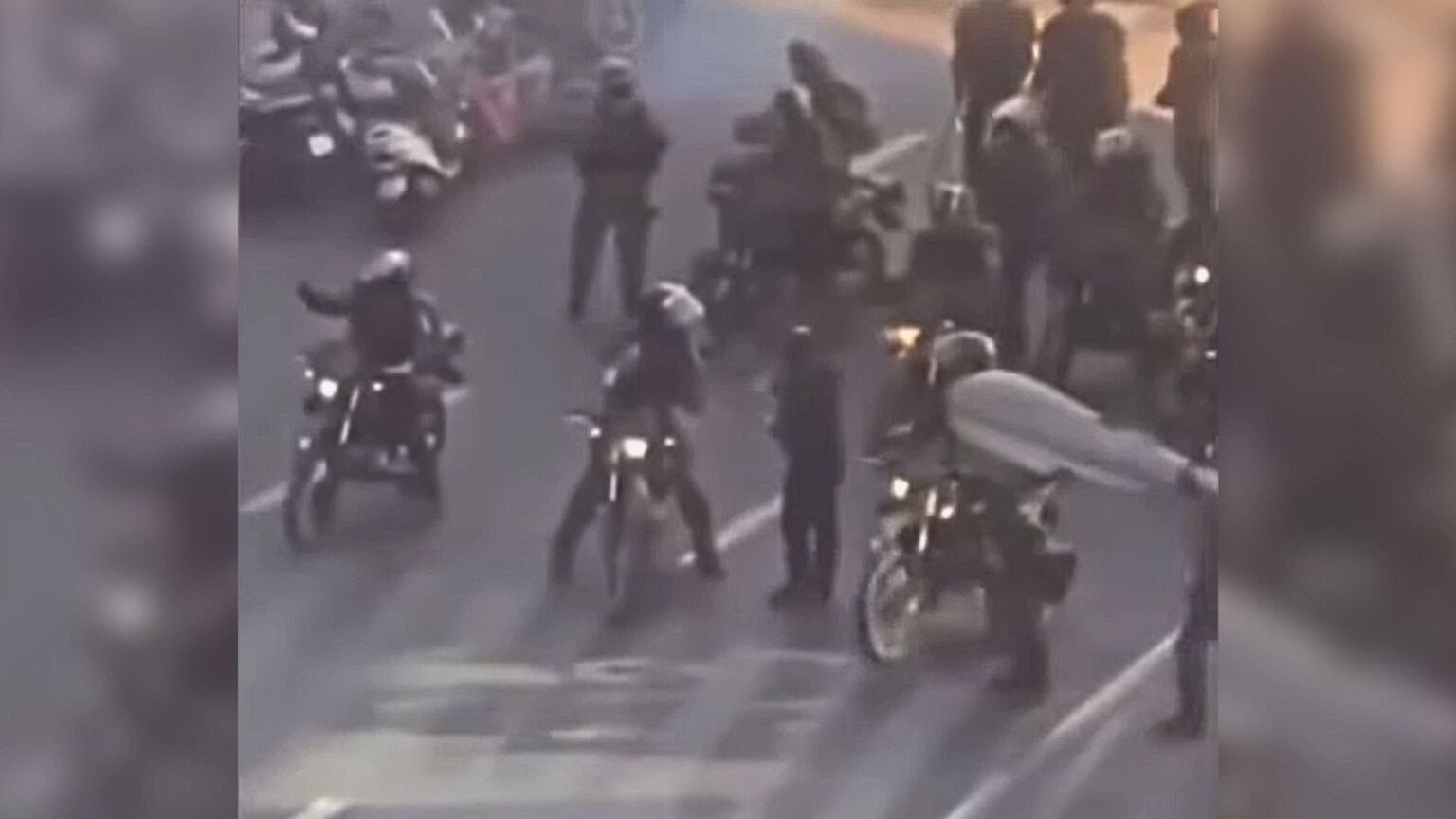
Christmas coincided with the outbreak of the most serious anti-regime protests in Iran since the women’s rights protests of 2022. Insofar as reports proliferating on social media can be trusted, the current unrest has since eclipsed those protests by far, both in their geographical spread – reaching pretty much every city in Iran – and in the sweeping political demands of the protesters. These include an end to the rule of the ayatollahs and growing calls to restore the monarchy that was removed by the Islamic Revolution of 1979.
There are reliable reports of Iran’s Revolutionary Guard being deployed to break up demonstrations in their own inimitable way, of local government offices being broken into, and of several protesters being shot. It has also been reported that police have, in some instances, retreated in the face of superior numbers of demonstrators. More wishful reports should probably be treated with scepticism until proved authentic. We do not yet know if it’s true that mullahs have been discarding their turbans in order to blend into the population, or if the ayatollahs are retreating to their fastness in Qom. Or if Tehran airport has been closed, either to receive emergency defence shipments, from Moscow and elsewhere, or perhaps to facilitate the evacuation of the supreme leader and his coterie.
That the situation is confused, however, is no reason not to report events that are not only dramatic and unusual at the very least, but could also potentially be of global importance. Trying to clear up confusion is, in any case, part of the media’s job. Yet the mainstream media in the West, especially in the UK, and most conspicuously the BBC, with the international reach it so prides itself on, have so far been largely missing in action where coverage of the Iranian protests is concerned.
Let me reiterate: it is entirely reasonable for news outlets in general, and for the BBC in particular, to take care in their coverage of unrest abroad, lest it be interpreted as taking sides. It should of course be wary of either becoming an unwitting participant in the protests and / or acting as a mouthpiece for a government with its own interests. But a careful approach need not, indeed should not, preclude efforts at objective reporting: the sort of reporting, in fact, on which many media outlets – in prime position, the BBC – have built their reputations.
A week on from the start of the demonstrations, there remains a yawning gap where reporting on Iranian developments might be. The gap was first noted on social media, at a time when it was still just about possible to think that the protests were a transient phenomenon that should not be exaggerated and might soon peter out. It might then have been argued that excessive focus on the protests could be interpreted as incitement, and that those Western media and governments who might welcome regime change in Iran would be well advised to keep their hopes to themselves.
As the days went by, the protests escalated, and the son of the late shah entered the fray on social media. The gap where mainstream-media coverage of Iran should have been only became more glaring. The question is why.
Nor was it long before social-media users started to offer their own conspiratorial answers. Western governments did not want to rock the boat in Iran, apparently, because the theocratic regime rather suited them, as did the treatment of Iran as a rogue state. A substream of this argument blamed the lack of reporting on Israel, claiming that Israel did not want the regime to fall either – for reasons I cannot quite fathom. (Perhaps – the convoluted thinking might go – because it is convenient for Israel to have an enemy and it would prefer to do the regime-toppling itself?)
Then there were what might be seen as the practical, journalistic arguments. These boiled down to the fact that it is the holiday season, the Iran protests hardly chime with the festive mood, and it is nigh impossible to get reporters into Iran anyway.
But these arguments simply do not hold water. The BBC and other outlets have broadcast copious reports about Gaza, including practically graphic accounts of bombed hospitals, hungry children and heroic aid workers, many of them based on footage filmed by local people or citizen journalists. By all means point out that foreign journalists are barred, but in this day and age, there are fallbacks. And there is lots of footage from Iran on social media, but it is for the most part not being transferred into the mainstream media.
The BBC, of all news providers, has less reason to plead lack of first-hand information than most. It has a Persian Service, which has been a thorn in the side of the Iranian authorities to the point where its reporters and their families in Iran have been threatened. But the existence of BBC Persian should place its London-based operation in an incomparable position at least to gather and verify information coming from Iran, even if its reporters and sources must remain anonymous for security reasons. What has been heard from BBC Persian, however, since the protests began?
Two other reasons might be adduced for the lack of coverage. One is the human interest and seasonal relevance of the Swiss nightclub fire that claimed so many young lives and has been dominating the UK and European news. There second is the risk, with the Iran events, of the coverage appearing ‘wrong’. Yet the risk that, say, the Arab Spring might have failed was never an excuse for not reporting what was going on. Outlets don’t usually place an embargo on certain outbreaks of unrest in case they come to nothing. That is not how news works.
A week on from the start of Iran’s protests, Iran did suddenly enter the headlines – although not as Iran per se, but courtesy of Donald Trump’s social-media post in the early hours of Friday morning, warning that the US would ‘come to the rescue’ of peaceful protesters in the event that the authorities use deadly force. As of Trump’s nocturnal post, Iran now merits a glance from the mainstream media in the West, but only through this American, Trumpian prism.
There has still been almost no word about the actual events in Iran. Nor has there been, at the time of writing, a response from European and UK political leaders. Were they perhaps waiting for a cue from the White House? Or were they, like the media perhaps, merely observing what they might see as a safe silence?
Iran has a population of 90million. Its theocratic governments have kept the country at odds with the Western world for nearly 50 years. It occupies a key position, geographically and potentially diplomatically. Change and even intimations of change here matter hugely. Whatever the whys and wherefores of the gap in mainstream-media reporting, it needs to be filled without further delay.
Mary Dejevsky is a writer and broadcaster. She was Moscow correspondent for The Times between 1988 and 1992. She has also been a correspondent from Paris, Washington and China.
You’ve hit your monthly free article limit.
Support spiked and get unlimited access.
Support spiked and get unlimited access
spiked is funded by readers like you. Only 0.1% of regular readers currently support us. If just 1% did, we could grow our team and step up the fight for free speech and democracy.
Become a spiked supporter and enjoy unlimited, ad-free access, bonus content and exclusive events – while helping to keep independent journalism alive.
Monthly support makes the biggest difference. Thank you.
Comments
Want to join the conversation?
Only spiked supporters and patrons, who donate regularly to us, can comment on our articles.