‘I’m taking on the establishment, and they hate me for it’
Nigel Farage on consensus, conformism and the virtue of dissent.
Want unlimited, ad-free access? Become a spiked supporter.
‘They’re not proper people.’
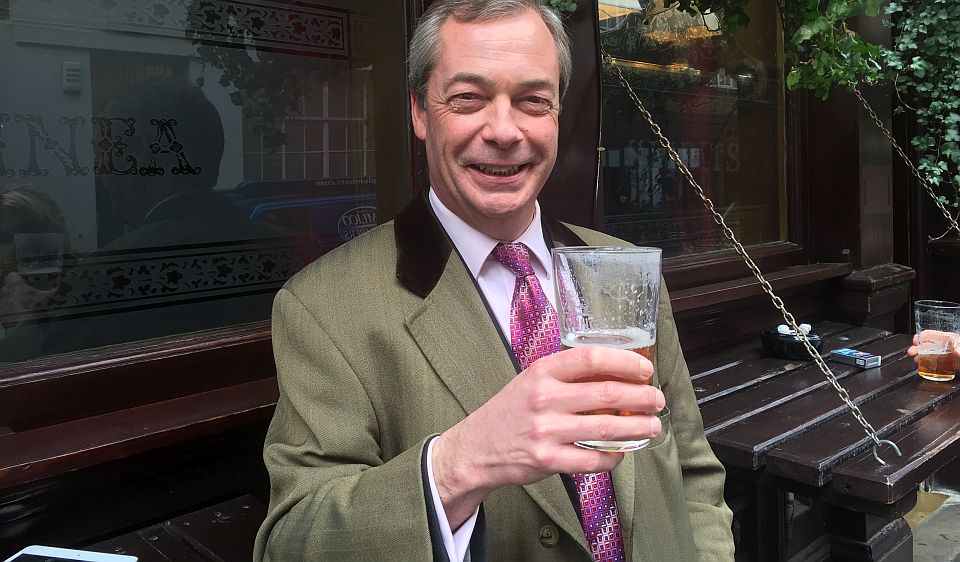
Pint in one hand, fag in the other, Nigel Farage is passing withering judgement on the political class. ‘They don’t pass the Farage Test’, he says of Cameron, Clegg and Miliband. The Farage Test? Warming to his theme, his voice rising an octave, he explains. ‘I judge everybody by two simple criteria. Number one: would I employ them? And number two: would I want to have a drink with them? To pass the Farage Test, you only have to pass one of those. There are lots of people I’ve employed over the years who I wouldn’t choose to have a drink with, and there are lots of people who are completely useless but rather nice to have a bit of a jolly with. But this mob don’t pass either.’ Then, after eviscerating Them, calling into question their employability and drinkability, wondering out loud if they’re even ‘proper people’, he lets out what I think we should call the Farage Laugh: a deep and hearty, nicotine-stained guffaw at the world: ‘HA HA HA HA HA HA HA.’
I don’t know if I’d pass the Farage Test, but the UKIP leader has agreed to have a drink with me. We’re at a pub in a small street in central London — outside, natch, for smoking purposes — with a pap lurking behind a parked van, clearly unable to believe his luck that he might get a shot of Farage drinking and smoking and laughing. We’re interrupted every five minutes by passers-by who want to shake Farage’s hand or get a selfie with him. (‘Go to UKIP dot org and become a member. Bloody well do it!’, he tells one young fan.) It’s chilly but sunny; Farage is making light work of his pint; he still has a little make-up on from a by-all-accounts barnstorming appearance on ITV’s Loose Women; and he’s ready, he says, to speak his mind. ‘Interviewing me over a drink — always far better. HA HA HA HA HA HA.’
One thing on the Farage Mind is the total out-of-touchness of his opponents in the upcoming General Election: the three main political parties. ‘They’re over-advised. They’re scared. They view the whole operation of politics as playing safe, as if criticism is a bad thing.’ And more fundamentally they’re the ‘wrong sort of people’, he says, to be doing a job that involves engaging the public and speaking to ordinary people. ‘Lack of breadth of life experience. They’ve not had the knocks.’ He adds one rider, ‘which is that David Cameron had a son who was ill and died’. ‘But if you take that out, if you examine the lives of these boys, it’s been seamless. My life, by contrast, has been marked by regular disasters and stupidities. I’ve had some dramatic failures, and I think that probably puts my feet a bit more firmly on the ground and it means I can speak to anybody. I honestly believe I am the most classless person you will ever meet.’
His ability to ‘speak to anybody’ is on full display today. Everyone who irritates the hell out of me by interrupting the interview to press the Farage flesh is engaged with directly and honestly. ‘I’m doing fine, whatever the buggers might say!’, he says to one man who asks how things are going. Farage is intrigued by the inability of the other party leaders to do what he does, to be normal, to engage the electorate in real, everyday language. Cameron has to boast about once having eaten a Cornish pasty in Leeds in a desperate bid to connect with the throng, while poor old Miliband can’t even eat a bacon sarnie without making a tit of himself and reportedly seeks expert advice on how to do that terrifying thing of Talking To People. Farage puts this colossal disconnect between the political class and the public down both to the political leaders’ seamless, knocks-free lives and also to the professionalisation of politics — the way politics has become the domain of an increasingly narrow, bubbled strata of society.
‘As the seven per cent that go to public schools dominate politics, the media, the arts, sport, every aspect of our life in this country, [we’ve] almost reached a situation where the only time these guys have met a working-class man or woman is if they are driving the car. And they can’t even be nice to them then’, he says.
He saves his most stinging class-based barbs for the Tories. ‘The Conservative Party is as upper class today as it has ever been. Over the past hundred years, the upper classes had more connection to their fellow man than they have today. And I’ll tell you why. Firstly, those that were from the landed classes may have been selfish financially, over the corn laws or whatever it was, but they ran their estates themselves. They actually knew the lads that cut the hay and looked after the horses. And then we had two world wars, which brought the whole class system together. Up until the late 1980s you had senior Tory politicians from posh backgrounds who could talk to the lads doing the scaffolding. They can’t do that now.’
It isn’t only the aloof, not-proper-people of the New Conservatives, New Labour and the Lame Lib Dems who fail the Farage Test: his strongest ire is aimed at another group that has of late become a major player in British politics, a key pillar of establishment thinking — the media. He’s cutting. ‘The media have now become a bigger problem than the politicians. We talk about the Westminster Village in politics, [but] forget it — the media village is even tighter, even narrower, even more inward-looking, and even less in touch with their own potential readership and with the country.’
Ouch. But Farage’s barely disguised fury with the media is understandable. It’s hard to remember in recent years any other person or thing being the recipient of as much samey, uniform media bashing as Farage. Even ‘Jihadi John’ has been the subject of some sympathetic editorials — ‘Us brutes made him like this!’ — but not ‘Nasty Nige’. From the newspaper of record, The Times, to the favoured newspaper of the new elites, the Guardian, and in pretty much every shade of commentary in between, Farage is bogeyman du jour, potential destroyer of Europe and repressor of Romanians. The anti-Farage hysteria reached its crescendo with Channel 4’s mockumentary UKIP: The First 100 Days, which provided a better insight into the cut-off, swirling, masses-fearing minds of TV execs and the newspaper hacks who cheer them than it did into UKIP’s policies or potential. Now Farage is firing back.
‘I’ve watched over three years, as UKIP has grown, the incredulity from journalists, incapable of fathoming why UKIP’s doing so well — they’re literally incapable.’ The media are even more unable to read the public mood than politicians are, he says, because they’re so beholden to ‘the narrow tribalism’ of ‘binary politics’. Why do they stick to this binary-politics script? Because it brings them rewards, he says. ‘Peerages, knighthoods — such patronage is dished out to the press on a scale that no other private-sector industry gets. I know [senior politicians] get an OBE or a knighthood, and if you’re a soldier you have a very good chance. And we understand that, because these are public servants. Private-sector rewards, however, are few and far between — but not if you’re a newspaper editor.’ The media, all shades, are now part of the establishment, he says.
Farage’s diagnosis of an increasingly influential but utterly unworldly, public-allergic media feels true. The more that politics has become bereft of any serious ideas or big-thinking policy, and the more that politicians have become bereft of the means or know-how for speaking to the public directly, the more the media have moved in to fill a gap, becoming, increasingly, the facilitator of politics, and even the shaper of the political agenda. The media now act, says Farage, like the guardians of ‘what is considered right-thinking’, and this is why they hate him with such rash feeling — his thoughts, his ideas, his politics are, by their judgment, un-right thinking, and thus must be shouted, or better still shut, down.
‘All through the civilisation of human beings, people form establishments’, he says: ‘An interwoven network that actually has a very big generational context, in that it hands on down. And we are challenging the establishment — we are challenging their very thought; we are challenging the very basis upon which they exist and operate. And there is nobody in history who has taken on the establishment and has not received the kind of treatment I am getting.’
He even accuses the media of creating a hostile working environment for UKIP people. The party’s door-steppers regularly face harassment and even threats, he tells me — and ‘this sort of violence and intimidation is one of the untold stories of the hatred that certain sections of the media have whipped up. There is now a group of people out there who, to be fair, probably weren’t UKIP supporters anyway, and who have had their own prejudices reinforced by the media and have been convinced that UKIP is a dangerous organisation.’
Some scoff at Farage’s claims to be anti-establishment. After all, he himself was privately educated, and he worked as a broker in the City before becoming a founding member of UKIP in 1993, an MEP in 1999, and eventually UKIP leader in 2006. And yet the anti-Farage fury, the media loathing for this man, does suggest he has rattled someone or something powerful. It’s hard to recall a time when the establishment closed ranks as firmly as it has done behind bashing UKIP, branded ‘fruitcakes and loonies’ by the leader of the Tory Party and as ‘racist’ by pretty much everyone who reads the Guardian. Nigel might have his Farage Test — the political and media classes have the Anti-Farage Test, now judging an individual’s fitness for polite society by whether he or she is a Farage-hater (if you are, you’re in; if you aren’t, you’re a racist son-of-a-bitch). Farage-bashing is the great unifier in these otherwise screwed-up, amorphous political times, uniting everyone from Tory leaders to student radicals (some campuses No-Platform UKIP), from edgy comedians to edge-free Times leader-writers, from bland Nick Clegg to the remnants of the 1970s anti-fascist movement.
And it’s entirely out of proportion to UKIP’s policies. It can’t be explained entirely by UKIP’s opposition to the EU, given that there are also left-wing trade unionists who hate Brussels. It can’t be because UKIP wants a ban on unskilled workers coming to Blighty, given that the Labour government did the exact same thing in 2006, when it smacked a seven-year ban on unskilled workers from Romania and Bulgaria, thus turning them into the second-class citizens of Europe. (spiked disagrees with UKIP’s position on immigration, for the same reason we disagree with the other parties’ position on it: it’s illiberal and avoids discussing the need for more industry and growth in Western European countries in favour of carrying out a Malthusian-style headcount of new arrivals and their predicted impact on our resources.) No, it’s something else about UKIP that gets the goat of the great and good — it’s a vibe, an attitude, a reluctance to stick to the ‘binary politics’ script, and a sometimes unprofessional and fruitily worded stab at some of the sacred cows of modern politics. ‘It’s because we challenge the consensus’, says Farage.
Consensus, and the breaking of it, and the blowback you get as a consequence, comes up again and again in our chat. And there’s no doubt that Farage is off-message, sometimes gloriously so, on a lot of what passes for mainstream, unquestioned political thought in modern Britain. Take climate change. What politician these days would admit to laughing about the polar bears? Farage would. ‘My boys, who were spoonfed climate change all through school, used to think it was hilarious when I ranted at the Six O’Clock News about that bloody iceberg and that bloody polar bear HA HA HA HA HA HA HA.’
He declares himself ‘agnostic on climate change’. ‘I haven’t got a clue whether climate change is being driven by carbon-dioxide emissions.’ But he does think that shutting down industry in response to climate change, and shutting down debate about climate change, are very bad ideas indeed. ‘We are a nation that produces 1.8 per cent of global carbon dioxide, so I do not get closing down our aluminium smelters, most of our steel production, and now our refining industry, and all that production being moved to India, and therefore the steel-based products made in India then having to be shipped back to Britain! This to me makes no sense at all.’
The politics of environmentalism is utterly hostile to progress, he says. ‘If Natalie Bennett won the election, we’d all be living in caves’, he says with a chortle. ‘[This politics] is very regressive. There is nothing progressive in terms of the evolution of society or living standards in what these people stand for. And the whole thing is based on a fallacy: that our fossil fuels are going to run out and therefore we have to adapt the way we live. Actually, the shale-gas [revolution] has shown over the past decade that we are finding more and more of this stuff.’ As for the idea that we should stop digging for coal or shale or uranium and instead turn to renewable energy — ‘I think wind energy is the biggest collective economic insanity I’ve seen in my entire life. I’ve never seen anything more stupid, more illogical, or more irrational.’
Here, Farage is kicking against one of the key planks of 21st-century consensus politics: the idea of planetary vulnerability and human hubris. And he gets massive flak for it. ‘[Climate change] is like a religion’, he says. ‘And you’re demonised if you question it. Ostracised completely. Johnny Ball. Think Of A Number. Brilliant man. He compares the amount of CO2 we produce in the whole atmosphere to a ping-pong ball in the Albert Hall, and he is completely ostracised for years. We’re almost back to Galileo. Whether it’s Galileo or Darwin, you challenge consensus, whether it’s in science, whether it’s in politics, and you are demonised for doing it.’ He remembers, in 2006, being on a Sunday morning TV show and being branded a ‘DENIER! DENIER!’ (his emphasis) after he raised issues with climate-change orthodoxy. ‘I thought I was attending the Salem witch trials. Quite extraordinary.’
Or take the nanny state, or the nudge industry, or the public-health lobby — whatever it’s being called these days. Here, too, Farage rips up a firmly established script. He says UKIP would allow pubs to choose to allow their patrons to smoke and would prevent minimum pricing on alcohol.
‘It’s the modern puritanism’, he says of the bossy new politics of lifestyle micromanagement. ‘It’s about controlling people. It is the same paternalistic agenda from the great and the good, who think they know better than ordinary folk what is good for them.’ He says he wants smoking restrictions and other booze-demonising policies kicked out of pubs for the simple reason that the freer a pub is, the better it is. ‘Every pub is a parliament’, he says. ‘It’s in pubs where you discuss who the England football manager should be, who you’re gonna vote for in the General Election, just how useless is your local councillor, what you think about the Archbishop of Canterbury. Pubs are essential parts of communities, essential places to meet and debate.’
And the overregulation of pub life has stored up a lot of social problems in 21st-century Britain, he reckons. We have a ‘drink problem with our youth’, he says, ‘boys and girls, intelligent youngsters, who go out on Friday nights with the intention of getting hammered… I actually think that if they were all drinking in pubs, there [would be] a degree of regulation. It doesn’t just come from the bar, but from everyone. “Hang on, son, calm down.”’
What he’s really worried about here is how regulation can hamper everyday community interaction — in this case the informal check that one generation of drinkers has always kept on the next generation of drinkers — and I think he makes a good point. But this argument, too, is a consensus-breaker, a flipped finger at the now widely embraced, rarely ridiculed ‘politics of behaviour’, as Labour unashamedly calls it. And so again Farage is demonised, branded uncaring, an unhealthy, smoke-happy, booze-promoting blot on the body Britain. A Bad Role Model.
Or take Ukraine. Farage is the only mainstream politician to have challenged the idea that the nasty war there is the handiwork of an Empire-dreaming Vladimir Putin. Farage’s big concern is with ‘the territorial ambitions of the European Union and NATO’, which, he tells me, ‘do not comprehend the mindset of Russia, which feels deeply threatened by this behaviour’: ‘If you poke the Russian bear with a stick, don’t be surprised if the bear reacts.’ He has no time for the celebration of the protesters in Maidan Square in Kiev, who, with the backing of Angela Merkel and John Kerry, toppled the Yanukovych government in 2014, precipitating the war. ‘I think the bringing down of an albeit corrupt but legitimately elected leader of Ukraine by people in that square waving EU flags… was disgusting’, he says firmly, and angrily. It was anti-democratic, he insists, and he isn’t wrong. Yet here, too, he’s been demonised, branded a Putin sympathiser, because once again he failed to read from the samey script of the political and media establishment.
‘I’ve been met with general horror’, he says. ‘See? We have consensus politics today, on everything. Everyone agrees on everything.’
Or take free speech on campus. Everyone from Cameron, who wants to keep Islamo-extremists out of universities, to Cameron-hating students, who want to No Platform the far right, agrees on the need for censorship in the academy. Farage doesn’t. ‘I do not believe in the suppression of open debate. If I was to say to you that radical Muslim extremists should not be allowed to preach at the Oxford Union, I would join the Peter Hain camp, which said Nick Griffin or Marine Le Pen should not be allowed to address the Oxford Union. That is moronic. The whole point about proper, open debate is that you allow it to happen.’
Why? Because it’s the best way to combat bad ideas, he tells me. ‘The best example in my lifetime was the appearance of Nick Griffin [at the Oxford Union and on TV], when the left thought he would poison the whole country — no, he looked a bloody idiot. I canvassed a few weeks later around the pubs of Oldham, even in some BNP pubs in Oldham, and the general view in the pubs was that he wasn’t much cop our bloke, was he?’
Listening to Farage, I don’t hear a racist or a fruitcake or a loon. Actually, I hear someone who says things that aren’t a million miles away from what Old Labour used to say. (During our drink, Farage favourably quotes both Tony Benn, on patriotism, and Michael Foot, on democracy.) Indeed, one of Farage’s staff later tells me that many in UKIP think the party has more in common with Old Labour than it does with either New Labour or the New Conservatives. Standing up for industrial growth; challenging greens’ implicit undermining of living standards; defending freedom of speech on campus; singing the praises of free and open public houses; saying we should leave people alone to enjoy a smoke; questioning whether every problem in Europe is really down to Russia… there’s often a leftish feel to Farage’s arguments. That the left in particular hate him reveals, I think, more about how the left has changed, and how it has abandoned some of its core ideals, than it does about any innate hatefulness on the part of Farage.
The mainstream media and chattering-class fury with Farage is really a story of the terrifying narrowing of the political sphere in Britain in recent years. Concrete consensuses have emerged on everything from the environment (endangered) to economic growth (not a great idea), from the spread of the welfare state (unquestionably brilliant) to the policing of personal lifestyle (all good). And a vast battery of insults, often pathological, have arisen to chastise anyone who pricks any of these consensus views. Question the environment thing and you’re a DENIER. Wonder if Western democracy is superior to Islamist radicalism and you’re ISLAMOPHOBIC. Challenge the smoking ban and you’re PRO-CANCER. The things it is acceptable to think and say shrink all the time, and the parameters of thought and opinion are tightly policed by the media, the Twittersphere and politicians themselves. Farage is feared, across the board, because he stands, often self-consciously, outside the bland, ideology-free, human-suspicious moral and political agenda now promoted by all sides in British politics and the media.
Should you vote UKIP? That’s entirely up to you. It couldn’t be any worse than a vote for the warmongering, liberties-destroying, recession-starting Labour Party, or the Libya-killing, economy-choking Tory Party, or the illiberal and undemocratic Liberal Democrats. But more pointedly, a few more consensus-kickers in British politics, whether they’re of a right-wing or left-wing hue, would be no bad thing, no bad thing at all. ‘One more drink’, says Farage. ‘A half. A swift half. HA HA HA HA HA HA HA.’
Brendan O’Neill is editor of spiked.
Picture by: Brendan O’Neill
You’ve hit your monthly free article limit.
Support spiked and get unlimited access.
Support spiked and get unlimited access
spiked is funded by readers like you. Only 0.1% of regular readers currently support us. If just 1% did, we could grow our team and step up the fight for free speech and democracy.
Become a spiked supporter and enjoy unlimited, ad-free access, bonus content and exclusive events – while helping to keep independent journalism alive.
Monthly support makes the biggest difference. Thank you.

Comments
Want to join the conversation?
Only spiked supporters and patrons, who donate regularly to us, can comment on our articles.