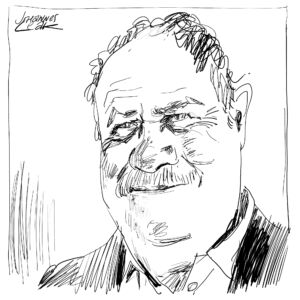
Dr Eugenie C Scott executive director of the National Centre for Science Education
What inspired me to take up science? I don’t know, maybe packs of feral dogs. When I was growing up 50 years ago in Minnesota, dogs were allowed to roam the streets, and they didn’t all act like Lassie.
In order to gauge whether a dog was friendly or waslikely to attack, most of us kids picked up on canine territorial behaviour pretty quickly, as well as the meaning of signals sent through different positions of tails, ears, and body. On the whole, I think leash laws are an improvement.
I was always interested in animals, but it was a case of delayed gratification. My mother didn’t allow pets, and I quickly learned not to bring any living creature into the house. I recall being appalled when my mother casually bludgeoned a small, errant bat with a tennis racket, for the blunder of flying into the wrong window. So I was interested in biology, in spite of my upbringing.
But I do remember when I became interested in evolution. I must have been around nine or 10 years old when my older sister brought home a college-level textbook in anthropology. I was something of a compulsive reader even then, and I casually picked up one of my sister’s books and flipped through the pages.
In the middle of the book was a set of plates showing primitive-looking people with big brows, prow-like noses and receding chins. They were kind of like her boyfriend of the time actually, an observation that was not appreciated. But I was gobsmacked by the reconstructions of these early fossil humans – Cro-Magnons, Neanderthals, Peking Man and the like.
This is where we started. These were the great-great-great-umpty-ump-great grandfathers of us all. It was stunning to a 10-year-old. The title of the book was Anthropology. I decided then that I wanted to be an anthropologist when I grew up.
When I was in junior high school, the teacher gave us one of those horrid ‘write a biography of a famous scientist’ assignments. I chose Eugene Dubois, the discoverer of Peking Man. My teacher, of course, had never heard of Dubois, and hadn’t a clue what Pithecanthropus erectus referred to – although in retrospect, I think the nervousness he showed at my references to P erectus in a class full of 12-year-olds might have been understandable.
Evolution was rarely taught in American high schools in the late 1950s and early 1960s, and my school was no exception. Evolution was omitted in my biology class, and wasn’t even mentioned in the textbook. One day after class, a friend and I were talking to kindly Mr Rasmussen, my biology teacher.
One of us asked him why there were so many different kinds of animals. He said: ‘Well, some people believe that some animals are better able to live in an environment than others, and they have more offspring and that kind comes to dominate in that environment, and the population gradually becomes different through time.’
My head reeled. This was such a wonderful, simple explanation, and it made so much sense. It is the essence of Darwinian natural selection, a prime mechanism of evolution.
I remember becoming terribly excited, and brimming over with questions. I wanted to know everything. Did this explain why we no longer had dinosaurs around? Did people change like this? Before I could say anything though, Mr Rasmussen quickly added: ‘Of course, some people think that God created all the animals like they look today.’ Mr Rasmussen held a finger to his lips conspiratorially, said ‘shh’, eased us out of the classroom and closed the door.
I had to wait until I got to college to study evolution, and I’ve been learning about it ever since.
Eugenie Scott is author of Evolution vs Creationism: An Introduction (buy this book from Amazon (UK) or Amazon (USA)), and coeditor of Not in Our Classrooms: Why Intelligent Design Is Wrong for Our Schools (buy this book from Amazon (UK) or Amazon (USA)).
|